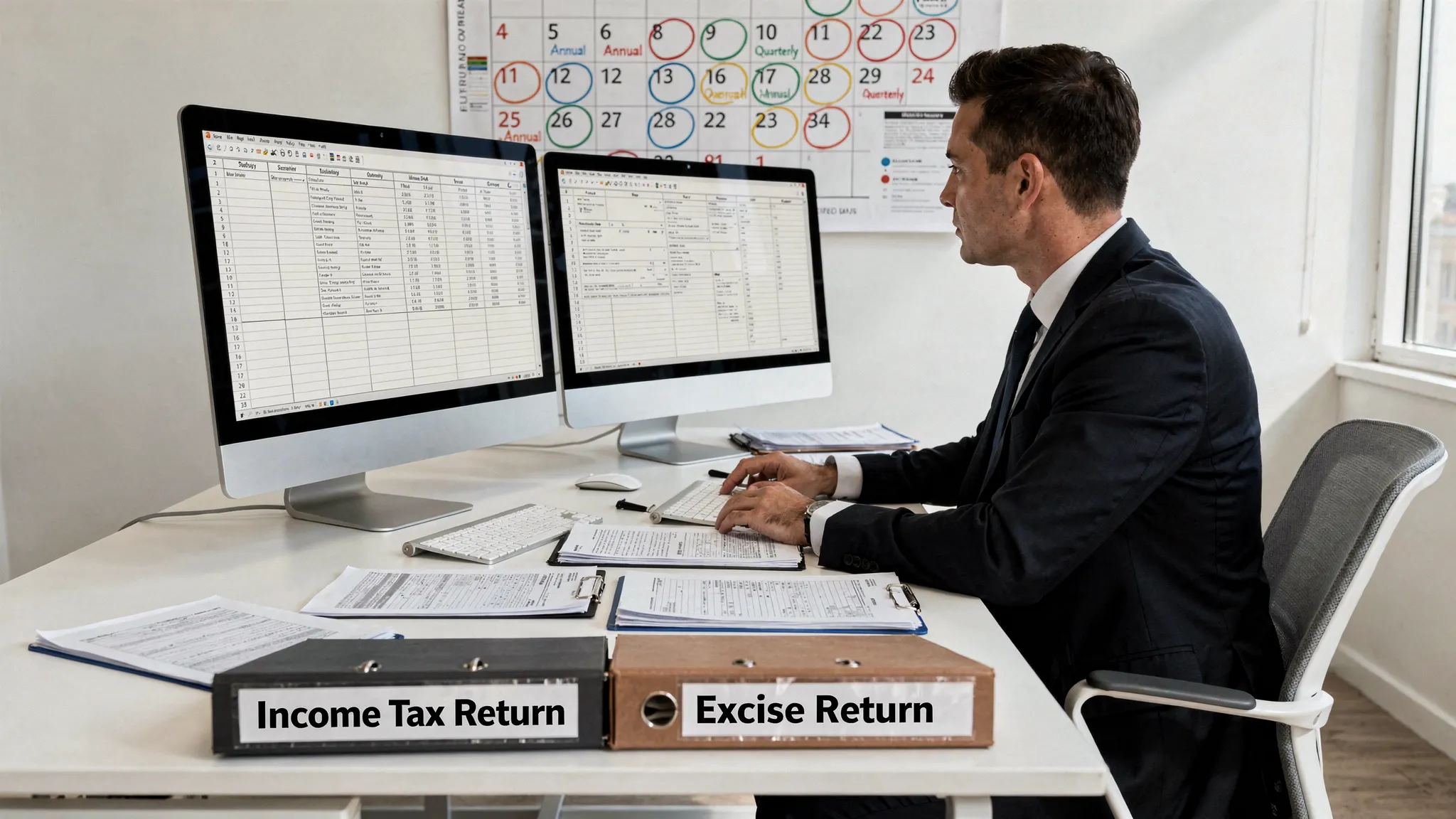
Income Tax Return vs Excise Return: Know Both
Confusing an income tax return with an excise return is one of the easiest ways to miss a deadline or underpay a tax you did not realize applied to your business. They are both “tax returns,” but they measure different things, follow different filing calendars, and often involve different recordkeeping.
This guide breaks down what each return is, who files, how deadlines work, and how to stay compliant if your business needs to file both.
What is an income tax return?
An income tax return reports income (revenue minus deductible expenses) for an individual or business over a tax year and calculates the tax due based on that net taxable amount.
What it typically covers
Depending on who is filing, an income tax return may report:
- Gross receipts or wages
- Ordinary and necessary business deductions
- Depreciation and amortization
- Credits, payments, and withholding
- Net taxable income and the resulting income tax
Common income tax returns (examples)
The exact form depends on your entity type and situation. Common examples include:
- Form 1040 for individuals
- Form 1120 for C corporations
- Form 1120-S for S corporations
- Form 1065 for partnerships
Income tax returns are generally filed annually, although many taxpayers also make estimated tax payments during the year.
If you are looking for official IRS starting points, see the IRS pages for business taxes and income tax information.
What is an excise return?
An excise return reports federal excise taxes. Excise taxes are not based on profit. They are usually triggered by a specific product, service, transaction, or activity, such as selling certain fuels, providing certain communications services, or owing industry-specific excise fees.
Form 720: the most common federal excise return
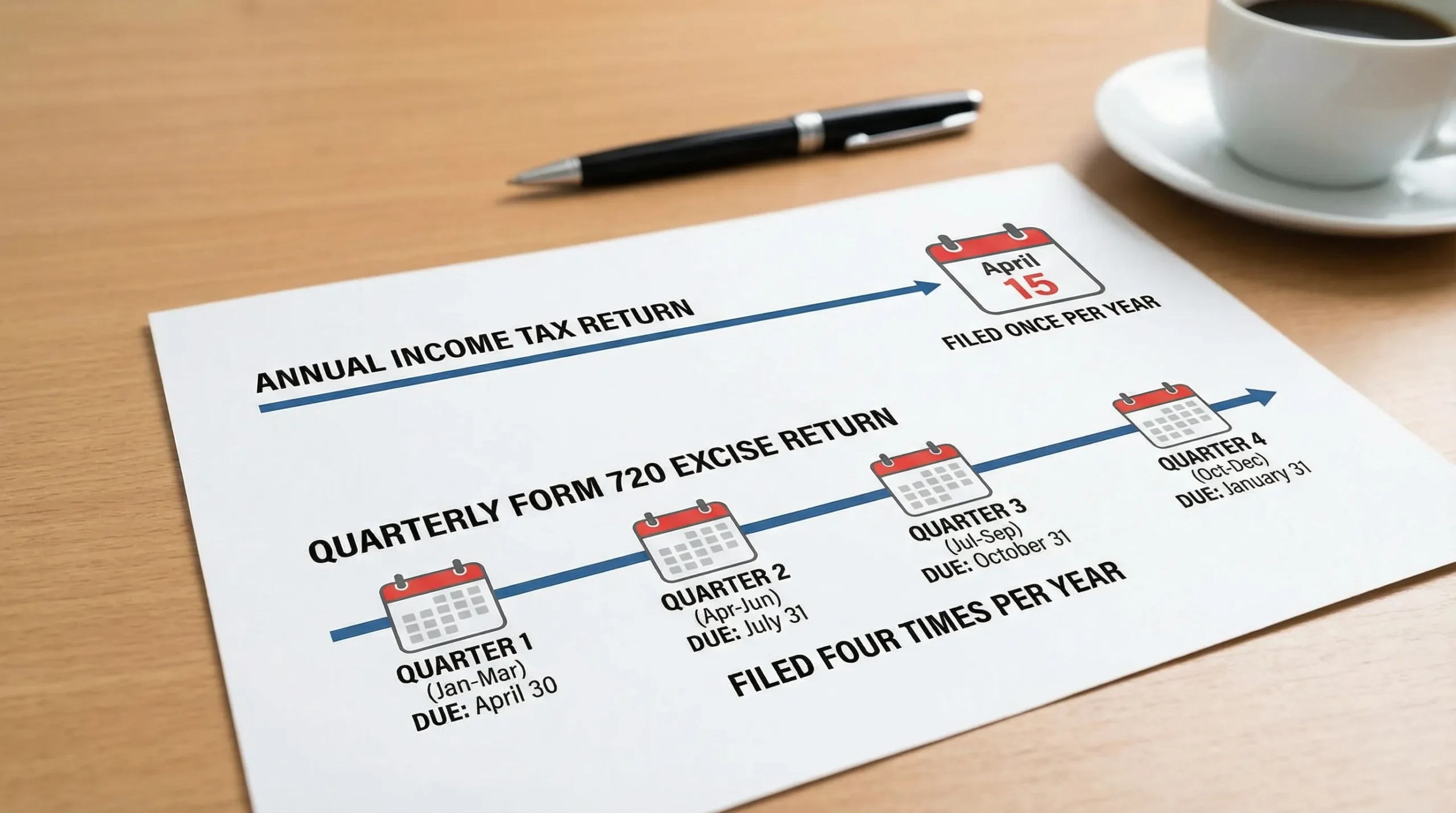
Many federal excise taxes are reported on IRS Form 720, Quarterly Federal Excise Tax Return.
Form 720 is typically filed quarterly, not annually. Even if your business is unprofitable, you can still owe excise tax if you performed a taxable activity.
For the IRS overview, start with the official Form 720 page.
Quarterly due dates (Form 720)
Form 720 has standard quarterly due dates:
- 1st quarter (Jan to Mar): due April 30
- 2nd quarter (Apr to Jun): due July 31
- 3rd quarter (Jul to Sep): due October 31
- 4th quarter (Oct to Dec): due January 31
If a due date falls on a weekend or legal holiday, the deadline generally moves to the next business day. For a deeper explanation, see the eFileExcise720 guide on the Form 720 due date.
Income tax return vs excise return: the key differences
Both returns go to the IRS, but they answer very different questions.
| Category | Income tax return | Excise return (often Form 720) |
|---|---|---|
| What it taxes | Net income (income minus deductions) | Specific taxable products, services, transactions, or activities |
| Trigger | Earning income (individual or business activity) | Performing a taxable activity, even if no profit |
| Filing frequency | Usually annual (plus estimated payments for many taxpayers) | Usually quarterly for Form 720 |
| How tax is calculated | Rates applied to taxable income | Often per-unit rates, percentage rates, or fixed fees depending on category |
| Who typically files | Individuals, corporations, partnerships (varies by form) | Businesses and organizations involved in certain excise-taxable activities |
| Common compliance risk | Misreporting income/deductions, missing estimated payments | Missing a quarter, using wrong tax code/rate, missing deposit rules |
A practical way to remember the difference
- Income tax asks: “What did you earn after expenses?”
- Excise tax asks: “Did you do the taxable thing, and what is the tax tied to that activity?”
Do you need to file both? Many businesses do
It is common to file an income tax return and also have excise obligations. Here are examples of business situations where both can apply:
Example 1: Manufacturer or importer with taxable products
A company might owe excise tax based on units sold or a percentage of sale price (depending on the excise category). That same business still files its regular income tax return based on annual profit.
Example 2: Employer owing an excise-related fee
Some organizations owe specific excise-type fees reported on Form 720 (for example, certain health-related fees in specific circumstances). Even if the organization has little taxable income, the excise filing can still be required.
Example 3: Service provider with excise-taxed services
If a business provides a service that falls under an excise category, it can have quarterly excise reporting while still filing an annual income tax return.
If you are unsure whether your business activities trigger Form 720, this article may help you self-screen: Does your business need to file Form 720?
How the two returns interact in your bookkeeping
Even though income tax and excise tax are different, your accounting system has to handle both cleanly.
1) Excise tax is often collected or calculated per transaction
Depending on the excise category, you may need transaction-level details, such as:
- Units sold or shipped
- Taxable sale price
- Exempt sales documentation (when applicable)
- Customer and destination details (when relevant)
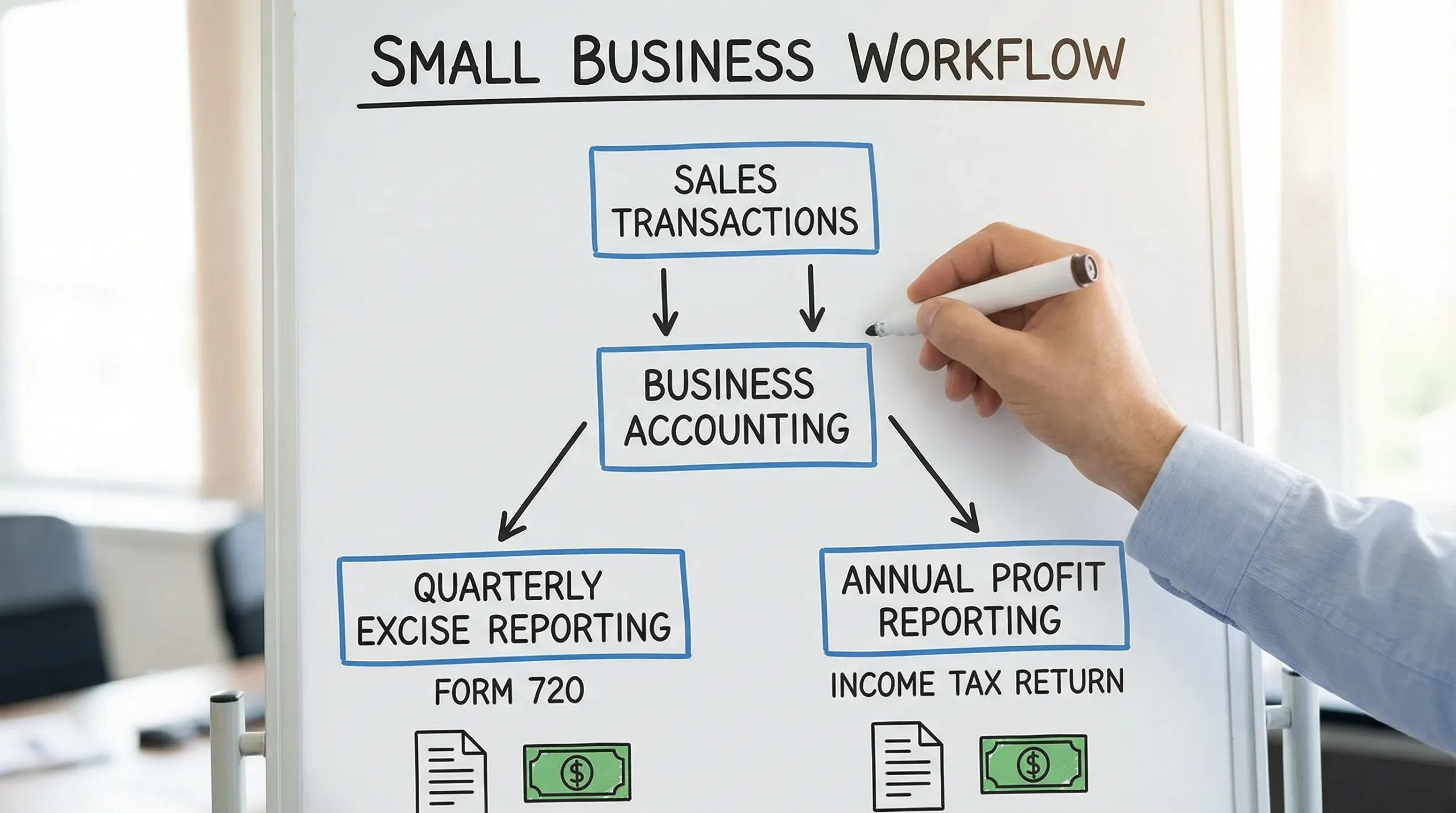
Those details drive your Form 720 figures, and they can also affect your income statement (for example, how you treat taxes collected and remitted).
2) Income tax is annual and profit-based
Income tax reporting relies heavily on year-end totals:
- Revenue recognition
- Expense categorization
- Asset purchases and depreciation
- Payroll and contractor reporting
You can be perfectly accurate on your annual income tax return and still be noncompliant on excise taxes if quarterly tracking was not set up.
Filing and payment timing: what trips people up
Income tax timing pitfalls
Income tax compliance issues often involve:
- Underpaying estimated taxes during the year
- Misclassifying expenses or missing documentation
- Filing late and accumulating penalties/interest
Excise timing pitfalls (Form 720)
Form 720 issues often involve:
- Forgetting that it is quarterly
- Missing additional deposit/payment rules for certain liabilities
- Reporting under the wrong tax code or attaching the wrong supporting form (when required)
If you are trying to build a repeatable quarter-end process, the Form 720 e-filing checklist is a useful operational reference.
Staying compliant when you have both returns
If your business needs to manage both an income tax return and an excise return, aim for a system that reduces “surprise tax” moments.
Align your calendar to both cycles
A simple approach is to maintain two compliance calendars:
- An annual calendar for income tax deadlines and year-end close activities
- A quarterly calendar for Form 720 data capture, review, and filing
Add internal cutoff dates that are earlier than the IRS deadline so you have time to fix missing records.
Reconcile excise data monthly (not just quarterly)
Quarterly filing feels frequent until you realize you might be reconstructing three months of transactional detail at once. A monthly reconciliation is often easier:
- Confirm what transactions were taxable
- Confirm exemptions are documented
- Tie totals to sales/shipping reports
This makes the Form 720 quarter-end process more like “review and file,” and less like “forensic reconstruction.”
Know when amendments and claims matter
If you later discover an error on an excise return, you may need:
- Form 720-X to amend a previously filed Form 720
- Form 8849 for certain refund claims (depending on the excise category and facts)
Because amendment and claim rules can be fact-specific, it is smart to consult the official IRS instructions or a tax professional when you are dealing with corrections.
E-filing: why it matters more for excise returns
E-filing can be helpful for many tax returns, but it is especially practical for quarterly excise compliance because you repeat the process multiple times per year.
With an IRS-authorized platform like eFileExcise720, businesses can file Form 720 online without software downloads, and with secure data handling and customer support.
If you are comparing submission methods, see: E-file IRS Form 720 or mail: which is faster?
Frequently Asked Questions
Is an excise return the same as an income tax return? No. An income tax return generally reports annual net income and calculates tax based on profit. An excise return reports taxes triggered by specific taxable activities, often filed quarterly on Form 720.
Can I owe excise tax even if my business had a loss? Yes. Excise taxes are usually not based on profit. If you performed a taxable activity, you may owe excise tax even when the business is not profitable.
How often is Form 720 filed? Form 720 is generally filed quarterly, with standard due dates of April 30, July 31, October 31, and January 31.
What happens if I miss a Form 720 deadline? Late filing and late payment can trigger penalties and interest. If you missed a deadline, it is usually best to file as soon as possible and review options for payment and penalty relief. See more details in Form 720 late filing penalties.
How do I know whether my business needs to file an excise return? It depends on whether you sell, manufacture, import, or provide items and services subject to federal excise tax, or if a specific excise fee applies to your organization. Start with Does your business need to file Form 720? and the IRS Form 720 guidance.
File your Form 720 excise return online with eFileExcise720
If you already file an income tax return each year, adding a quarterly excise return can feel like a big operational shift. eFileExcise720 is an IRS-authorized e-filing portal designed to make Form 720 compliance simpler, with free account creation, no software download, secure data protection, and personalized customer support.
Get started here: e-file Form 720 online with eFileExcise720.