
8849 Refund Timeline
8849 Refund Timeline
Filing a refund claim is often part of normal cash flow planning for businesses that pay federal excise taxes on fuel and other activities. Understanding the 8849 Refund Timeline helps you set realistic expectations, avoid preventable issues, and reduce the chance that your claim gets delayed for follow-up.
IRS Form 8849 is used to request a form 8849 refund for certain excise tax refund situations where tax was already paid and you are eligible to claim it back. Because a refund is tied to IRS review, accuracy and documentation matter as much as timing.
What Is Form 8849?
Form 8849 (Claim for Refund of Excise Taxes) is an IRS form used to request a federal excise tax refund when you have paid excise tax and later determine you qualify for a credit or refund. This commonly applies to businesses working with fuel and fuel-related activities, but it can also apply to other specific excise tax situations.
Form 8849 can be used for claims such as:
- Fuel tax overpayments
- Nontaxable use of fuel (for example, certain off-highway business use)
- Alternative fuel credits
- Undyed diesel fuel credits (when allowed for the use and conditions)
- Other specific excise tax credits allowed under the IRS rules for Form 8849
Form 8849 includes different schedules depending on what you are claiming, so selecting the correct schedule is a key part of a complete form 8849 refund claim. For a broader overview of the form and schedules, you can also review eFileExcise720’s Form 8849 refund claim page.
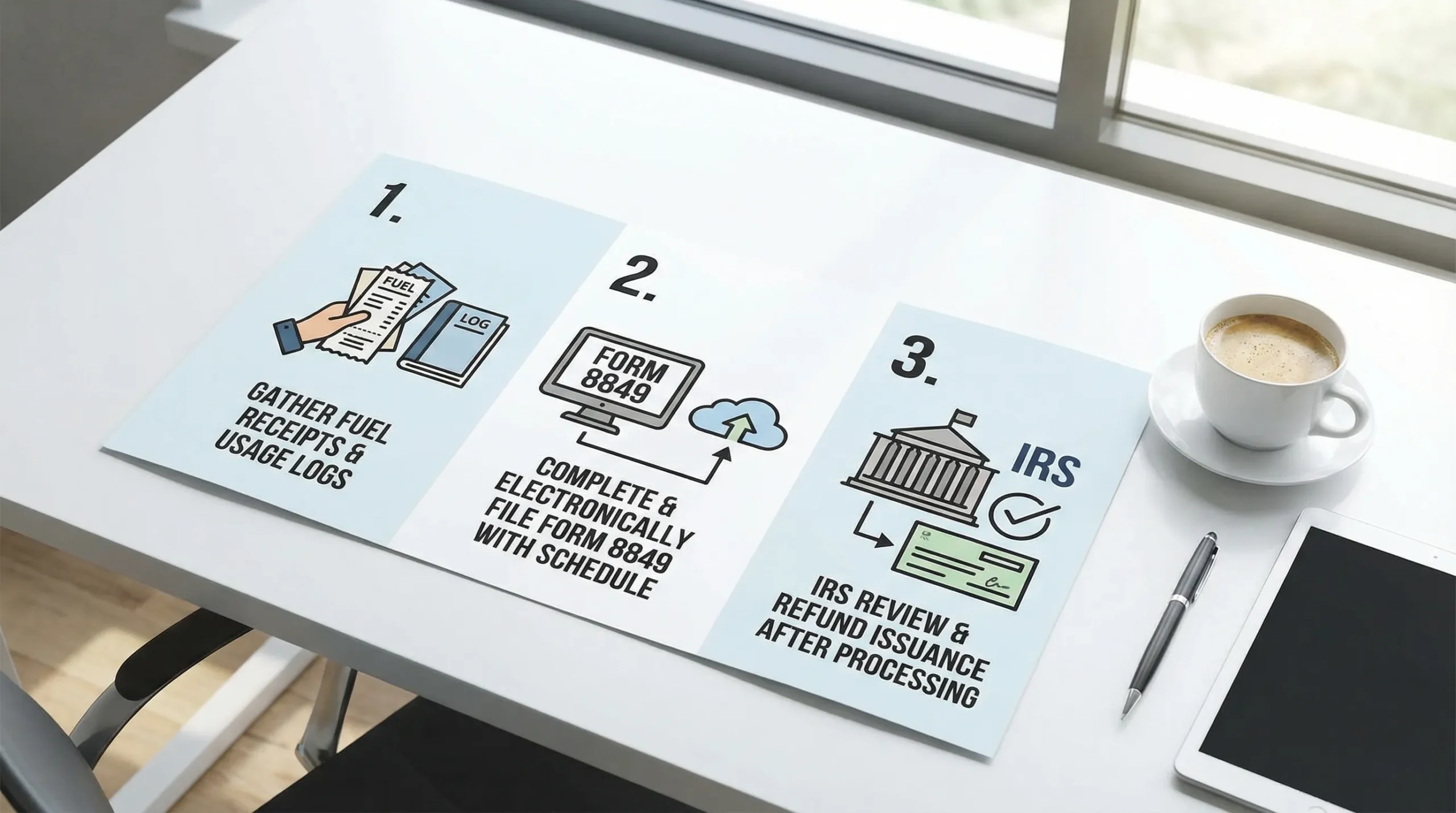
How Long Does the 8849 Refund Timeline Take?
The IRS does not provide a single universal timeline that applies to every claim, because the form 8849 refund processing time depends on multiple factors, including the type of claim, completeness, and whether the IRS needs additional review.
In general, the 8849 Refund Timeline can take several weeks, and sometimes longer, depending on IRS workload and the specifics of your filing. A clean, consistent submission typically moves through review more smoothly than a claim with missing details or mismatched records.
Filing method also matters. Electronic filing can help reduce processing delays compared to paper filing because it supports cleaner data entry, validation checks, and faster submission delivery to the IRS. That said, electronic filing does not guarantee a faster refund, and the IRS may still review claims and request additional information.
If you are planning around an excise tax refund timeline, it is wise to treat the timeline as variable and to file as early as practical once your claim is ready.
Factors That Can Affect the 8849 Refund Timeline
Delays usually happen when something triggers manual review or follow-up. Below are common reasons the IRS may take longer to process a claim.
| Factor | Why it can slow processing | What to watch for |
|---|---|---|
| Errors or missing information | Incomplete fields or inconsistent entries can require corrections | Missing gallons, dates, or required business details |
| Incorrect schedule selection | The schedule must match the refund type being claimed | Using the wrong schedule for the fuel type or use |
| Math miscalculations | Totals that do not reconcile can lead to review | Inconsistent gallon totals or tax computations |
| High IRS filing volume | Seasonal or peak periods can extend review time | Filing close to major due dates or busy seasons |
| Requests for additional documentation | The IRS may request support for the amounts claimed | Receipts, invoices, usage logs, or other proof |
| Mismatched EIN or business details | Identity and account mismatches can pause processing | Business name, EIN, or address not matching IRS records |
These issues are also frequent sources of form 8849 refund delays, especially for businesses with high-volume fuel activity where small reporting differences can add up.
How to Avoid Delays in Your Form 8849 Refund
You cannot control IRS workload, but you can control the quality and consistency of your claim. These steps help reduce avoidable errors and support smoother review.
- Double-check gallon totals or taxable amounts against your internal reports and source documents.
- Use the correct schedule for your claim type and fuel use category.
- Make sure your business name and EIN match what the IRS has on record.
- Keep supporting documentation available in case the IRS requests it.
- File Form 8849 online when possible to reduce common data-entry errors and improve submission accuracy.
Operationally, many organizations also benefit from improving how they store and access supporting records (like invoices, fuel logs, and dispatch reports). If you rely on internal systems to manage high-volume documentation, having reliable infrastructure can help your team respond faster to information requests. Some businesses use secure VPS hosting to run internal document tools or reporting systems, especially when they need stable access for multiple locations.
How Form 8849 Relates to Form 720
Form 720 (Quarterly Federal Excise Tax Return) is used to report and pay certain federal excise taxes on a quarterly basis. Form 8849 is used to request refunds of excise taxes that were previously paid, assuming you meet the eligibility requirements for the refund category.
Some businesses may file both forms during the year. For example, a company may report fuel-related excise taxes on Form 720 and later file Form 8849 to claim a refund for qualifying nontaxable uses or other allowable credits.
Examples of taxes commonly associated with Form 720 include:
- Fuel taxes
- Environmental taxes
- Communications taxes
- Air transportation taxes
If you need background on Form 720 filing and how it fits into federal excise tax compliance, see eFileExcise720’s guide on understanding Form 720 and how to file it.
How efileexcise720.com Supports Form 8849 Filing
eFileExcise720 is an IRS-authorized e-filing platform designed to help businesses file excise tax forms accurately and securely, including Form 8849.
When you use efileexcise720.com to file Form 8849 online, you can:
- Submit your Form 8849 refund claim through an IRS-authorized electronic filing process
- Use a secure online system designed to protect sensitive tax information
- Reduce common preparation errors through guided entry and validation-oriented workflow
- Get access to customer support if you have questions during preparation
- File amendments when corrections are required (for example, when adjustments are needed after submission)
Electronic filing can support a cleaner submission and help reduce avoidable delays in the 8849 Refund Timeline, but refund timing ultimately depends on IRS processing and review.
FAQs
What is the typical 8849 Refund Timeline? The 8849 Refund Timeline varies. Many claims are processed in several weeks, but timing depends on claim type, IRS workload, and whether the IRS needs additional review.
How long does a form 8849 refund processing time usually take? There is no single standard timeframe. The form 8849 refund processing time can be shorter when the return is complete and consistent, and longer when there are errors, missing details, or documentation questions.
Can electronic filing improve my excise tax refund timeline? Electronic filing may help reduce delays caused by paper handling and common data-entry mistakes. It can support a smoother excise tax refund timeline, but it does not guarantee a faster refund.
What causes delays in a federal excise tax refund? Common causes include missing information, incorrect schedules, math issues, EIN or business detail mismatches, high IRS volume, or IRS requests for supporting documents.
Do I need to file Form 720 before filing Form 8849? Not always. Some refund claims relate to excise tax previously paid and may not require a Form 720 filing immediately beforehand. However, Form 720 and Form 8849 often relate to the same federal excise tax activity, so it is important to follow IRS instructions for your specific claim type.
How can I check the status of my form 8849 refund claim? Businesses typically monitor IRS correspondence and keep copies of the filed claim and supporting records. If you e-file, retain your submission confirmation and filing records so you can reference them if the IRS requests follow-up.
File Form 8849 Online to Help Reduce Avoidable Delays
A well-prepared claim is one of the best ways to prevent unnecessary delays in the 8849 Refund Timeline. If your business is ready to submit a form 8849 refund for an eligible excise tax refund, consider using an IRS-authorized electronic option.
To support accurate submission and reduce avoidable errors, file Form 8849 online through eFileExcise720. (This content is for general informational purposes and is not tax advice.)