
Why Businesses Are Switching to E-Filing for IRS Form 720
E-filing IRS Form 720 used to feel like “nice to have” tech. In 2026, it is increasingly a strategic finance decision. The businesses switching fastest are the ones that treat excise compliance as part of their quarterly close, cash flow planning, and audit readiness, not just a tax task that gets rushed at the deadline.
If your organization files Form 720 for fuels, environmental taxes, communications, air transportation, or the PCORI Fee, the shift to electronic workflows can reduce rework, tighten documentation, and make corrections and refunds easier to manage.
What is driving the shift to e-filing Form 720?
1) Finance teams are optimizing for speed and proof, not just “filing”
Paper filing is slow in the ways that matter most to modern controllers and CFOs:
- You may wait longer for confirmation that the IRS actually received the return.
- If the IRS flags an error, you can lose time diagnosing what happened and when.
- “Proof of timely filing” becomes a logistics exercise (tracking, copies, mail receipts), not a clean system record.
E-filing flips that: teams prioritize fast acknowledgment, clearer submission records, and fewer manual steps, especially when the quarterly close is already compressed.
To put the broader trend in context, the IRS has reported for years that the U.S. tax system has moved decisively toward electronic submission for many return types (see the IRS’s annual Data Book for e-file adoption across major filing categories). Even though excise is its own niche, the operational expectation inside companies increasingly mirrors the rest of the tax stack: digital first.
2) Excise tax risk is being managed like operational risk
For many businesses, excise exposure is tied to operational data: gallons, barrels, invoices, customer exemptions, product codes, import entries, or plan enrollment counts for PCORI.
That reality pushes teams toward repeatable processes:
- Standardized data pulls and reconciliations
- Consistent sign-offs
- Audit-ready storage of support
E-filing is not a magic wand, but it typically pairs well with a controlled workflow where you can document what you filed, when you filed it, and what source data supported it.
3) Refunds and corrections are no longer “edge cases”
A major reason businesses modernize Form 720 workflows is that the filing is rarely static. Overpayments, exports, exempt uses, and reporting corrections can drive refund activity.
That is where Form 8849 claim for refund of excise taxes becomes operationally important. Companies do not want refund opportunities sitting in email threads and spreadsheets. They want a process.
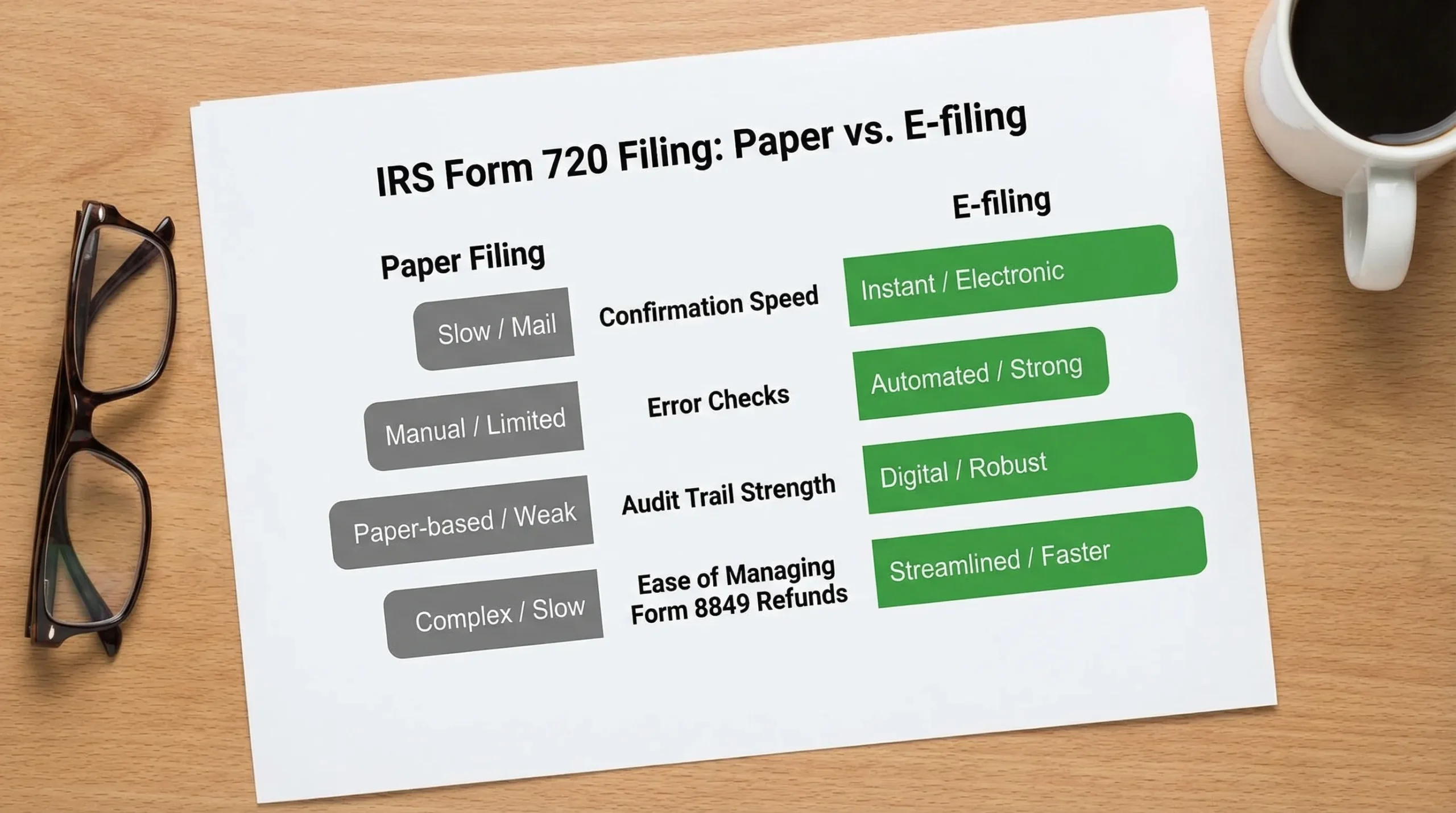
Paper vs e-file: the comparison most businesses actually care about
Here is a practical view of what typically changes when a company shifts from mailing returns to e-filing.
| Dimension | Paper filing (mail) | E-filing (online) | Why it matters to leaders |
|---|---|---|---|
| Submission confirmation | Often slower and more manual | Typically faster acknowledgment | Reduces uncertainty near due dates |
| Error handling | Errors discovered later, more back-and-forth | Many issues caught earlier (validation) | Less rework and fewer late fixes |
| Audit trail | Copies, scans, mail receipts | System records and acknowledgments | Stronger documentation for audits and diligence |
| Multi-entity filing | Easy to lose consistency quarter to quarter | More consistent repeatable workflows | Helps standardize close procedures |
| Refund workflow (8849) | Document-heavy, easy to fragment | Easier to coordinate with digital records | Speeds up internal reviews and support gathering |
The cash flow angle: why Form 8849 matters in e-filing conversations
Even when your quarterly tax return service process is “good enough,” refunds can change the business case. Many finance teams justify process upgrades when they connect excise compliance to working capital.
A clean 8849 form workflow is mainly about two things:
- Eligibility confidence: knowing when you should use the tax form 8849 (refund claim) versus correcting on Form 720 or filing an amendment.
- Documentation discipline: organizing invoices, export support, usage logs, terminal statements, or other substantiation so the claim is defensible.
The operational lesson learned from high-volume filers is simple: refund claims go faster when the business can quickly answer, “What is the claim, which schedule is it on, and where is the backup?” That is a lot easier when the rest of your excise reporting is already digital.
If your business routinely evaluates refund opportunities (for example, fuel credits for qualified uses), treat IRS Form 8849 as part of a monthly or quarterly control cycle, not a once-a-year scramble.
PCORI Fee: a common reason nontraditional “excise filers” go digital
For many employers and plan sponsors, the PCORI Fee is their only interaction with federal excise reporting. It is reported on Form 720 (often described informally as the pcori 720 form or form 720 pcori filing), and that can be a surprise for benefits teams who are used to payroll and income tax workflows.
What pushes PCORI filers toward e-filing?
- Benefits data lives in systems, not in tax binders.
- The filing is simple, but the risk of “missing it” is real.
- Teams want clean, repeatable evidence that the filing was submitted and accepted.
If your company has changed plan design, added an HRA/ICHRA, shifted between fully insured and self-insured arrangements, or acquired another employer, moving PCORI reporting into a controlled e-file process can reduce last-minute uncertainty.
“Investor-ready” excise compliance: what diligence teams look for
The request for cleaner excise processes often comes from outside tax.
In M&A, lenders and investors tend to focus on two questions:
- Are liabilities complete and accurately accrued? (no surprise assessments post-close)
- Is documentation strong enough to support positions and refund claims?
A realistic example seen in lower-middle-market transactions is a buyer asking for support around fuel-related excise, environmental taxes, or communications excise, and then discovering the target’s proof of filing is scattered across mail receipts, PDFs, and individual inboxes. The fix is usually not “hire more people.” It is building a systemized process with consistent submission records and refund support.
For energy-intensive businesses, excise taxes can also intersect with broader energy management and procurement decisions. Industry groups like the BVGE (Bundesverband der gewerblichen Energienutzer) track the operational realities commercial energy users face, and those realities often reinforce the same theme: you need consistent data and defensible documentation.
Where eFileExcise720 fits (without overcomplicating your workflow)
eFileExcise720 is an IRS-authorized e-filing platform built specifically to help businesses file Form 720 online, with secure data handling and dedicated customer support. It also supports related excise workflows, including Form 720 amendments (720-X) and Form 8849 claims.
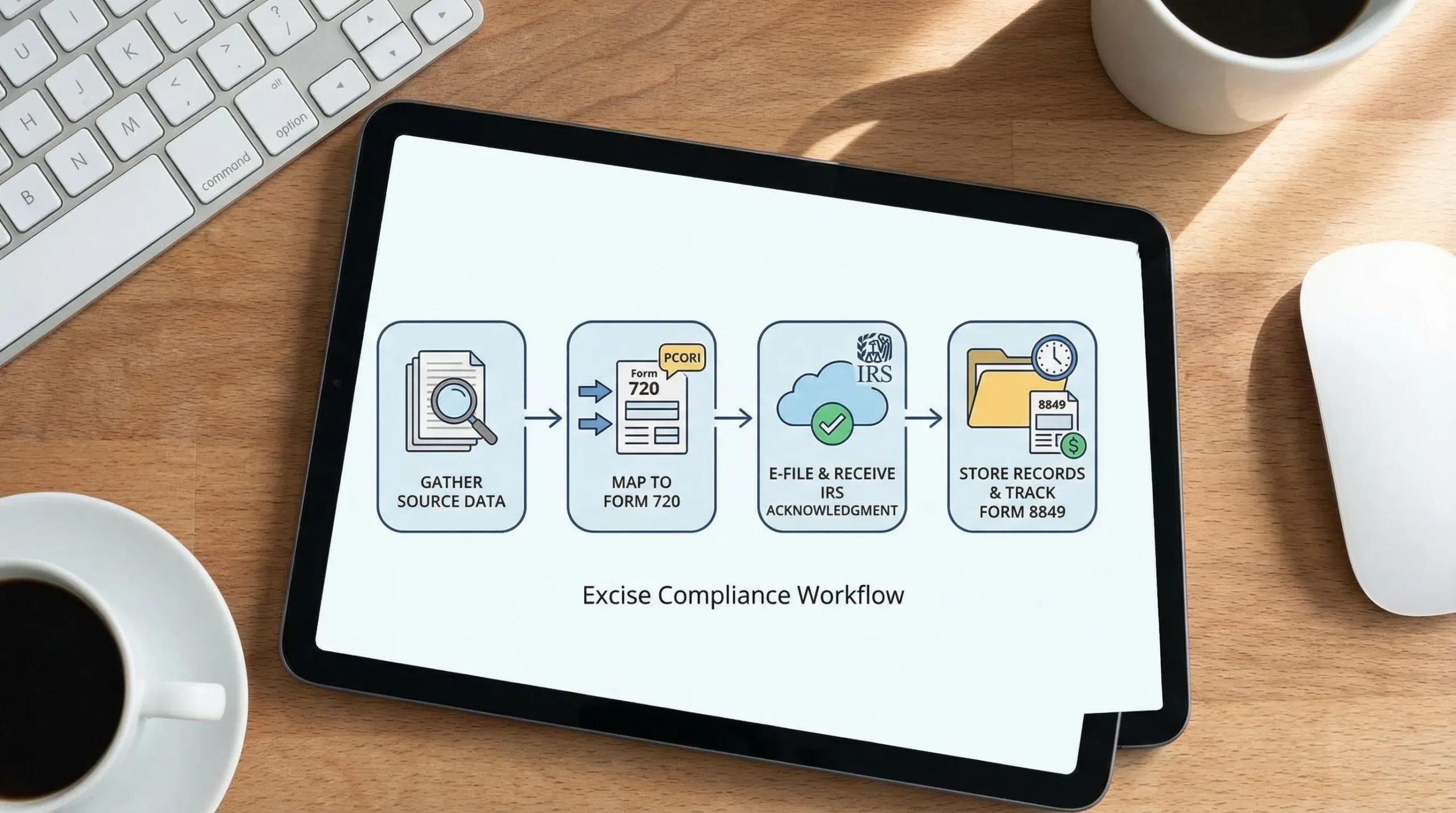
If you are switching from paper, look for a process that is straightforward:
- Create an account (free)
- Prepare and validate Form 720 entries by category
- Submit electronically and retain acknowledgments
- Keep supporting schedules and documentation organized for future questions or refund activity
Frequently Asked Questions
Is e-filing IRS Form 720 actually better than mailing it? For most businesses, yes. E-filing typically improves submission proof, reduces manual handling, and helps teams respond faster if something needs to be corrected.
When should I use a Form 8849 claim for refund of excise taxes instead of adjusting Form 720? Use Form 8849 when you are making a refund claim for certain excise taxes (often with schedule-specific rules). If you are correcting a previously filed Form 720, an amendment (Form 720-X) may be appropriate. The best path depends on the tax type and why the amount changed.
What is IRS Form 8849 used for? IRS Form 8849 is used to claim refunds of certain federal excise taxes. The specific schedule you file depends on the type of claim (for example, different fuel-related refund situations).
Do I file the PCORI Fee on Form 720? Yes. The PCORI Fee is reported on Form 720, which is why many employers that do not consider themselves “excise taxpayers” still need a Form 720 PCORI filing process.
Can I file the 8849 form and Form 720 in the same year? Yes. Many businesses file Form 720 quarterly and file Form 8849 when they have eligible refund claims, depending on the schedules and timing rules that apply.
Ready to switch to e-filing for Form 720?
If you want a faster, more controlled way to file Form 720, manage Form 720 PCORI reporting, and support refund workflows tied to IRS Form 8849, use an IRS-authorized portal built for excise.
Create your free account and start your next filing with eFileExcise720.