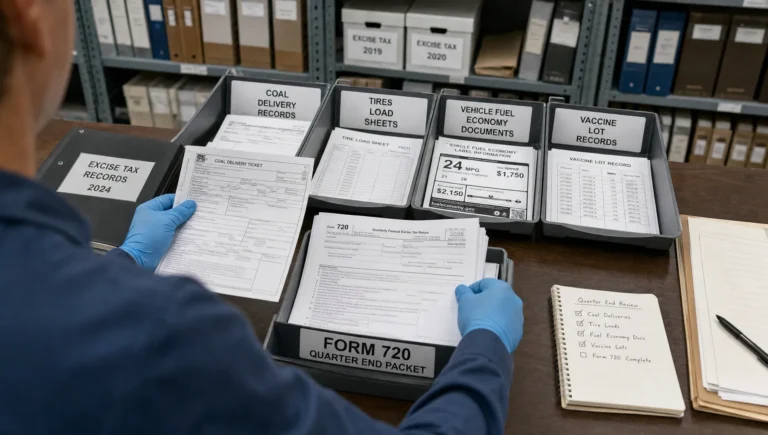
File Taxes Services: What Businesses Actually Need in 2026
Most businesses don’t fail at taxes because they “forget to file.” They fail because their filing process is built for last year’s reality: more transaction volume, more tax types, tighter payment timelines, and higher data security expectations.
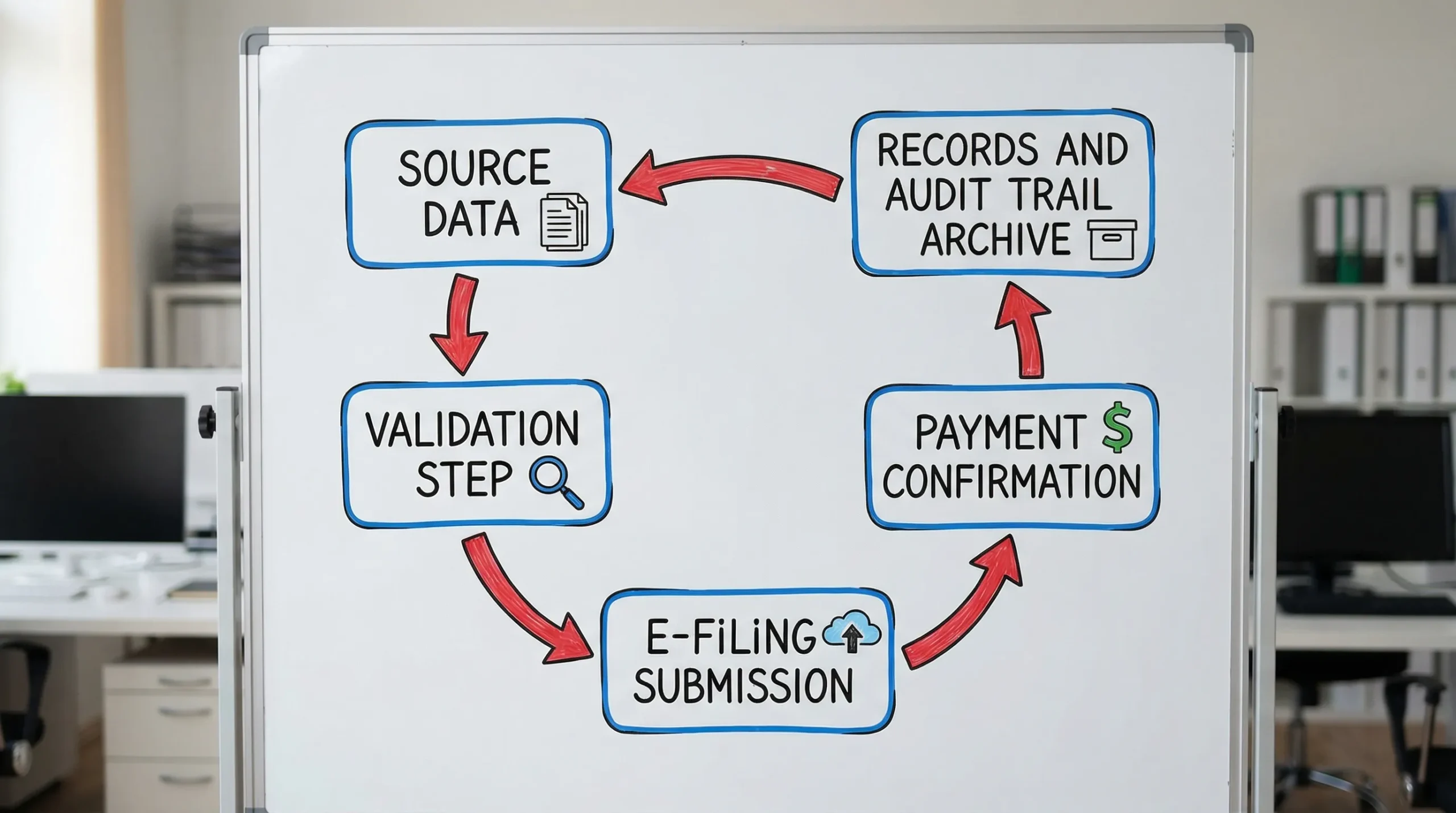
In 2026, choosing file taxes services is less about who can generate a PDF and more about who can help you run a repeatable compliance workflow: accurate source data in, validated return out, payment on time, and a clean audit trail when questions come up.
This guide breaks down what businesses actually need from tax filing services in 2026, especially if your operations touch federal excise taxes (IRS Form 720) alongside more familiar income, payroll, and sales tax obligations.
What “file taxes services” should cover in 2026 (beyond annual income tax)
A modern tax filing service should map to how your business is taxed, not how your calendar feels. Many teams discover too late that “tax filing” includes multiple filing tracks with different owners, frequencies, and data sources.
Common buckets businesses manage in parallel:
- Income tax (federal and state): annual, plus extensions and estimates.
- Payroll tax: frequent deposits, quarterly filings, annual reconciliations.
- Sales and use tax: often monthly or quarterly, state-by-state nexus rules.
- Information returns: 1099s, W-2s, other reporting.
- Excise tax and specialty filings: often quarterly, sometimes with separate deposit requirements.
If your business has excise exposure, the service you choose needs to handle the “quarterly close” discipline that looks more like payroll than like an annual income tax return.
The 5 non-negotiables businesses should demand from tax filing services
1) The right authorization for the job (especially for e-filing)
Not all e-file options are equal. For federal submissions, you generally want a provider that is properly authorized to transmit returns through IRS e-file systems when applicable. The IRS maintains guidance and resources for e-file providers and e-filing programs on its site (start here: IRS e-file for providers).
Why it matters:
- You reduce “paper risk” (mail delays, missing signatures, uncertainty about delivery).
- You get electronic acknowledgments, which can be critical for proving timely filing.
- You minimize common rejection issues through validation checks.
2) Security that matches today’s threat level
Tax filing is high-value data. In 2026, your filing service should be able to explain, clearly, how it protects sensitive information.
At a minimum, ask about:
- Encryption (in transit and at rest)
- Access controls (multi-user roles, MFA options)
- Audit logs (who did what, and when)
- Data retention and deletion policies
For context on expectations, the IRS publishes security guidance for protecting taxpayer data (see IRS Publication 4557). You do not need to become a security engineer, but you should expect your provider to answer security questions without dodging.
3) Payment and deposit alignment (not just filing)
“Return filed” is not the same as “tax paid correctly.” Strong file taxes services help you align:
- Deposit requirements (where applicable)
- Payment timing with the statutory deadline
- Internal approvals so payments are not blocked at the last minute
For many federal taxes, payments run through EFTPS (see EFTPS). The right service will fit your payment workflow rather than forcing workarounds.
4) Amendment and correction support
Mistakes happen. What matters is whether you can correct them without chaos.
A service worth using should support a clean correction path, for example:
- Clear version control (original vs corrected filing)
- Ability to amend when your form type allows it
- Guidance on whether a correction is an amendment vs a refund claim
This is especially important for excise taxes, where corrections may involve Form 720-X (amended quarterly excise return) or Form 8849 (claims) depending on the situation.
5) Real support, at the moment you actually need it
In practice, tax teams get stuck on:
- “Which line does this transaction map to?”
- “Do we owe this tax, or did we already deposit it?”
- “Why did our return reject?”
The best tax filing services in 2026 pair software convenience with human support that understands the form and the underlying business activity.
Why excise taxes change the standard for “good” filing services
If your business touches federal excise taxes, you’re dealing with a tax category that can be triggered by operational facts, not profit.
Examples of excise-triggering activities include (depending on your facts):
- Fuel-related activities
- Environmental taxes
- Certain communications services
- Air transportation-related taxes
- Foreign insurance premiums
- PCORI fee reporting for certain health plan sponsors
These liabilities are typically reported on IRS Form 720 (Quarterly Federal Excise Tax Return), which has fixed quarterly due dates (often April 30, July 31, October 31, and January 31, with weekend/holiday adjustments). If your team needs a refresher on the cadence, keep a dedicated due-date reference in your close calendar (the IRS Form 720 instructions are the source of truth: Form 720 and instructions).
What makes excise different operationally:
- Line-level mapping matters: small classification errors can create incorrect tax.
- Source data is fragmented: terminals, invoices, broker entries, fleet reports, benefits administration, and more.
- Refund logic is separate: overpayment or exempt use often requires a claim workflow, not just “fix it next quarter.”
So, in 2026, “file taxes services” that are great for annual income tax can still be the wrong tool for quarterly excise compliance.
Three service models businesses use, and where each fits best
Most businesses end up with a blend, but it helps to be explicit about which model you are buying for which need.
| Service model | Best for | Where it can fall short | What to verify in 2026 |
|---|---|---|---|
| Traditional CPA or tax firm | Complex planning, entity structuring, multi-state strategy, representation | Can be slower for high-frequency filings, may rely on email-based data collection | Turnaround time, document portals, amendment workflow, who owns source-data QA |
| General-purpose tax software | Standardized annual filings, basic business returns | Often not built for specialized quarterly excise workflows | Coverage for your specific forms, e-file acknowledgments, support quality |
| Specialized e-filing portal (form-specific) | High accuracy for a specific form set (for example, excise returns), streamlined data entry | Not a full replacement for tax planning across every tax type | IRS authorization status, supported categories, security, support responsiveness |
A practical approach for many 2026 teams:
- Keep a CPA for planning, oversight, and complex positions.
- Use a specialized e-file workflow for recurring operational filings where speed, validation, and traceability matter.
A 2026 buyer’s checklist: what to ask before you choose a filing service
Start with a “tax footprint map,” not a vendor demo
Before shopping, write down:
- Every tax return you file (by form name), and how often
- Who provides the numbers (systems, teams, third parties)
- Who approves filing and who pushes payments
- What breaks today (late data, rework, uncertainty, rejected returns)
This prevents the most common failure: buying a tool optimized for the wrong bottleneck.
Ask vendors about capabilities that prevent real-world failures
Use this table as a conversation guide.
| Capability | Why it matters | How to evaluate |
|---|---|---|
| Coverage for your specific forms and categories | “We support excise” is not the same as supporting your exact lines/categories | Ask them to confirm support for your exact filing needs and edge cases |
| Built-in validation checks | Reduces rejects and prevents avoidable math or mapping errors | Ask what is validated before submission and what triggers warnings |
| Amendment and claim workflow | Corrections are inevitable | Ask how amendments are filed, tracked, and documented |
| Payment support and timing | Filing without paying correctly still creates penalties/interest risk | Ask how payments are initiated, recorded, and reconciled |
| Secure account controls | Tax data is sensitive | Ask about MFA, user roles, audit logs, and security documentation |
| Exportable records | Audit readiness depends on retrieval | Ask what you can export (PDFs, summaries, confirmations) and retention duration |
| Support by people who know the form | Critical during deadlines | Ask who answers questions and what “support” includes (technical vs tax filing guidance) |
Industry reality check: examples where “filing services” must match operations
Different industries create different tax friction. Here are a few scenarios where businesses often outgrow generic filing workflows.
Logistics, transportation, and fleet-heavy businesses
Fleet reporting, fuel usage, and vendor invoices tend to be spread across systems. If your team is already managing operational growth (new depots, new routes, new equipment), quarterly compliance can slip without a strong process.
Even adjacent procurement decisions can signal a step-change in operations. For example, businesses expanding storage or yard capacity might buy shipping containers online to move faster on space and staging. That kind of growth usually increases transaction volume, vendors, and operational complexity, which is exactly when you want tighter tax data controls and a filing service that can keep up.
Manufacturers and importers
Manufacturing and importing can introduce product classification and documentation complexity that affects multiple tax regimes. When excise applies, the work is often in the mapping and documentation, not the final calculation.
Employers and plan sponsors (PCORI and benefits-related reporting)
Some employers and plan sponsors have Form 720 exposure through the PCORI fee. These filings can be annual within the Form 720 framework, but still benefit from a service that supports the form correctly and preserves a clean record trail.
What “good” looks like for Form 720 filing support
If Form 720 is in your footprint, a service is doing its job when it helps you achieve three outcomes:
1) You can reliably gather the right inputs each quarter
Your best filing setup is boring and repeatable. Typical inputs vary by tax type, but the core idea is the same: reconcile operational systems to the numbers on the return.
2) Your submission is traceable end-to-end
You should be able to answer, quickly:
- What was filed, for which quarter
- Who prepared and who approved
- What confirmation you received
- What you paid, when, and through what channel
3) Corrections are handled through a documented workflow
When an issue is discovered, you should have a standard playbook: determine whether you need an amendment (Form 720-X) or a claim (Form 8849), gather support, file, and store proof.
How eFileExcise720 fits into a 2026 tax filing stack (without overcomplicating it)
If your business needs to file IRS Form 720, you generally want a purpose-built option that is designed around excise realities, not retrofitted from annual income tax workflows.
eFileExcise720 is an IRS-authorized online platform focused on simplifying Form 720 compliance. Based on the information available, it offers:
- IRS-authorized e-filing for Form 720
- Free account creation and no software download
- Secure data protection and simple dashboard navigation
- Coverage across Form 720 categories
- Support for amendments (Form 720-X) and Form 8849 claims
- Personalized customer support
If you are comparing options, the key question is not “Can I file?” It is “Can I file accurately, on time, quarter after quarter, and prove it later?”
To see the platform or start a filing workflow, visit eFileExcise720.

A practical next step: build a quarterly “tax close” routine
Even the best file taxes services cannot fix a chaotic upstream process. The winning pattern for 2026 is a lightweight quarterly close that mirrors financial close discipline:
- Set a recurring internal cutoff date for source data collection
- Reconcile operational reports to filing totals
- Review payment method and timing before submitting
- Archive confirmations and supporting files in one place
When this routine exists, choosing the right filing service becomes an accelerator instead of a patch.