Filing Federal Taxes for Free: What Businesses Should Know
Filing federal taxes for free sounds simple until you run a business. The IRS offers several no-cost tools, but they do not apply to every entity, every tax type, or every filing method. A sole proprietor may be able to file an individual federal income tax return at no cost if eligible, while a corporation, partnership, payroll filer, or excise tax filer may need a different path.
The key is understanding what “free” actually means. Sometimes it means free tax preparation. Sometimes it means free electronic payment. Sometimes it simply means you can download IRS forms at no cost, but still need software, a provider, or a professional to complete and transmit the return correctly.
For businesses, the smartest approach is not just asking, “Can I file for free?” It is asking, “Which federal tax am I filing, what IRS system supports it, and what risks come with the cheapest option?”
What “filing federal taxes for free” means for businesses
When people search for filing federal taxes for free, they are often thinking about individual income tax filing. Business tax compliance is broader. A business may deal with income tax, employment tax, excise tax, information returns, estimated tax payments, or refund claims in the same year.
That matters because IRS free filing tools are usually form-specific. A free tool for a Form 1040 does not automatically handle a partnership return, a payroll tax return, or a quarterly federal excise tax return.
Here is a practical overview of common business federal tax tasks and where free options may or may not exist.
| Federal tax task | Common forms | Possible no-cost IRS option | What businesses should watch |
|---|---|---|---|
| Sole proprietor income tax | Form 1040, Schedule C, Schedule SE | IRS Free File, if eligible | This is mainly for individual federal income tax returns, not separate business entity returns. |
| Partnership or corporation income tax | Form 1065, Form 1120, Form 1120-S | IRS business e-file options through approved software or providers | There is no universal guided IRS Free File equivalent for all business entities. |
| Employment taxes | Form 941, Form 940, Form 943, Form 944 | Free deposits through EFTPS | Paying taxes through EFTPS is not the same as filing the required return. |
| Federal excise taxes | Form 720, Form 720-X, Form 8849 | IRS forms are free to access; payments can often be made through EFTPS | Form 720 categories can be technical, and e-filing typically uses an IRS-authorized provider. |
| Information returns | Forms 1099, W-2 | IRS IRIS for many 1099 filings and SSA Business Services Online for W-2 filings | Setup, corrections, deadlines, and taxpayer identification rules still matter. |
The takeaway is simple: free federal tax tools can reduce filing costs, but they do not replace tax classification, recordkeeping, or deadline management.
Free IRS tools businesses should know
The IRS has expanded digital services over time, and many of them are useful for small businesses. Still, each tool has a specific purpose.
IRS Free File
IRS Free File is designed primarily for eligible individual taxpayers filing federal income tax returns. It may help a self-employed person or sole proprietor who reports business activity on Schedule C with Form 1040.
However, it is not a broad business filing system for every entity type. If your business files as a partnership, S corporation, C corporation, or must report specialized federal taxes, you will likely need another option.
Free File Fillable Forms
Free File Fillable Forms may be available for taxpayers comfortable preparing their own federal individual return without guided software. This can be useful for experienced filers, but it is not a substitute for business tax software, payroll tax filing, or excise tax e-filing.
For business owners, the limitation is important. A Schedule C filer may find it useful, while a company filing Form 720 or Form 1120 should not assume the same tool applies.
EFTPS for federal tax payments
The Electronic Federal Tax Payment System, commonly called EFTPS, is a free federal tax payment system. Businesses often use it to make payroll tax deposits, estimated tax payments, and certain excise tax payments.
But EFTPS only handles payment. It does not prepare or file your tax return. If you owe federal excise taxes, for example, making a payment does not complete your Form 720 filing obligation. The return and the payment are separate compliance steps.
IRS business e-file resources
The IRS maintains resources for business and self-employed e-file options. These options vary by form and may involve authorized software, transmitters, payroll providers, or tax professionals.
This is where many businesses get confused. “IRS e-file” does not always mean there is a free IRS-hosted filing portal for the exact form your business needs. It often means the IRS accepts that return electronically through approved systems.
IRIS for certain information returns
The IRS Information Returns Intake System, or IRIS, can help businesses file many Form 1099 information returns electronically. This can be a valuable free option for businesses that need to report contractor payments, interest, rents, or other reportable payments.
It does not cover every business tax filing need, but it is worth knowing if your business issues information returns.
When “free” can become expensive
Choosing the cheapest filing method is not always the lowest-cost decision. Federal tax mistakes can create penalties, interest, amended returns, delayed refunds, and extra administrative work.
This is especially true when a business files specialized forms, handles multiple tax categories, or has recurring quarterly obligations. A free paper form may be fine for a simple return, but it may not provide validation, electronic acknowledgment, or category-specific guidance.
Businesses should be cautious when a “free” offer does not clearly explain:
- Which federal forms are included
- Whether state filings are included
- Whether e-filing is included or only preparation is free
- Whether business schedules or specialized forms cost extra
- Whether payment, amendments, or support are separate
- Whether the system supports the exact tax year and filing period
A free option can still be a good option. The problem is assuming that “free federal filing” means every business obligation is covered from start to finish.
Special note for Form 720 filers
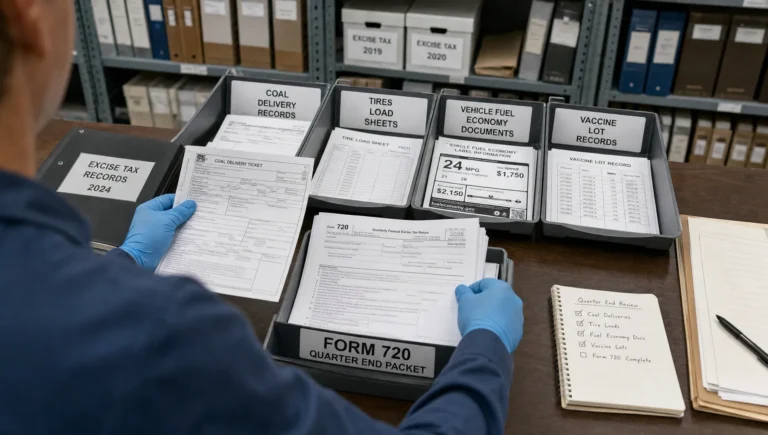
Form 720 is the IRS Quarterly Federal Excise Tax Return. It is used to report many federal excise taxes, including taxes connected to fuel, environmental activities, communications, air transportation, indoor tanning, certain manufactured goods, and the PCORI fee.
That makes Form 720 different from a standard annual income tax return. It is generally filed quarterly, and businesses may also have deposit requirements depending on the tax category and liability. If you are new to excise tax compliance, start with this overview of what Form 720 is and how to file it.
For Form 720, the “free” route usually means you can access IRS forms and instructions at no cost and make qualifying federal tax payments through EFTPS. But electronic filing of Form 720 is commonly handled through an IRS-authorized e-file provider. The benefit is not just convenience. It can also help businesses avoid mailing delays, manual processing issues, and missing proof of electronic submission.
If your business has no tax due for a quarter, do not automatically assume you can ignore the return. In some cases, a business may need to submit a zero liability return. You can learn more about that process here: File Form 720 Zero Liability Return Online.
How to decide whether a free filing method is enough
Before choosing a filing method, identify the exact federal obligation. A business owner may be able to file a personal return for free, pay federal deposits for free, and still need a paid or provider-supported solution for a separate business return.
Use these questions before filing:
- Are you filing an individual return, business entity return, employment tax return, excise tax return, or information return?
- Does the free tool support your exact IRS form and tax period?
- Do you need to file electronically, or is paper filing acceptable for your situation?
- Will you receive proof that the IRS accepted or rejected the return?
- Are you only making a payment, or are you also submitting the return?
- Do you need support for corrections, amendments, or refund claims?
For simple individual returns, a free IRS-supported option may be enough. For recurring business filings, specialized tax categories, or deadlines with penalty exposure, an authorized filing platform may be worth the added control.
Form 720 deadlines still apply, even if you use a free tool
Free filing does not extend your deadline. If a business is required to file Form 720, the standard quarterly due dates generally fall at the end of the month following each quarter: April 30, July 31, October 31, and January 31. When a deadline falls on a weekend or legal holiday, the due date is typically moved to the next business day.
Businesses should also distinguish between return due dates and deposit deadlines. Certain excise taxes may require semi-monthly deposits, which are separate from the quarterly Form 720 submission.
If you need the current schedule, review this guide to the Form 720 due date. Missing a filing or payment deadline can lead to penalties and interest, even when the original mistake was a misunderstanding about “free” filing.
Amendments and refunds are separate from original filing
Another common mistake is assuming that a free filing option covers corrections or refunds. Business tax corrections often require a different form.
For federal excise taxes, businesses commonly use:
| Situation | Common form | Purpose |
|---|---|---|
| Correcting a previously filed Form 720 | Form 720-X | Amends certain excise tax reporting errors. |
| Claiming a refund or credit of certain excise taxes | Form 8849 | Requests a refund or credit under eligible excise tax rules. |
| Reporting current-quarter excise tax liability | Form 720 | Reports quarterly federal excise taxes. |
The right form depends on whether you are correcting a prior return, claiming a refund, or reporting current liability. For a deeper comparison, read Form 720 vs Form 8849: What’s the Difference?.
A practical business checklist for free federal tax filing
If your goal is to reduce costs while staying compliant, start with a process instead of a platform. Filing federal taxes for free only works well when you already know what must be filed.
Create a simple federal tax map for your business. Include your entity type, income tax return, payroll tax obligations, excise tax exposure, information returns, and payment schedule. Then match each obligation to an IRS tool, authorized provider, accountant, or internal process.
At minimum, confirm these items before each filing season or quarter:
- Your legal business name, EIN, and address match IRS records
- Your entity classification is correct for federal tax purposes
- Your taxable activities have been reviewed for excise tax exposure
- Your payroll and contractor reporting obligations are current
- Your tax payments and return filings are tracked separately
- Your records support every amount reported on the return
- Your calendar includes quarterly, annual, and deposit deadlines
This checklist is especially useful for businesses that sell fuel, import taxable products, operate in transportation, sponsor self-insured health plans, provide indoor tanning services, or work in industries where excise tax obligations are easy to overlook.
Frequently Asked Questions
Can a business file federal taxes for free? Sometimes. A sole proprietor may qualify for free federal individual income tax filing, and many businesses can make federal tax payments for free through EFTPS. However, separate business entity returns, payroll returns, excise tax returns, and specialized filings may require software, an authorized provider, or professional help.
Does IRS Free File work for LLCs? It depends on how the LLC is taxed. A single-member LLC treated as a disregarded entity may report business income on the owner’s Form 1040 Schedule C, which may be eligible for IRS Free File if the owner qualifies. Multi-member LLCs, partnerships, S corporations, and C corporations generally have different filing requirements.
Can I file Form 720 for free? IRS forms and instructions are available at no cost, and federal tax payments can often be made through EFTPS. However, electronic filing of Form 720 is generally handled through an IRS-authorized e-file provider. eFileExcise720 offers free account creation and an online platform for Form 720 filing, but businesses should review the filing process before assuming every step is free.
Is paying through EFTPS the same as filing a federal return? No. EFTPS is a payment system. It helps businesses make federal tax payments, but it does not submit the tax return itself. If your business owes Form 720 excise tax, you may need both a payment and a filed return.
Are state business taxes included in free federal filing? Usually not. Federal and state filing systems are separate. A federal free filing option may not include state income tax, sales tax, state excise tax, franchise tax, or local business filings.
What is the biggest risk when choosing a free filing option? The biggest risk is using a tool that does not support your required form or filing situation. That can lead to missed returns, late payments, rejected filings, or unsupported amendments.
File Form 720 online with confidence
Free federal filing tools can be helpful, but businesses with federal excise tax obligations need a filing method built for Form 720. eFileExcise720 is an IRS-authorized online platform that helps businesses file Form 720 without downloading software.
You can create a free account, navigate a simple dashboard, receive customer support, and file excise tax returns securely. The platform supports Form 720 categories, Form 720-X amendments, and Form 8849 claims support for eligible refund situations.
If your business needs to file federal excise taxes this quarter, start at eFileExcise720 and choose a filing path that fits your compliance needs, not just the promise of “free.”