Free Online Tax Return Options for Excise Filers
If you searched for a free online tax return option and your business files excise taxes, the first thing to know is that “tax return” can mean very different things. A free consumer filing tool for a personal Form 1040 is not the same as filing IRS Form 720, the Quarterly Federal Excise Tax Return.
That distinction matters. Excise filers often deal with category-specific rates, quarterly due dates, deposit rules, supporting schedules, amendments, and refund claims. Some parts of the process can be handled at no cost using IRS resources, while actual electronic filing for Form 720 usually requires an IRS-authorized e-file provider.
This guide breaks down what is truly free, what is not, and how excise filers can choose the most cost-effective filing path without creating compliance risk.
What “free online tax return” means for excise filers
Most people associate a free online tax return with individual income tax filing. The IRS offers IRS Free File for eligible individual taxpayers, and many consumer tax products advertise free federal filing for simple personal returns.
Excise tax filing is different. Businesses and certain plan sponsors use IRS Form 720 to report federal excise taxes, including categories such as fuel, environmental taxes, communications services, air transportation, indoor tanning, foreign insurance, and the PCORI fee.
Form 720 is not a personal income tax return. It is a specialized federal excise tax return, usually filed quarterly. Because it involves activity-based tax categories, IRS numbers, schedules, deposits, and sometimes claims or amendments, it is not typically covered by free consumer tax software.
So, when excise filers look for free online tax return options, the better question is: Which parts of the Form 720 process can be done free, and when does it make sense to use an authorized online filing platform?
Free options excise filers can use
There are several no-cost resources that can help you understand, prepare, and manage your excise tax responsibilities. However, each one has limits.
| Free option | Best for | Cost | Important limitation for excise filers |
|---|---|---|---|
| IRS Free File | Individual Form 1040 filing | Free for eligible taxpayers | Not designed for Form 720 excise tax filing |
| IRS Form 720 and instructions | Researching tax categories, lines, and schedules | Free | You still need to prepare, file, and pay correctly |
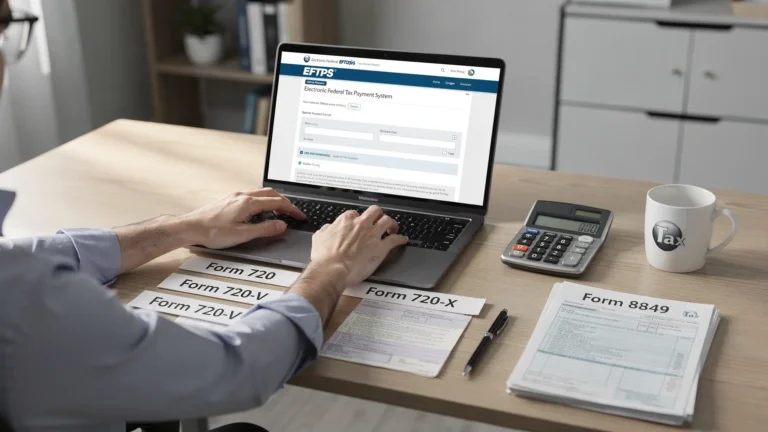
| EFTPS | Making federal tax deposits and payments | Free | Payment does not replace filing Form 720 |
| IRS tax calendars and reminders | Tracking due dates | Free | Does not calculate your liability |
| Free account creation with an e-file provider | Starting an online excise filing workflow | Free to create an account when offered | Filing submission terms vary by provider |
The key is to avoid assuming that “free” means the entire excise filing process is free, automatic, or complete. A free IRS form or payment portal can be helpful, but it does not necessarily provide guided Form 720 e-filing, validation, support, or electronic acknowledgment.
Why free consumer tax software usually does not work for Form 720
Free tax filing tools are usually built for individuals with simple income tax situations. They may support wages, standard deductions, basic credits, and common Form 1040 schedules.
Form 720 is built around a different compliance model. It asks whether your business had taxable excise activity during a quarter, then requires reporting by specific tax category. Depending on your activity, you may need to calculate tax based on gallons, barrels, units, premiums, service charges, covered lives, or other measures.
For example, an excise filer may need to handle:
- Federal fuel excise tax reporting
- Environmental excise taxes
- Communications or air transportation taxes
- Indoor tanning tax
- PCORI fee reporting
- Form 6627 for environmental taxes
- Schedule C claims or adjustments
- Schedule T reporting for two-party exchanges of taxable fuel
That is why an individual “free online tax return” product generally will not solve a Form 720 filing requirement. Even if your income tax return is simple, your excise tax return may still require specialized handling.
If you are still confirming whether your business needs Form 720 at all, start with a practical overview like What Is Form 720? A Simple Guide for Business Owners.
Can you file Form 720 for free by paper?
The IRS provides Form 720 and its instructions at no charge. In many cases, a business can complete the form manually and mail it to the IRS. That may feel like the cheapest route because there is no online filing provider involved.
However, paper filing has trade-offs. You are responsible for choosing the correct tax category, entering the right IRS number, applying the correct rate, completing any required schedules, signing the return, mailing it to the correct address, and keeping proof of timely filing.
Paper filing may be workable for a very simple, one-time situation if you are confident in the form. But for recurring quarterly excise filers, businesses with multiple tax categories, or filers who need fast confirmation, e-filing is often more practical.
A paper return also does not eliminate payment obligations. If you owe tax or deposits, you may need to use the Electronic Federal Tax Payment System or another IRS-approved payment method. Filing the return and paying the tax are related, but they are not the same step.
When online excise filing is worth considering
Using an IRS-authorized online platform can be valuable when the cost of making a filing mistake is greater than the cost of guided e-filing.
This is especially true if you file Form 720 more than once a year, report more than one excise category, need assistance understanding the form, or want a clearer submission workflow. Online filing can also help when you need to file an amendment using Form 720-X or submit a claim related to excise taxes using Form 8849.
For excise filers, the main benefits of an authorized online platform are practical:
- Faster filing workflow compared with manual preparation
- No software download needed
- Secure handling of filing data
- Guided dashboard navigation
- Support for Form 720 categories
- Access to customer support when questions come up
- Online options for amendments or related claims when supported
eFileExcise720 is an IRS-authorized e-filing portal built specifically for Form 720 federal excise tax returns. Account creation is free, and the platform is designed to help excise filers prepare and submit returns online with secure data protection and dedicated customer support. Before submitting any return, review the filing options available for your specific situation.
2026 Form 720 deadlines to know
Excise filers should pay close attention to filing deadlines because Form 720 is generally due quarterly. The return is usually due by the last day of the month after the quarter ends. If the due date falls on a weekend or federal holiday, the due date moves to the next business day.
| Tax period | Period covered | 2026 filing due date |
|---|---|---|
| 1st quarter | January 1 to March 31, 2026 | April 30, 2026 |
| 2nd quarter | April 1 to June 30, 2026 | July 31, 2026 |
| 3rd quarter | July 1 to September 30, 2026 | November 2, 2026 |
| 4th quarter | October 1 to December 31, 2026 | February 1, 2027 |
Some excise taxes also have deposit requirements that occur before the quarterly return is due. For many filers, deposits are made through EFTPS. Review the current IRS instructions or work with a qualified tax professional if you are unsure whether deposit rules apply to your business.
For more detail, see this guide to the Form 720 due date.
How to reduce filing costs without increasing risk
The best way to save money on excise tax compliance is not always to choose the cheapest filing method. It is to reduce rework, penalties, rejected filings, and amended returns.
Start by organizing your records before you begin any online filing process. For Form 720, that may include sales reports, gallons sold or used, taxable units, invoices, import records, policy or plan data, covered lives for PCORI reporting, deposit confirmations, and prior-quarter returns.
Then confirm the exact tax category. Form 720 includes many different excise taxes, and using the wrong line can create errors even if your dollar amount seems reasonable. If your business handles fuel, chemicals, petroleum products, communications services, indoor tanning, or self-insured health plan reporting, take extra care to map the activity to the correct IRS category.
It also helps to separate the filing decision from the payment decision. Filing Form 720 reports the liability. Paying through EFTPS or another approved method satisfies the payment side. A business can make a payment and still be noncompliant if it does not file the return, and it can file the return but still face penalties if payment or deposits are late.
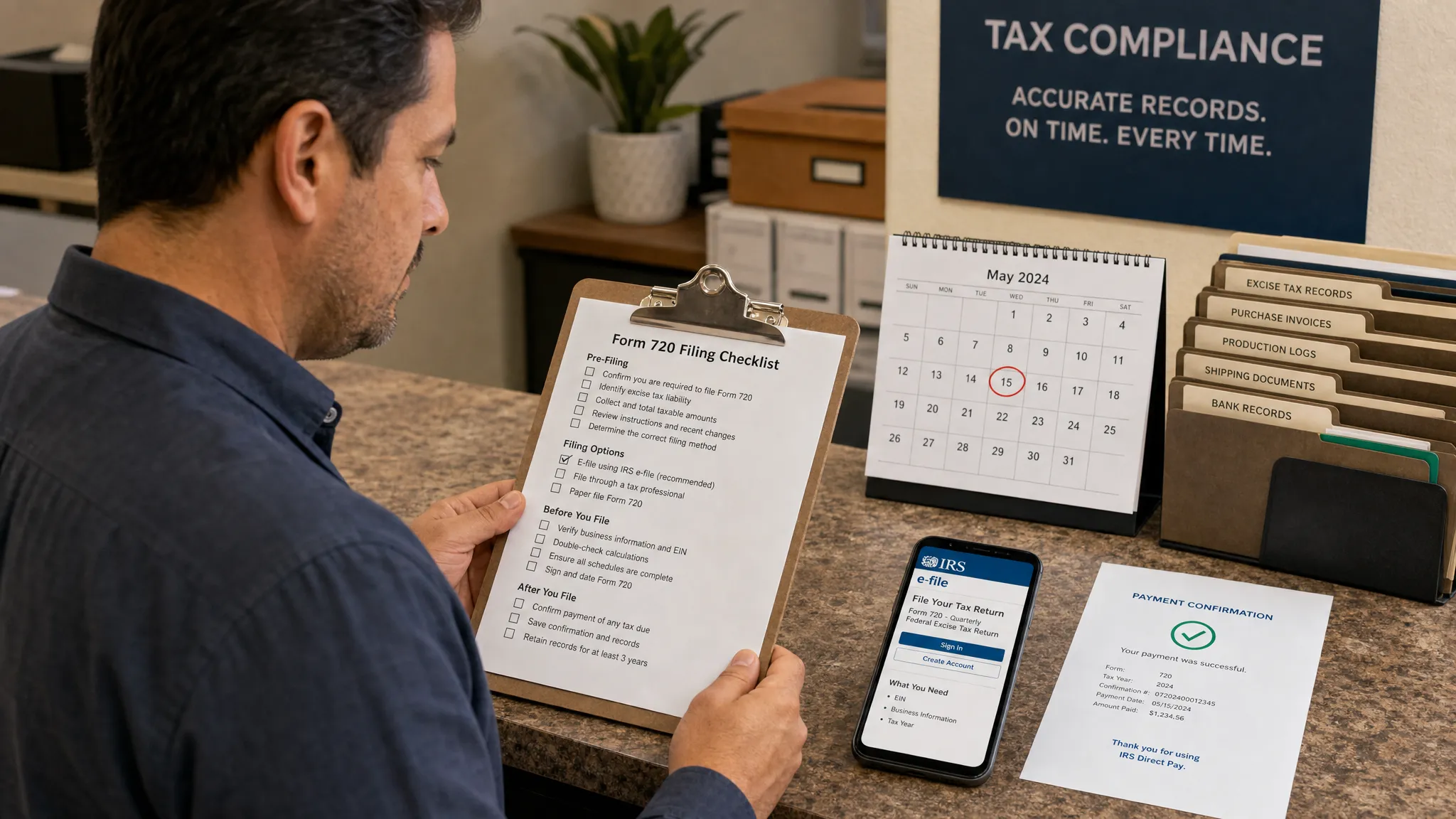
Finally, save all confirmations. Keep copies of the filed return, payment confirmations, worksheets, supporting schedules, and source documents. Excise tax records should be easy to retrieve if the IRS sends a notice or if you need to amend a return later.
Choosing the right option for your situation
There is no single best filing path for every excise filer. The right choice depends on what you are trying to file, how complex your activity is, and whether you need electronic submission.
| Your situation | Best starting point |
|---|---|
| You only need to file a personal income tax return | IRS Free File or other consumer tax filing options |
| You are researching whether your business owes excise tax | IRS Form 720 instructions and educational guides |
| You need to pay federal excise tax or deposits | EFTPS, plus a separate Form 720 filing when required |
| You need to file Form 720 electronically | An IRS-authorized Form 720 e-file provider |
| You made a mistake on a prior Form 720 | Review Form 720-X amendment options |
| You may qualify for an excise tax refund or claim | Review Form 8849 claim rules |
| You file quarterly or across multiple categories | Consider a guided online excise filing platform |
If you are unsure whether you need Form 720, focus first on your business activity, not your business type. The obligation is usually triggered by what you sell, manufacture, import, insure, provide, or administer.
A practical online workflow for excise filers
If you want to start online and keep costs controlled, use a structured process before submitting anything.
- Confirm the filing obligation: Identify the specific activity that may trigger federal excise tax, such as fuel sales, environmental tax activity, communications charges, indoor tanning services, or PCORI responsibility.
- Choose the correct quarter: Match the activity to the right Form 720 filing period and confirm the due date.
- Gather records: Collect invoices, transaction reports, usage logs, import documents, plan data, prior returns, and payment confirmations.
- Calculate liability: Apply the correct tax category, unit of measure, and rate based on IRS guidance.
- Decide how to file: Compare paper filing, professional preparation, or an IRS-authorized online provider.
- Handle payment separately: Use EFTPS or another approved IRS payment method if tax or deposits are due.
- Store confirmation records: Save the return, acknowledgment, payment proof, and supporting worksheets.
This approach lets you use free resources where they make sense while still choosing specialized support when the filing itself requires it.
Where Form 720-X and Form 8849 fit in
Excise filers often discover that the original return is only one part of the compliance picture. If you already filed Form 720 and later find an error, you may need Form 720-X to amend the return.
If you are seeking a refund or claim for certain excise taxes, Form 8849 may be the right path instead. This is common in some fuel-related situations, but eligibility depends on the tax type, use case, and documentation.
Because these forms serve different purposes, do not treat them as interchangeable. If you are comparing correction and refund options, this guide explains the difference between Form 720 and Form 8849.
Frequently Asked Questions
Is there a completely free online tax return option for Form 720? IRS Free File is designed for eligible individual income tax returns, not Form 720 excise tax filing. IRS forms and instructions are free, and EFTPS is free for payments, but electronic Form 720 submission is typically handled through an IRS-authorized e-file provider with its own filing terms.
Can I use IRS Free File for my business excise tax return? Generally, no. IRS Free File is for personal federal income tax returns. Businesses and plan sponsors that need to report federal excise taxes generally use Form 720, which requires a different filing process.
Can I prepare Form 720 myself and mail it? Yes, many filers can download the IRS form, prepare it manually, and mail it. The IRS does not charge for the form itself, but you are responsible for accuracy, mailing, payment, and recordkeeping.
Does paying through EFTPS mean I filed Form 720? No. EFTPS is a payment system. It helps you make deposits or payments, but it does not replace the requirement to file Form 720 when a return is due.
Does eFileExcise720 offer free account creation? Yes. eFileExcise720 offers free account creation and requires no software download. The platform supports Form 720 e-filing, Form 720 amendments, and Form 8849 claims support. Review the available filing options before submitting your return.
What is the safest option for recurring excise filers? If you file quarterly, report multiple categories, or need support for amendments or claims, an IRS-authorized e-filing platform can reduce manual work and help you keep the process organized.
Start with the right filing path
Free online tax return tools can be useful, but excise filers need to be careful about choosing tools built for the right type of return. IRS Free File may help with a personal income tax return, while Form 720 requires specialized excise tax filing steps.
If you need to file Form 720 online, eFileExcise720 provides an IRS-authorized portal with secure data handling, simple dashboard navigation, support for Form 720 categories, and personalized customer support. Create a free account at eFileExcise720 and start your excise tax filing workflow with confidence.