
IRS Form for Tax Return: How to Find the Right One Fast
Picking the wrong IRS form can cost you time, create avoidable back-and-forth with the IRS, and in some cases lead to penalties if it delays a required filing. The good news is that you can usually identify the correct IRS form for tax return purposes in a few minutes, as long as you start with the right questions and use the IRS’s form “About” pages and instructions.
Below is a fast method you can reuse every filing season, plus a quick map of common tax-return forms (including when Form 720 is the right answer for federal excise taxes).
Start with 3 questions (this finds the right form faster than Google)
Before searching for a form number, clarify these three items. They narrow the options quickly and help you avoid the most common mix-ups.
1) What type of tax is it?
Most “tax return” searches fall into one of these buckets:
- Income tax (individual, business, trust/estate)
- Employment/payroll tax (withholding, Social Security/Medicare, unemployment)
- Excise tax (fuel, environmental, communications, certain manufacturing/retail, PCORI fee, and other activity-based excise taxes)
- Information reporting (reports payments or transactions, not a tax return in the classic sense)
2) Who is filing?
The same activity can point to different forms depending on the filer.
- Individual
- Corporation
- S corporation
- Partnership
- Trust/estate
- Tax-exempt organization
- Business with employees
3) What time period is being reported?
A lot of form confusion is really “period confusion.”
- Annual (calendar year or fiscal year)
- Quarterly
- Monthly (common for certain deposits and operational reporting)
- Event-based (triggered by a transaction or activity)
When you know the tax type, filer type, and period, you can usually identify the correct form without guessing.
The fastest way to find the correct IRS form (and confirm it)
Search engines are fine for discovery, but the safest way to confirm you’re using the right form is to use the IRS’s own “About” pages and instructions.
Step 1: Use the IRS “Forms & Instructions” search
Go to the IRS Forms, instructions & publications page and search by:
- Form number if you have it (example: “720”)
- A plain-English phrase (example: “quarterly federal excise tax return”)
This is the quickest way to land on the official form and the official instructions.
Step 2: Open the “About Form ___” page
For many forms, the IRS provides an “About Form” page that helps you verify:
- What the form is used for
- Who must file
- The most recent revision
- Where to find instructions and related schedules
Example for excise taxes: About Form 720, Quarterly Federal Excise Tax Return.
Step 3: Read the instructions first (not last)
If you are choosing between similar forms (or you’re not sure whether you’re filing a return, an amendment, or a refund claim), the instructions usually settle it immediately.
- Instructions for Form 720
- Instructions for Form 8849
Step 4: Confirm the tax year or revision date
Using the wrong revision or wrong-year instructions is an easy way to introduce errors.
A practical rule: download the form from the IRS site each time you file, even if you filed “the same thing” last quarter or last year.
Step 5: Check whether you need a schedule or an attachment
Some “forms” are incomplete without schedules, supporting statements, or companion forms. For example, excise tax filings often involve schedules depending on the tax category.
If the IRS instructions mention a schedule you do not recognize, pause and identify whether:
- It is required for your activity
- It is optional
- It is only needed for certain methods (such as deposits or claims)
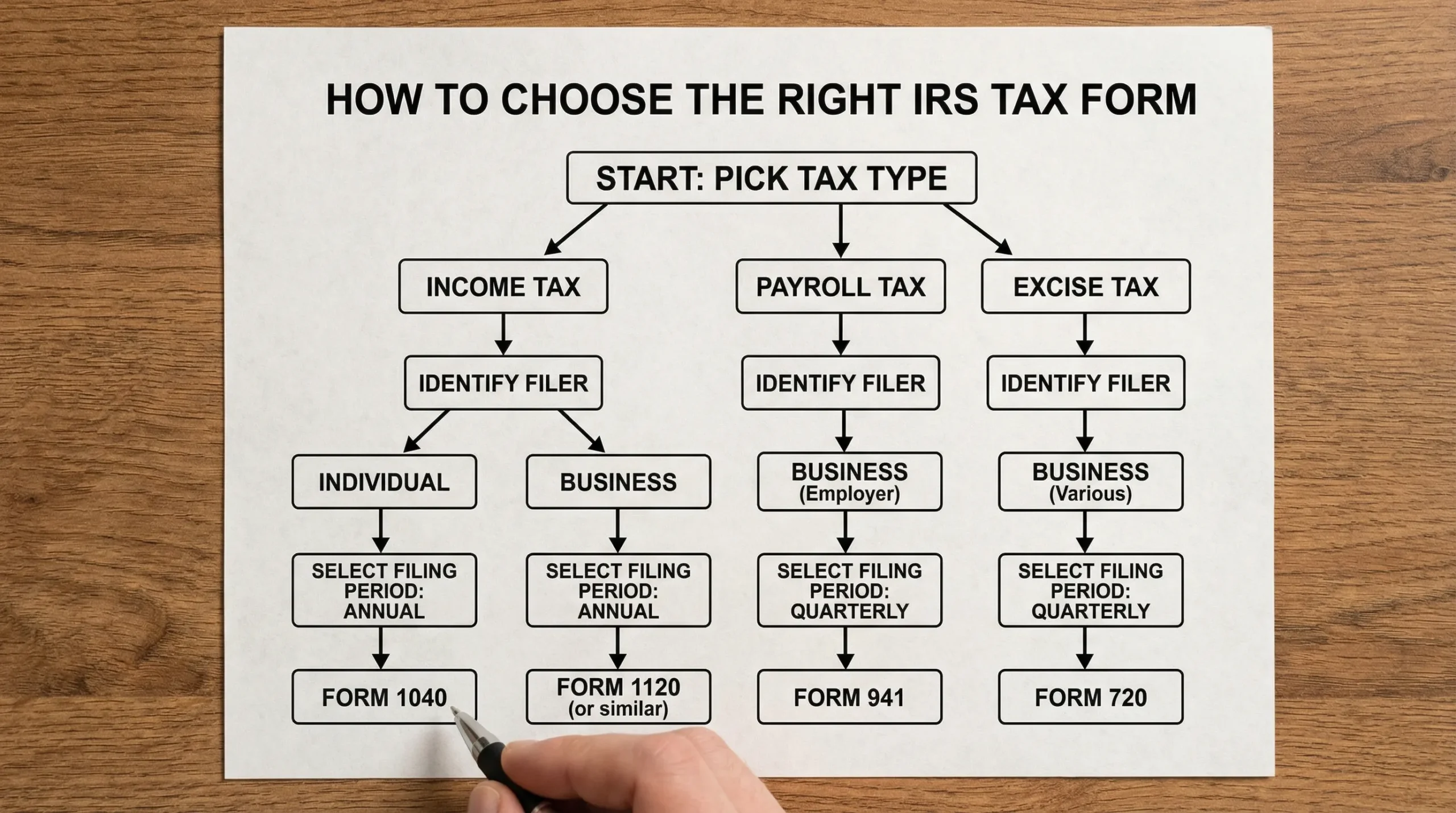
Quick map: common IRS forms used as “tax returns”
This table is a practical starting point for the most common “Which IRS form do I need?” situations. Always confirm details in the official instructions, especially for special elections and exceptions.
| If you need to report… | Most common IRS form | Who typically files | Filing rhythm (typical) |
|---|---|---|---|
| Individual income tax | Form 1040 | Individuals | Annual |
| Income tax for a trust or estate | Form 1041 | Trusts/estates | Annual |
| Partnership income return (informational) | Form 1065 | Partnerships | Annual |
| Corporate income tax | Form 1120 | C corporations | Annual |
| S corporation income return (informational) | Form 1120-S | S corporations | Annual |
| Employer quarterly payroll taxes | Form 941 | Employers | Quarterly |
| Federal unemployment tax | Form 940 | Employers | Annual |
| Federal excise taxes (activity-based) | Form 720 | Businesses with taxable excise activities (or specific fees) | Quarterly (some items reported once a year on a quarter’s 720) |
| Amendment to a previously filed excise return | Form 720-X | Form 720 filers correcting a quarter | As needed |
| Claim for refund/credit of certain excise taxes | Form 8849 | Eligible claimants (varies by schedule) | As needed |
If your situation is not listed, the IRS forms search page is still the quickest way to confirm the right “family” of forms.
When the right IRS form for a tax return is Form 720
If your business owes federal excise tax, the right tax return is often Form 720 (Quarterly Federal Excise Tax Return).
Form 720 is different from income tax returns (like 1040 or 1120) because it is typically activity-based. In other words, filing is triggered by what you do (or what you sell, import, manufacture, broker, or bill), not by your entity type.
Common categories reported on Form 720 can include:
- Fuel-related excise taxes
- Environmental taxes
- Communications and air transportation excise taxes
- Certain manufacturing/retail excise taxes
- The PCORI fee (reported and paid on Form 720, typically due by July 31 each year)
If you want a business-friendly overview, see the IRS “About” page for Form 720. You can also review eFileExcise720’s explainer on understanding Form 720 and how to file it.
Form 720 vs. Form 720-X vs. Form 8849 (the common confusion)
Many filers get delayed because they pick the right “topic” but the wrong action.
- Form 720 is the original quarterly excise tax return.
- Form 720-X is used to amend or make adjustments to a previously filed Form 720 for a specific quarter.
- Form 8849 is used to claim refunds/credits of certain excise taxes (often fuel-related), using the appropriate schedule.
If you want a clearer comparison (with real-world filing context), eFileExcise720 also breaks this down here: Form 720 vs Form 8849: What’s the Difference?
A “find it fast” checklist to avoid wrong-form mistakes
Use this quick checklist before you start entering numbers.
- Confirm the filing requirement is real (not just a vendor invoice note or contract clause).
- Identify the exact tax category and where it appears in the IRS instructions.
- Match the filing period to the form (quarterly vs annual vs “as needed”).
- Download the current form and instructions from IRS.gov.
- Verify whether a companion schedule is required.
- Decide whether you are filing an original return, an amendment, or a refund claim.
This is especially important for excise taxes, where the same underlying activity could lead to:
- Regular quarterly reporting (Form 720)
- A correction to a prior quarter (Form 720-X)
- A refund claim pathway (Form 8849)
How to file Form 720 faster (and more confidently)
Once you’ve confirmed that Form 720 is the right IRS form for your tax return, speed usually comes from two areas:
1) Organize your data around the IRS lines, not your internal accounts
Form 720 reporting is line-driven and category-driven. A clean approach is to reconcile your internal totals to the specific IRS reporting lines you’ll use before you begin filing.
If you need quarter-by-quarter tips, eFileExcise720 has a practical prep guide here: Form 720 e-filing checklist for 2026.
2) Use an IRS-authorized e-file option for Form 720
Paper filing can work, but e-filing typically reduces preventable problems such as:
- Mailing delays
- Missing fields
- Basic data-entry errors
- Lack of fast confirmation that the IRS received your return
eFileExcise720 is an IRS-authorized online platform focused on excise tax compliance, including Form 720, Form 720-X amendments, and Form 8849 claims. It’s designed to let you file without downloading software, with secure data handling and customer support when you get stuck.
If you are comparing methods, you may also find this useful: E-file IRS or mail: which is faster for Form 720?

Frequently Asked Questions
What is the best way to find the right IRS form for a tax return? Use the IRS Forms, instructions & publications search, then open the “About” page and the instructions for the form you think you need. Confirm who files it and for what period.
Why does the IRS have so many different tax return forms? Different forms exist because filing rules depend on tax type (income, payroll, excise), filer type (individual, corporation, partnership), and the reporting period (annual, quarterly, event-based).
How do I know if I need Form 720 or Form 941? Form 941 is for employer payroll taxes (withholding and Social Security/Medicare). Form 720 is for federal excise taxes tied to specific activities (fuel, environmental, communications, PCORI fee, and other excise categories). The IRS instructions for each form make the difference clear.
Is Form 8849 a tax return? Form 8849 is generally a claim form used to request refunds or credits of certain excise taxes (using the right schedule). Depending on your situation, you might file Form 8849 instead of claiming on Form 720, or in addition to filing Form 720.
What should I do if I already filed the wrong form? Stop and identify whether you need to amend, replace, or file an additional return. For excise taxes, that often means evaluating whether Form 720-X (amendment/adjustment) or Form 8849 (refund claim) is appropriate. When in doubt, consult the IRS instructions or a qualified tax professional.
Can I file Form 720 online? Yes, Form 720 can be e-filed through IRS-authorized providers. If your return involves federal excise taxes, you can file online through eFileExcise720.
File Form 720 online with eFileExcise720
If you’ve confirmed the correct IRS form for tax return filing is Form 720, you can e-file it through eFileExcise720, an IRS-authorized portal built for federal excise tax returns. You can also handle Form 720-X amendments and Form 8849 claims in the same place, with secure data protection and customer support when you need it.
Get started here: File Form 720 Online.