
Online Tax Forms Guide: Find the Right IRS Excise Form Fast
Finding the right IRS excise tax form can feel harder than it should, especially when you are trying to stay compliant on a quarterly schedule. If you are searching for online tax forms and you keep running into Form 720, Form 720-X, and Form 8849, this guide will help you quickly identify which excise form you need, what it is used for, and what information to have ready before you file.
First, confirm you are dealing with a federal excise tax
Excise taxes are different from income taxes. They are typically tied to specific products, services, or activities (for example, certain fuel-related taxes, environmental taxes, communications and air transportation taxes, or specialized items like foreign insurance tax). Many excise taxes are reported on a quarterly return rather than annually.
If your business activity triggers a federal excise tax, the IRS generally expects you to report it using Form 720 (Quarterly Federal Excise Tax Return) and, depending on your situation, supporting schedules or related forms.
For official form downloads and instructions, start with the IRS form pages:
Quick IRS excise form finder (use this table)
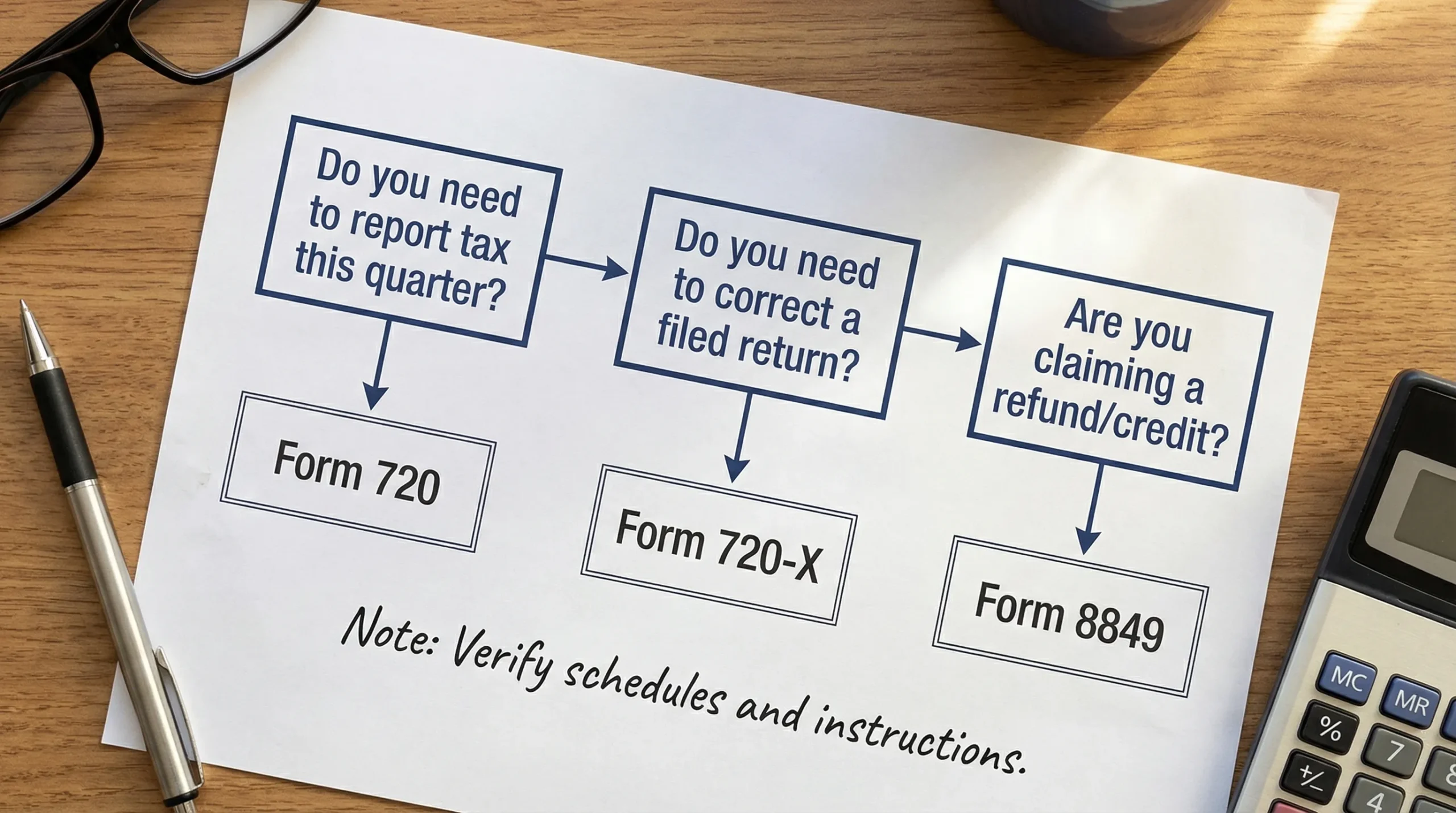
Use the table below as a fast way to choose the correct form based on what you are trying to do.
| What you need to do | Most common IRS excise form | When you typically use it | Notes to watch for |
|---|---|---|---|
| Report and pay federal excise tax for the quarter | Form 720 | You owe excise tax for a calendar quarter | May require additional schedules/attachments depending on the tax category |
| Fix a previously filed Form 720 (increase or decrease tax) | Form 720-X | You already filed Form 720 and need to correct it | Often used for true corrections; keep records supporting the change |
| Claim a refund/credit for certain excise taxes | Form 8849 | You are eligible for a claim (often category-specific) | Some claims require schedules (for example, Schedule 1, 2, or 3 depending on claim type) |
| Report environmental excise taxes (when applicable) | Form 6627 (attachment) | Your Form 720 category requires it | Not a standalone return for most filers; typically attached when required |
| Support fuel-related reporting (when applicable) | Schedule T, Schedule C (attachments) | Your fuel activity requires these schedules | Common in fuel-related excise contexts; requirements depend on what you are reporting |
If you are unsure which categories apply, the most reliable approach is to review the current Form 720 Instructions (available from the IRS Form 720 page) and match the activity to the applicable IRS number/category listed in the instructions.
Form 720 vs. 720-X vs. 8849: how to choose in 60 seconds
Most confusion comes from mixing up three different goals: reporting, correcting, and claiming.
If you are reporting what you owe for the quarter, start with Form 720
Use Form 720 when you have excise tax liability for the quarter and need to file the quarterly return. Even if you owe nothing, some businesses still file a “zero return” depending on their circumstances and filing expectations.
If you need a refresher on timing, the quarterly due dates are fixed on the calendar (with weekend/holiday shifts). This due date overview can help you sanity-check your quarter selection: Form 720 due dates.
If you already filed Form 720 and need to correct it, Form 720-X is usually the starting point
Use Form 720-X to amend or adjust a previously filed Form 720. Common triggers include discovering underreported taxable transactions, misapplied rates, incorrect IRS numbers, or entering amounts in the wrong quarter.
The key mindset is this: 720-X is for fixing the original reporting. It is not just “another way to get money back.” Your records should show exactly what changed and why.
If you are eligible for a claim (refund/credit), Form 8849 may be required
Form 8849 is used for certain refund claims related to excise taxes. Whether you should use 8849 (and which schedules apply) depends on the specific claim type, the tax involved, and the facts supporting your eligibility.
When in doubt, check the IRS guidance directly: About Form 8849.
The fastest way to identify the right Form 720 category
Form 720 is not one single tax. It is a container for many excise tax categories. To find the right category quickly, do this:
-
Identify the activity (what you sold, provided, manufactured, imported, or paid premiums for).
-
Look up the matching line and IRS number in the Form 720 Instructions.
-
Confirm whether an additional form or schedule is required for that category.
A practical example: foreign insurance tax is reported on Form 720 when U.S. persons pay premiums to foreign insurers for U.S. risks and no exemption applies. If that is your situation, this specific explainer can help you validate your understanding before you file: Foreign Insurance Tax on Form 720.
What to gather before you start filing online (so you do not pick the wrong form)
Choosing the right form is easier when you have the right inputs in front of you. Before you begin, gather:
- Your EIN and legal business information as used on prior IRS filings
- The calendar quarter you are reporting (or correcting)
- The documents that support the taxable amount (sales reports, invoices, tickets, premium statements, coverage data, or other category-specific records)
- Any prior Form 720 filing details if you are amending (what was filed, for which quarter, and what needs to change)
- Any deposit/payment information if you were required to make deposits (for example, via EFTPS)
Having these ready reduces the two most common time-wasters: filing in the wrong quarter and using the wrong tax category.
Filing IRS excise forms online: what “good” looks like
When people search for online tax forms, they usually want three outcomes: speed, fewer errors, and proof of submission. For excise returns, “proof” usually means an electronic acknowledgment that the return was accepted.
A reliable online filing workflow typically includes:
- Clear selection of the correct return type (file, amend, or claim)
- A guided way to enter category-specific amounts
- Built-in checks to help prevent obvious rejects (for example, missing required fields)
- Secure handling of taxpayer data
- An electronic submission path and confirmation
If you want to file Form 720 through an IRS-authorized e-file provider and avoid paper mailing delays, you can file online through eFileExcise720 (no software download required, free account creation).
Common mistakes that slow filers down (and how to avoid them)
Mistake 1: Picking the wrong “tool” for the job
A quick rule:
- Form 720 is the quarterly reporting vehicle.
- Form 720-X is for correcting a previously filed Form 720.
- Form 8849 is for certain refund/credit claims.
If you are trying to correct an error and also want a refund, you may need to follow the IRS’s process for that specific category, which can involve either 720-X, 8849, or both depending on circumstances. Always verify with the current IRS instructions for your category.
Mistake 2: Using the right form but the wrong quarter
Excise tax reporting is quarter-based, and quarter selection affects due dates, penalty exposure, and matching against deposits. If your numbers are correct but the quarter is wrong, you can still create a compliance problem.
Mistake 3: Ignoring attachments that apply to your category
Some excise categories require schedules or additional forms to support the return. If you omit them, you risk delays, correspondence, or rework.
If you want a practical preparation list that helps prevent rejects, see this checklist-style resource: Form 720 e-filing checklist for 2026.
Mistake 4: Treating excise tax like “set it and forget it”
Excise tax obligations can change with business activity. New products, new services, changes in sourcing, and new customer contracts can change your filing profile. A short quarterly review (even 15 minutes) often catches issues early.
When you should talk to a tax professional
This guide is meant to help you find the right IRS excise form fast, not replace advice for complex scenarios. Consider professional support if:
- You are entering a new excise category for the first time
- You have multi-entity or acquisition-related reporting complexity
- You are unsure whether you qualify for a refund claim
- You are dealing with IRS notices, audits, or large corrections
You can still file online, but it is often worth validating the category and approach first.
Frequently Asked Questions
What is the difference between Form 720 and Form 2290? Form 720 is a quarterly return for many types of federal excise taxes. Form 2290 is a separate form used for the Heavy Highway Vehicle Use Tax (HVUT). If you are unsure which applies, confirm the tax type first on the IRS website.
Can I file Form 720 online? Yes. You can file Form 720 electronically through an IRS-authorized e-file provider. E-filing generally provides faster confirmation than mailing.
If I made a mistake on Form 720, do I always use Form 720-X? Often, yes, Form 720-X is used to correct a previously filed Form 720. But the correct method can depend on the type of correction and the excise category, so check the current IRS instructions.
Is Form 8849 only for fuel tax refunds? No. While fuel-related claims are common, Form 8849 can be used for multiple excise tax refund or credit claim types, depending on eligibility and the schedules required.
Do I still need to file Form 720 if I owe zero excise tax for the quarter? It depends on your facts and filing expectations for your situation. Some filers submit a zero return, while others may not be required for that quarter. Check IRS guidance for your category and history.
What is the safest way to avoid filing the wrong excise form? Start by clarifying your goal (report, amend, or claim), then confirm your category using the current IRS instructions for the form. Keeping quarter-based records organized also helps.
File the right excise form online with less guesswork
If you have identified that you need Form 720, need to correct a prior quarter with Form 720-X, or need help supporting a claim with Form 8849, you can handle it online with an IRS-authorized provider.
Create your free account and get started here: eFileExcise720.