Taxes to File Each Quarter: A Compliance Calendar for Businesses
Missing a quarterly tax deadline can cost more than a late fee. It can trigger IRS penalties, interest, and time-consuming notices, especially when you are juggling payroll, sales tax, estimated income tax, and industry-specific filings like federal excise tax.
This compliance calendar breaks down the most common taxes to file each quarter for US businesses, with due dates you can plan around and practical steps to stay organized.
How to use this quarterly tax compliance calendar (and avoid surprises)
Quarterly deadlines vary based on your business type, where you operate, and what you sell. Use the calendar below as a baseline, then confirm your exact obligations with your CPA or payroll provider.
A few reminders that prevent most “we didn’t know” problems:
- Weekend and holiday rules apply. If a federal due date falls on a weekend or holiday, the deadline generally shifts to the next business day. The IRS summarizes this in Publication 509.
- Deposits are not the same as returns. Many taxes must be deposited throughout the quarter, even though the return is filed at quarter-end (common with payroll and some excise taxes).
- State and local rules can be more frequent than quarterly. Sales tax, withholding, and certain industry taxes are often monthly, even for small businesses.
Quarterly filing deadlines at a glance (federal)
These are the core federal filings that drive most quarterly compliance routines.
| Deadline (typical) | What it covers | Form(s) | Who it applies to |
|---|---|---|---|
| April 30 | Q1 payroll tax return and Q1 federal excise tax return | Form 941, Form 720 | Employers, excise-taxable businesses |
| July 31 | Q2 payroll tax return and Q2 federal excise tax return | Form 941, Form 720 | Employers, excise-taxable businesses (and many PCORI filers) |
| October 31 | Q3 payroll tax return and Q3 federal excise tax return | Form 941, Form 720 | Employers, excise-taxable businesses |
| January 31 | Q4 payroll tax return and Q4 federal excise tax return | Form 941, Form 720 | Employers, excise-taxable businesses |
Official IRS form pages:
Q1 (January to March): what to file and pay
Q1 is when many businesses are still finishing year-end tasks, but quarterly compliance starts immediately.
Common Q1 taxes and filings
Payroll tax deposits (ongoing): Federal income tax withholding, Social Security, and Medicare are typically deposited on a monthly or semiweekly schedule based on your lookback period. Your payroll system should help manage this, but it is still worth reconciling deposits monthly.
Estimated income tax payments (if required): If you are required to pay estimated taxes, you may have a Q1 payment due in April. This depends on entity type.
Sales and use tax (state): Some states require monthly sales tax returns even if you are a small business. Others allow quarterly filing. Confirm your state’s schedule.
The big Q1 deadline: April 30
By April 30, many businesses file:
- Form 941 for Q1 (wages paid January through March)
- Form 720 for Q1 (excise tax transactions in Q1)
If your business has excise tax exposure, Q1 is also a good time to verify whether you should have been making periodic deposits via EFTPS. The IRS EFTPS system is here: EFTPS.
Q2 (April to June): what to file and pay
Q2 often brings more “non-obvious” tax items, especially for businesses that offer benefits or operate in regulated product and service categories.
Common Q2 taxes and filings
Estimated income tax payments: Q2 estimated tax due dates often fall in mid-June for individuals and some pass-through owners, and can differ for corporations.
Sales tax and state payroll filings: Many states require quarterly withholding and unemployment returns around the same time window as federal Q2 filings.
Industry-specific excise items: If you have any activities that trigger excise taxes, you will generally report them on Form 720 for the quarter they occurred.
The big Q2 deadline: July 31
By July 31, many businesses file:
- Form 941 for Q2
- Form 720 for Q2
Important nuance: some obligations are reported on Form 720 but are not “every quarter” for every filer. A well-known example is the PCORI fee, which is reported on Form 720 but is generally filed annually on the return due July 31 for many plan sponsors. If benefits compliance touches your business, confirm whether PCORI applies.
Q3 (July to September): what to file and pay
Q3 is often operationally busy, which makes it a common quarter for missed deadlines. The best defense is to treat tax prep like a monthly close, not an annual scramble.
Common Q3 taxes and filings
Payroll deposits and reconciliations (ongoing): Ensure your payroll register ties out to your quarterly totals before you file Form 941.
Sales and use tax: If you sell into multiple states (including online sales), validate whether you have triggered new filing requirements due to economic nexus thresholds.
Federal excise tax (if applicable): Confirm you are mapping transactions to the correct Form 720 categories as they occur, not at quarter-end.
The big Q3 deadline: October 31
By October 31, many businesses file:
- Form 941 for Q3
- Form 720 for Q3
Q4 (October to December): what to file and pay
Q4 has the same quarterly rhythm as the first three quarters, plus year-end planning and data cleanup.
Common Q4 taxes and filings
Payroll deposits (ongoing): This is the time to confirm employee information is accurate (names, SSNs, addresses) so year-end wage reporting is smoother.
Estimated income tax payments: Certain taxpayers have a Q4 estimated payment due in December.
Excise tax tracking: If you file Form 720, reconcile any deposit requirements and ensure your Q4 liability data is complete before January.
The big Q4 deadline: January 31
By January 31, many businesses file:
- Form 941 for Q4
- Form 720 for Q4
Separately, January is also packed with annual wage and information reporting deadlines (for example, W-2 and many 1099 forms), which is another reason Q4 reconciliation matters.
Estimated income tax payments: quick schedule by business type
Estimated tax rules can be complex, especially for businesses with seasonal income or owners who also have other income sources. This table is a helpful starting point for planning discussions with your tax advisor.
| Taxpayer type | Typical estimated tax due dates (calendar year filers) | Where to confirm |
|---|---|---|
| Individuals (including many sole proprietors and pass-through owners) | April 15, June 15, September 15, January 15 | IRS estimated taxes overview |
| C corporations | April 15, June 15, September 15, December 15 | IRS corporate estimated tax guidance |
If a date falls on a weekend or federal holiday, the due date typically shifts to the next business day.
Taxes businesses often forget to calendar (until a notice arrives)
Many compliance problems are not caused by “hard” tax work, they come from missed triggers. A few of the most common:
State payroll filings and unemployment returns: Even if your federal cadence is solid, states have their own quarterly (and sometimes monthly) due dates.
Sales tax in additional states: Growth can create new obligations. If your customers are in multiple states, you may need to track economic nexus thresholds and marketplace facilitator rules.
Excise tax on specific products and services: Federal excise taxes can apply to a wide range of activities, including certain fuel transactions, air transportation, communications, manufacturers and retailers of specific products, and more. If you are unsure whether you have a filing requirement, reviewing the Form 720 categories early can prevent quarter-end surprises.
Amendments and claims: If you discover an error after filing, you may need to amend or file a claim rather than “fix it next quarter.” For excise taxes, that commonly involves Form 720-X or Form 8849, depending on the situation.
A quarterly close process that makes deadlines easier
The most reliable way to hit deadlines is to build a repeatable quarterly routine. A simple workflow most finance teams can adopt:
1) Do a mid-quarter check-in
Around the middle of each quarter, confirm:
- Your payroll deposits are posting as expected
- Your taxable sales and exempt sales are being coded correctly
- Any excise-taxable transactions are being captured with the right documentation
Catching issues mid-quarter avoids a painful quarter-end reconstruction.
2) Reconcile before you prepare returns
Reconcile the supporting data first, then prepare the return. For example:
- Payroll register totals should match your accounting records for wages and withholding
- Excise transactions should tie to invoices, bills of lading, usage logs, or other category-specific records
3) Build “proof of compliance” into your process
Keep a clean audit trail:
- Filing confirmations (especially IRS acknowledgements for e-filed returns)
- Payment confirmations (EFTPS, ACH, credit card confirmations, as applicable)
- Workpapers showing how totals were calculated
Where Form 720 fits in your quarterly calendar (and how to simplify it)
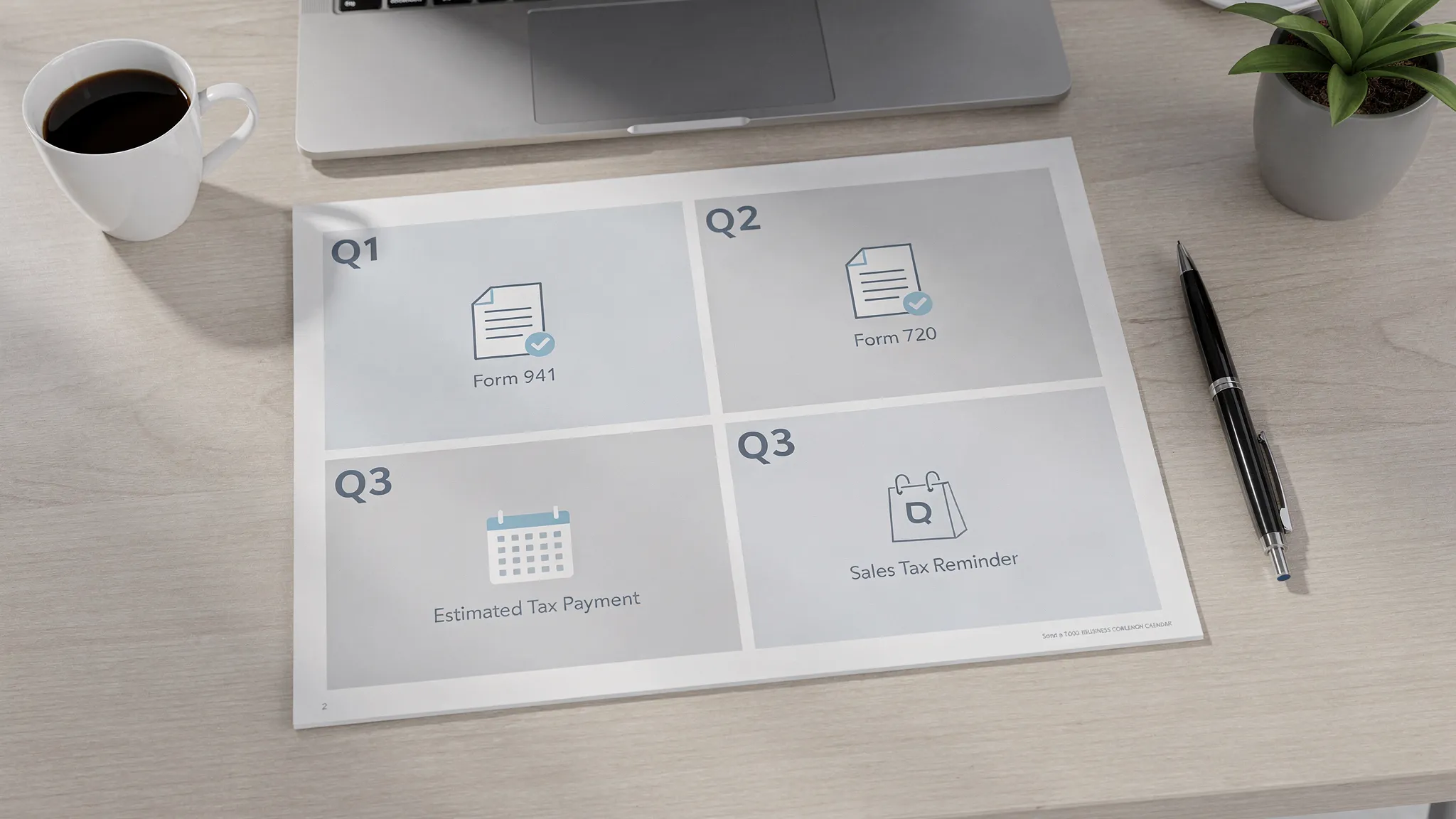
If your business owes federal excise taxes, Form 720 is typically a quarterly filing with due dates that align with Form 941 (April 30, July 31, October 31, January 31, with weekend and holiday adjustments).
In practice, what makes Form 720 challenging is not the calendar date, it is:
- Identifying which Form 720 categories apply to your business
- Tracking liability throughout the quarter (and deposits when required)
- Including any needed schedules or supporting information
- Correcting issues quickly if the IRS rejects a return due to mismatched data
If you want a more streamlined way to handle quarterly excise compliance, eFileExcise720 is an IRS-authorized e-filing portal for Form 720 that allows you to file online without downloading software. You can also use it for Form 720 amendments (Form 720-X) and certain claims (Form 8849) when applicable. Learn more or start here: eFileExcise720.
Put your quarterly compliance calendar on autopilot
A good quarterly calendar does two things: it tells you what is due, and it creates enough lead time to gather the right information without rushing.
If you set recurring reminders for mid-quarter check-ins, run reconciliations before you draft returns, and keep proof of filing and payment in one place, you will dramatically reduce the most common business tax headaches.
For businesses with federal excise tax exposure, building Form 720 into that same quarterly rhythm is one of the fastest ways to stay compliant year-round.