what is communication service tax? Meaning, Rates and Who Needs to Pay
Communication bills have changed a lot in the last decade. Many businesses now pay for VoIP calling collaboration tools contact center seats mobile plans and bundled internet. That mix can make a simple question surprisingly hard: what is communication service tax and when does it apply.
Communication service tax explained for US businesses
What is communication service tax?
In the US the term communication service tax often refers to the federal communications excise tax. This is a federal excise tax that can apply to certain communications services under Internal Revenue Code sections 4251 through 4254.
In plain words it is a small percentage tax tied to certain communications charges. It is usually collected by the service provider on customer bills then reported and paid to the IRS on Form 720 (Quarterly Federal Excise Tax Return).
You can confirm the structure and filing framework in the IRS Form 720 instructions which list communications taxes among the excise tax categories reported on the return. See IRS Form 720 and instructions.
Communication service tax rates (Federal)
The federal communications excise tax rate is commonly 3% for taxable communications services.
This sounds simple but the hard part is usually deciding what charges are taxable in a modern invoice.
Here is a practical view of the rate and the typical tax base concept.
| Item | Typical treatment for federal communications excise tax | Typical rate |
|---|---|---|
| Taxable communications service charge | Included in tax base | 3% |
| Non service items that are separately stated (examples can include certain equipment fees or non taxable add ons depending on facts) | Often excluded when not part of taxable service | 0% |
| Taxes and regulatory fees already imposed by governments | Not the base for the federal excise tax in many billing layouts but invoice design varies | 0% |
Important: Whether a charge is taxable depends on the exact facts and billing structure. When in doubt review the IRS rules or ask a qualified tax professional.

Who needs to pay communication service tax?
There are two different roles that get confused.
Who pays the tax economically
In many cases the customer pays it as part of the bill. You may see it listed as a federal excise tax line on an invoice.
Who must file and remit to the IRS
The party that bills for the taxable communications service is often the one responsible for reporting the tax to the IRS and paying it. That is why communications tax filing is mainly a concern for:
-
Telecom and phone service providers
-
VoIP providers and resellers (depending on structure)
-
Businesses that bundle communications service into a taxable charge to customers
If you are only buying phone service for internal use you usually do not file Form 720 for this tax. You typically pay it on the invoice. The filing burden tends to sit with the provider that collects the tax.
What services are most likely to be taxable?
Many business owners ask this right after switching to VoIP or bundling voice with internet.
At a high level the federal communications excise tax has historically applied to certain telephone type services. A major point many teams miss is that IRS guidance in the mid 2000s removed the tax from many long distance services. That change reduced tax exposure for some billing models but not all.
Because product bundles vary so much the best way to manage risk is to treat this like an invoice classification project.
A simple way to classify your invoice lines
Ask your team to review invoices and map each line item into one of three buckets:
-
Clearly taxable communications service charges
-
Clearly non taxable charges (based on IRS rules and your facts)
-
Unclear charges that need review (common with bundles)
Then track the taxable subtotal by month. This creates an audit friendly trail and helps prevent over collecting or under collecting.
Communication service tax on Form 720: what to expect
If you are the party required to remit the tax you will generally report it on Form 720 in the communications section.
Filing timing
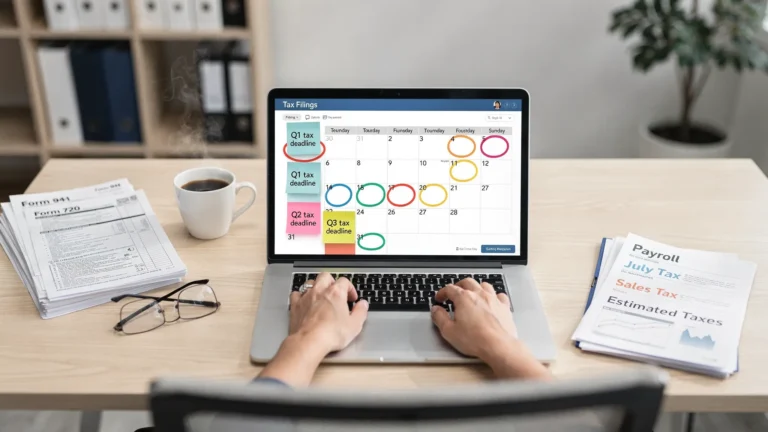
Form 720 is a quarterly return. The due date is the last day of the month that follows the end of the quarter.
-
Q1 due April 30
-
Q2 due July 31
-
Q3 due October 31
-
Q4 due January 31
If your excise tax liability is large you may also have deposit requirements during the quarter. The IRS rules can require semi monthly deposits when net liability exceeds certain thresholds.
How the workflow should look in a well run finance team
A practical workflow that reduces errors looks like this:
| Step | Owner | Output | Why it matters |
|---|---|---|---|
| Invoice line mapping | Billing or finance | Taxable vs non taxable mapping | Prevents wrong tax base |
| Monthly tax base total | Accounting | Running taxable subtotal | Prevents surprises at quarter end |
| Quarter close reconciliation | Controller | Tie to GL and billing reports | Supports audit trail |
| Form 720 preparation and review | Tax or compliance | Draft return and support file | Reduces reject risk |
| Payment and proof of filing | Treasury or AP | Confirmation and records | Avoids penalties |
Trends in 2026 that increase communication service tax risk
Even if the federal rate is steady the business risk changes because billing models change.
Bundling and all in pricing
More providers sell “one seat” pricing that can include voice messaging softphone support and analytics. When bundles are not separated it can be harder to defend what is taxable.
Strategic move: Ask whether your invoices clearly separate communications service charges from other charges. If they do not separate them consider reformatting invoices and contracts.
VoIP and hybrid communications stacks
Many companies now pay multiple vendors for calling plus conferencing plus messaging. A single service may not create a filing obligation but a provider that bills taxable communications service should be sure its tax treatment matches the legal definitions.
Strategic move: Do a quarterly product taxability review especially after a pricing change.
Multi category excise compliance under one return
Form 720 can include many excise categories beyond communications. Some businesses end up filing for other reasons such as the PCORI Fee for certain health plans. Others handle fuel related items such as aviation fuel tax depending on industry.
Strategic move: Build a single Form 720 calendar with owners for each category so one filing does not get missed.

Lessons learned from real world finance teams
These are common patterns that show up when investors or CFOs review compliance after growth.
Example 1: A fast growing VoIP reseller with bundled pricing
A reseller moved to a single monthly seat price to improve sales. Later the team struggled to explain what part of the seat price related to taxable communications service. The fix was not complex. They updated contracts and invoices to separate voice service from non taxable add ons and aligned their reporting to that split.
Lesson: Billing design is a tax control. Do not wait until an audit to clean up invoice structure.
Example 2: A private equity backed service business that only filed Form 720 for PCORI
The company already filed Form 720 annually for PCORI. After an acquisition they began reselling a communications service to customers. The finance team assumed it was covered by existing processes but did not add a quarterly communications review. They later had to amend returns.
Lesson: Acquisitions change tax profiles. Add Form 720 category checks to due diligence.
Filing support with E Eile Excise 720
If you need to file communications taxes on Form 720 you want a process that is fast secure and easy to repeat each quarter.
E Eile Excise 720 is an IRS authorized e filing platform built to simplify Form 720 compliance. It supports Form 720 categories plus amendments on Form 720-X and refund claim workflows that use Form 8849 where applicable.
You can start with a free account then follow a guided dashboard to complete the return. For current pricing and help with your specific filing situation use the site options or contact us for support at eFileExcise720.
Frequently Asked Questions
What is communication service tax in the US?
It often refers to the federal communications excise tax that can apply to certain communications services. It is generally collected by the service provider and reported to the IRS on Form 720.
What is the communication service tax rate?
A common federal rate used for taxable communications services is 3%. Always confirm the correct treatment for your service type using IRS guidance.
Do I need to file Form 720 if I only pay a phone bill?
Usually no. In many cases the business buying the service pays the tax on the invoice while the provider files Form 720 and remits the tax.
What is communications tax filing and who is responsible? Communications tax filing is the process of reporting and paying the federal communications excise tax to the IRS. The party that bills customers for the taxable communications service is often responsible.
How is communication service tax related to PCORI Fee?
They are separate excise items. PCORI is a health plan related fee that is reported on Form 720 while communication service tax is tied to certain communications charges. Some businesses file Form 720 for both depending on what they do.
Can I fix a mistake if I filed the wrong communications tax amount?
Often yes. You may be able to amend prior filings using Form 720-X depending on the situation. Keep strong invoice support and reconcile totals before amending.
File Form 720 online with confidence
If you are responsible for communications excise tax reporting do not leave it to last minute spreadsheets. File your Form 720 online through eFileExcise720 to get an IRS authorized e filing experience with secure handling and customer support. Check pricing on the site then contact us if you want help choosing the right filing path for your business.