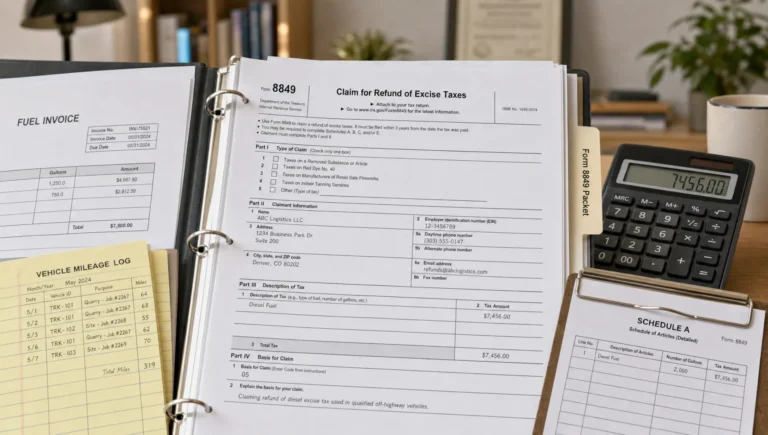
Form Use Guide: Which IRS Excise Forms Fit Your Business?
Choosing the right IRS excise tax form is one of the easiest ways to avoid rejections, rework, and unnecessary notices. Many businesses know they have an excise tax obligation, but they are unsure whether that means filing a quarterly return, amending a prior quarter, or submitting a refund claim. This guide breaks down form use, which IRS excise forms typically apply to which situations, so you can match the right form to the right job.
Start with the “tax event”: what did your business do?
Excise tax forms are activity-driven. The IRS generally cares about what happened (for example, selling certain products, providing certain services, or being responsible for certain fees), then it assigns the reporting to the correct form.
A practical way to narrow it down is to ask:
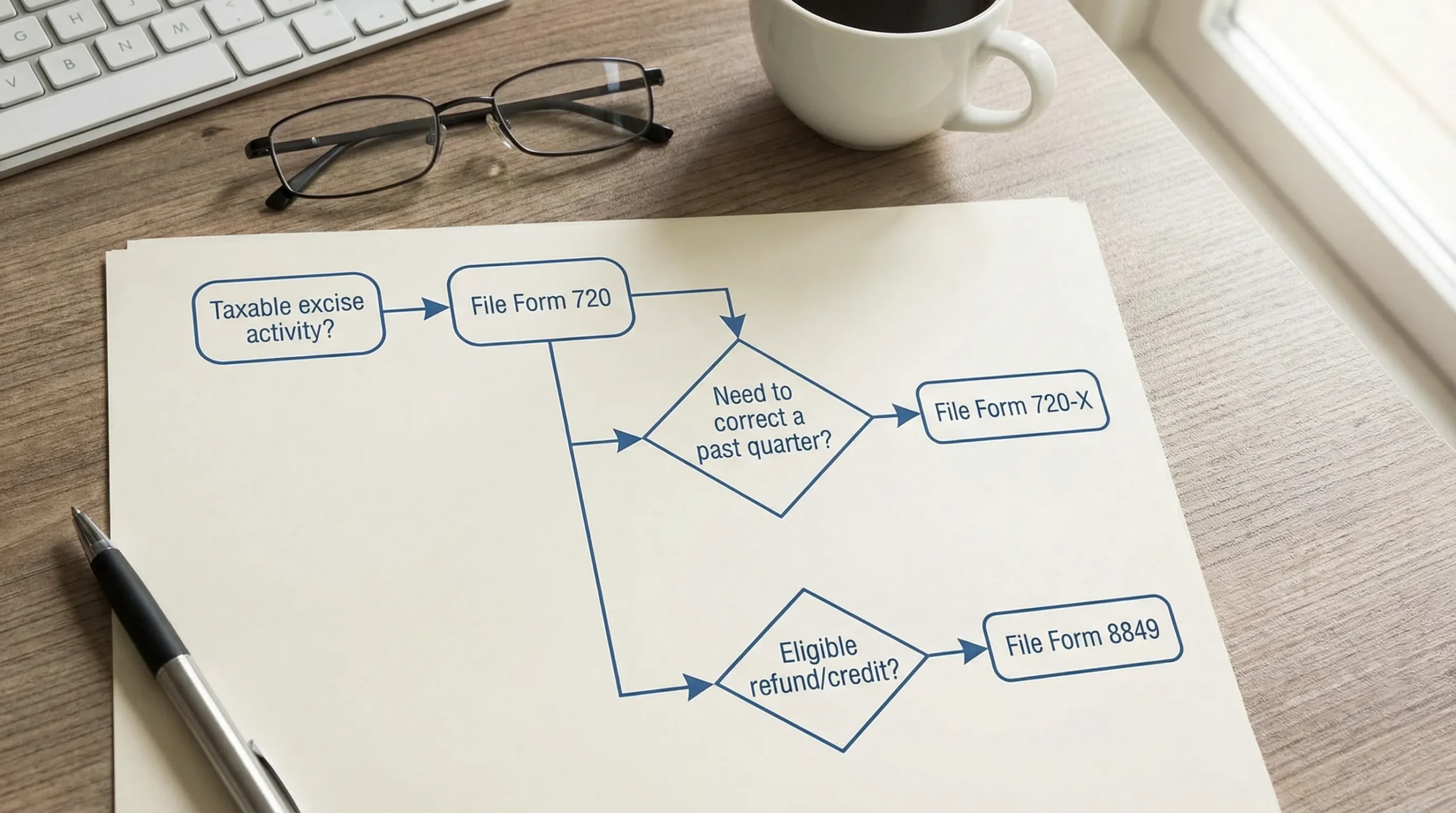
- Did you have excise tax liability for a period? That usually points to a return (most often Form 720).
- Are you fixing a past return? That points to an amendment (often Form 720-X).
- Are you requesting a refund or credit for excise tax already paid? That often points to Form 8849 (or in some cases, a claim process tied to a specific return).
If you are new to excise taxes, the IRS also provides official instructions and form pages you can reference (for example, the IRS Forms and Instructions directory).
The core excise forms most businesses run into
If your excise tax obligations relate to federal excise taxes reported quarterly, most paths lead to the “Form 720 family”: the main return, its amendment, and refund/credit claims.
| Form | Best used for | Typical timing | Common example triggers |
|---|---|---|---|
| Form 720 (Quarterly Federal Excise Tax Return) | Reporting and paying federal excise tax liability | Filed by quarter when you have reportable excise activity (some items are reported on Form 720 on a special schedule) | Fuel taxes, communications and air transportation taxes, certain manufacturing/retail excise taxes, environmental taxes, PCORI fee reporting |
| Form 720-X (Amended Quarterly Federal Excise Tax Return) | Correcting a previously filed Form 720 | After you discover an error in a prior quarter | Underreported or overreported tax in a prior quarter, correcting tax rate, tax code, or taxable quantity |
| Form 8849 (Claim for Refund of Excise Tax) | Requesting certain refunds/credits of excise taxes (often fuel-related, depending on schedule and facts) | Filed when you have an eligible claim and supporting records | Fuel credits/refunds and other excise refund situations supported by Form 8849 schedules |
Form 720 (quarterly): when it fits your business
Use Form 720 when your business has a federal excise tax liability to report for a quarter. A common mistake is thinking Form 720 is only for fuel businesses. In reality, Form 720 covers multiple categories of excise taxes, and many businesses run into it because of the service they provide, the product they sell, or a fee they owe.
Form 720 is organized by tax category and IRS tax numbers. Depending on what applies, you may also need to attach schedules (for example, Schedule A for certain liabilities, Schedule C for claims, and other supporting schedules). Those schedules are part of the Form 720 filing package, not separate “standalone” returns.
Businesses that often need Form 720
While the details depend on your facts and the current IRS rules for the quarter, Form 720 commonly comes up for:
- Fuel-related activities: certain sales, uses, or events involving gasoline, diesel, kerosene, alternative fuels, and related excise taxes.
- Communications: some communications services can trigger excise tax reporting.
- Air transportation: certain amounts paid for taxable transportation of persons or property by air can be involved (often relevant to airlines and some ticketing/transportation flows).
- Manufacturing and retail excise taxes: certain products and sales categories can create liability.
- Environmental taxes: certain chemicals and related categories can apply.
- PCORI fee reporting: the Patient-Centered Outcomes Research Institute fee is reported on Form 720 (it is not a quarterly obligation in the same way as many other excise items, but it is still reported on Form 720).
If you are in a travel or tourism business that handles high volumes of card payments, refunds, and chargebacks, keeping clean payment records can make tax classification and documentation easier, especially when you must reconcile taxable charges versus non-taxable amounts. Some agencies use an all-in-one travel payment platform to centralize payment methods and reconciliation, which can help your finance team maintain clearer audit trails.
Form 720-X (amendment): when you should amend instead of “starting over”
Use Form 720-X when you need to correct a Form 720 you already filed. This is the form that matches the task of fixing a prior quarter.
Typical reasons a business files Form 720-X include:
- Reporting an excise tax under the wrong IRS tax number
- Using the wrong taxable quantity or computation
- Missing a line item that should have been included
- Correcting an overstatement or understatement after reviewing records
720-X vs 8849: which one is the right tool?
A frequent “form use” question is whether to claim money back by amending the return (Form 720-X) or by filing a refund claim (Form 8849). The correct path depends on the nature of the adjustment and the IRS rules for that type of claim.
Here is a practical way to think about it:
| Situation | Often the better fit | Why |
|---|---|---|
| You reported something incorrectly on a prior Form 720 and need to correct the filed quarter | Form 720-X | It is designed specifically for correcting previously reported amounts |
| You have a qualifying excise tax refund/credit claim supported by Form 8849 schedules (commonly fuel-related claims) | Form 8849 | It is designed as a claim form with schedule-based substantiation requirements |
Because excise tax corrections and claims can be fact-specific, many businesses confirm the correct approach using the IRS instructions for the relevant forms and, when needed, a tax professional.
Form 8849 (refund/credit claim): when it fits your business
Use Form 8849 when you have an eligible claim for refund of excise taxes and the claim is properly reported on Form 8849 with the right schedule. In practice, many Form 8849 claims relate to fuel, but Form 8849 includes multiple schedules for different claim types.
Form 8849 is not simply “money back because we overpaid.” It is a structured claim process. The IRS generally expects you to:
- Select the correct schedule for the claim type
- Provide the required details and calculations
- Maintain documentation that supports eligibility (for example, invoices, usage records, or other substantiation required for the claim)
Processing times can vary based on the schedule, the completeness of the claim, and IRS workload, so it is worth building a documentation checklist before filing.
Other IRS excise forms you may hear about (and why they might not be yours)
Form 720 is common, but it is not the only excise-related form in the IRS ecosystem. Depending on your industry, you may also encounter other excise forms such as:
- Form 2290 (Heavy Highway Vehicle Use Tax) for certain highway vehicles.
- Form 730 (Monthly Tax Return for Wagers) for wagering excise taxes.
- Form 11-C (Occupational Tax and Registration Return for Wagering) for certain wagering registrations and occupational taxes.
These forms serve different tax regimes than Form 720. If your obligation is tied to quarterly federal excise taxes reported under Form 720 categories, focus your compliance process around Form 720, plus 720-X and 8849 when corrections or claims apply.
A quick “which form do I use?” checklist
If you want a simple decision framework, use this checklist:
- We had taxable excise activity this quarter: Start with Form 720.
- We already filed Form 720, but found an error: Look at Form 720-X.
- We are seeking an excise tax refund/credit that is claimed via schedules: Look at Form 8849.
- We have attachments or schedules to support the return/claim: Confirm which schedules are required for your tax category.
Common scenarios (and the forms that typically match)
Scenario A: You sell or use fuel in a way that triggers excise tax
Many fuel-related excise taxes are reported on Form 720. If you later discover you misreported gallons, used the wrong tax rate, or selected the wrong tax number, Form 720-X may be the correction tool.
If you have an eligible fuel-related credit/refund situation that belongs on a Form 8849 schedule, Form 8849 is often the right claim path.
Scenario B: You provide taxable transportation or related services
If your business is involved in air transportation-related excise categories, you typically start with Form 720 to report liability for the quarter when the tax applies.
Because transportation businesses often have complex billing (fares, fees, agency commissions, refunds, partial credits), strong reconciliation processes matter. Clean records help you determine what is taxable, what is excluded, and what quarter a transaction belongs in.
Scenario C: You are a plan sponsor that must report the PCORI fee
PCORI is a common source of confusion because it is reported on Form 720, but it is not a “standard quarterly excise tax workflow” for many organizations.
If PCORI applies to your plan arrangement, Form 720 is typically used for reporting. If you later need to correct the reported PCORI amount for the filed period, Form 720-X is the amendment route.
Scenario D: You filed the right form, but the IRS rejected or questioned it
An IRS rejection is usually a filing or data-validation issue, not a sign you picked the wrong form. In these cases:
- For a rejected Form 720, you usually correct the issue and resubmit the Form 720.
- For a discovered error after acceptance, you usually evaluate Form 720-X.
If you are unsure whether it is a correction versus a claim, compare the nature of the change: “fix what we filed” usually points to 720-X, while “claim a refund/credit” often points to 8849 when the claim type belongs on Form 8849.
Compliance tip: match your internal records to the quarter and the tax code
Excise tax compliance becomes significantly easier when your bookkeeping or operational reporting can answer three questions quickly:
- What happened? (taxable product sold, taxable service provided, fee owed)
- When did it happen? (the quarter matters for Form 720)
- How does the IRS want it coded? (the applicable IRS tax number and schedule)
A lot of excise tax errors are not math errors. They are classification and timing errors.
Frequently Asked Questions
Is Form 720 only for fuel taxes? No. Fuel is a major category, but Form 720 covers multiple federal excise tax categories, including communications, air transportation, certain manufacturing/retail excise taxes, environmental taxes, and PCORI fee reporting.
If I made a mistake on a previously filed Form 720, can I just file a new Form 720? Typically, no. If the original quarter was already filed, the usual path is to correct it with Form 720-X rather than submitting a duplicate original return.
What is the difference between Form 720-X and Form 8849? Form 720-X is used to amend a previously filed Form 720. Form 8849 is used to claim certain refunds or credits of excise taxes using the appropriate Form 8849 schedule, often for fuel-related claim types.
Do I need to file Form 720 even if I owe zero? It depends. Some businesses file “zero returns” to stay compliant for quarters where they are registered/expected to file, while others may not have a filing requirement without reportable activity. Confirm the requirement for your tax situation using the current IRS guidance or a tax professional.
Can I e-file Form 720, 720-X, and Form 8849? Yes, these forms can be e-filed through IRS-authorized providers, subject to IRS rules and the provider’s supported forms and categories.
File the right excise form online (without the guesswork)
If you have identified the correct form, or you are deciding between Form 720, Form 720-X, and Form 8849, eFileExcise720 helps you file online through an IRS-authorized e-filing portal. You can create an account for free, file without downloading software, and get dedicated customer support while keeping your data protected with secure handling.
To get started, visit eFileExcise720 and choose the excise form that matches your situation.