Business IRS Form Guide: Common Forms and When to Use Them
Running a business means dealing with more than one tax return. An income tax return may get the most attention, but it is only one piece of the compliance picture. Hiring an employee, paying a contractor, selling a taxable product, claiming an excise tax refund, or changing your entity classification can each trigger a different IRS form.
This business IRS form guide explains the common forms U.S. businesses encounter, what each one is used for, and when it typically comes into play. It is designed as a practical roadmap, not a substitute for advice from a CPA, enrolled agent, or tax attorney.
Start with the trigger, not the form number
The easiest way to choose the right IRS form is to start with the business event. Ask what happened first, then match that event to the form the IRS uses to collect, report, correct, or refund tax information.
Common triggers include starting a business, hiring workers, paying nonemployees, filing annual income taxes, reporting payroll taxes, reporting federal excise taxes, correcting a prior filing, or claiming a refund. The same business may use several forms in the same year because each form serves a different purpose.
The IRS also treats business tax obligations differently depending on your entity type, tax election, payroll status, industry, and taxable activities. A single-member LLC taxed as a sole proprietorship, for example, usually reports business income differently from an S corporation. A fuel distributor or indoor tanning business may also have federal excise tax obligations that a typical service business does not.
For broad IRS background, the IRS maintains a helpful overview of business taxes for small businesses and self-employed taxpayers.
Quick reference: common business IRS forms and when to use them
The table below is not exhaustive, but it covers many forms businesses commonly ask about.
| IRS form | Common purpose | When businesses typically use it |
|---|---|---|
| Form SS-4 | Apply for an Employer Identification Number | When starting a business, hiring employees, opening business bank accounts, or needing a federal tax ID |
| Form W-9 | Request taxpayer information from a vendor or contractor | Before paying an independent contractor or vendor that may need a 1099 |
| Form W-4 | Employee withholding certificate | When hiring an employee or when an employee updates federal withholding |
| Form 941 | Employer’s quarterly federal tax return | To report federal income tax withholding, Social Security tax, and Medicare tax for employees |
| Form 940 | Annual FUTA tax return | To report federal unemployment tax for employers |
| Forms W-2 and W-3 | Wage reporting for employees | After year-end to report employee wages and transmit W-2 data |
| Form 1099-NEC | Nonemployee compensation reporting | To report qualifying payments to independent contractors and certain service providers |
| Form 1099-MISC | Miscellaneous income reporting | To report certain rents, prizes, awards, royalties, and other miscellaneous payments |
| Schedule C | Profit or loss from business | Used with Form 1040 by many sole proprietors and single-member LLCs |
| Form 1065 | Partnership return | For partnerships and many multi-member LLCs taxed as partnerships |
| Form 1120-S | S corporation return | For corporations or LLCs with a valid S corporation election |
| Form 1120 | C corporation income tax return | For C corporations and some LLCs taxed as corporations |
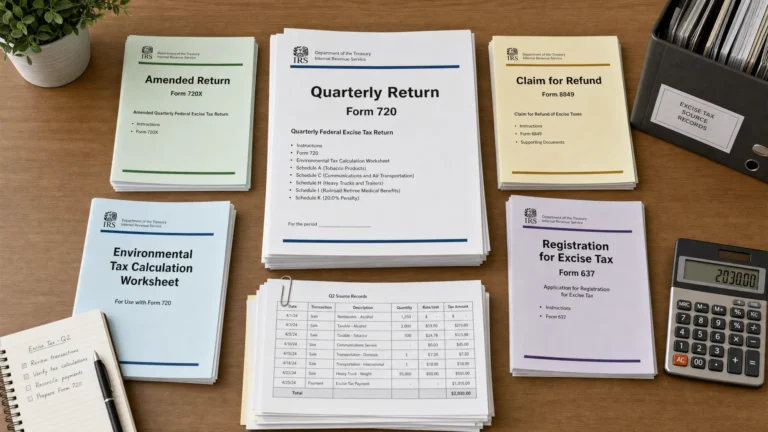
| Form 720 | Quarterly Federal Excise Tax Return | To report many federal excise taxes, such as fuel, environmental, communications, air transportation, indoor tanning, and PCORI fees |
| Form 720-X | Amended Quarterly Federal Excise Tax Return | To correct certain previously filed Form 720 information |
| Form 8849 | Claim for Refund of Excise Taxes | To claim certain excise tax refunds or credits using the proper schedule |
| Form 2290 | Heavy Highway Vehicle Use Tax Return | For taxable heavy highway motor vehicles used on public highways |
| Form 8300 | Report of cash payments over $10,000 | When a trade or business receives more than $10,000 in cash in one transaction or related transactions |
| Form 7004 | Extension for certain business returns | To request an automatic extension for many business income tax returns |
Startup and entity forms: setting up the business correctly
Before a business files income, payroll, or excise tax returns, it needs the right tax identity. These setup forms often affect every later filing.
Form SS-4: Apply for an EIN
Form SS-4 is used to apply for an Employer Identification Number, commonly called an EIN. Many businesses need an EIN to hire employees, open bank accounts, file employment tax returns, file certain excise tax returns, or operate as a corporation or partnership.
Even if a sole proprietor can sometimes use a Social Security number for federal tax purposes, an EIN is often useful for separating business and personal records. If your business will file Form 720, Form 941, Form 940, or many other business returns, you will generally need accurate EIN information on those filings.
Form 2553 and Form 8832: Entity tax elections
Entity type and tax classification are not always the same thing. A state-law LLC, for example, may be taxed as a disregarded entity, partnership, C corporation, or S corporation depending on ownership and elections.
Form 2553 is used by eligible entities to elect S corporation status. Form 8832 is used for certain entity classification elections. These forms can have major tax consequences, including how profits are reported, whether payroll must be run for owner-employees, and which annual return the business files.
Because entity elections have eligibility rules and deadlines, businesses should confirm the best option with a qualified tax professional before filing.
Forms W-9 and W-4: Collect the right worker information
Form W-9 is usually collected from independent contractors, vendors, and certain payees. It gives the business the payee’s legal name, tax classification, and taxpayer identification number so the payer can issue the correct information return, such as Form 1099-NEC or Form 1099-MISC.
Form W-4 is for employees. It tells the employer how to withhold federal income tax from wages. Mixing up W-9 and W-4 can signal a deeper worker classification problem. If a worker is legally an employee, treating that person as a contractor can create payroll tax, penalty, and benefits issues.
Annual income tax forms: match the return to the business structure
Every business needs to report income, but the form depends on how the business is taxed. The form you use for annual income tax is usually different from the forms used for payroll taxes, excise taxes, or information reporting.
| Business structure or tax status | Common annual IRS form | What it generally reports |
|---|---|---|
| Sole proprietor | Schedule C with Form 1040 | Business profit or loss reported on the owner’s individual return |
| Single-member LLC taxed as disregarded entity | Schedule C with Form 1040, in many cases | Business income reported by the owner unless another election applies |
| Partnership | Form 1065 | Partnership income, deductions, and Schedule K-1 allocations |
| Multi-member LLC taxed as partnership | Form 1065 | LLC activity reported under partnership tax rules |
| S corporation | Form 1120-S | Corporate income, deductions, and shareholder Schedule K-1 items |
| C corporation | Form 1120 | Corporate income tax return |
| Tax-exempt organization | Form 990 series, depending on facts | Annual information reporting for many exempt organizations |
For calendar-year businesses, partnership and S corporation returns are commonly due around March 15, while many sole proprietor and C corporation returns are commonly due around April 15. Exact deadlines can vary by fiscal year, weekend, holiday, disaster relief, or IRS updates.
Form 7004 is often used to request an extension for certain business returns, including many partnership and corporate returns. Sole proprietors usually use the individual extension process rather than Form 7004 for Schedule C filings. An extension generally gives more time to file, not more time to pay tax due.
Payroll and contractor forms: what changes when you pay people
The moment a business pays workers, tax compliance becomes more complicated. The main question is whether the worker is an employee or an independent contractor. That classification determines which IRS forms apply.
Employees: W-4, Form 941, Form 940, W-2, and W-3
When you hire employees, you generally collect Form W-4 and begin withholding payroll taxes. Most employers report federal income tax withholding, Social Security tax, and Medicare tax on Form 941 each quarter. The IRS provides more detail on Form 941 and its instructions.
Employers may also need to file Form 940 annually to report federal unemployment tax. After year-end, employers issue Form W-2 to employees and transmit wage information to the Social Security Administration, commonly with Form W-3 when required.
Payroll tax compliance also includes tax deposits, not just form filing. Larger liabilities may require deposits before the quarterly return is due. Businesses should use the IRS deposit schedule that applies to their payroll profile and keep proof of timely payments.
Contractors: W-9, Form 1099-NEC, and Form 1099-MISC
If your business pays independent contractors, collect Form W-9 before payment whenever possible. That makes year-end reporting easier and reduces the risk of missing taxpayer identification numbers.
Form 1099-NEC is commonly used to report nonemployee compensation. Form 1099-MISC is used for certain other payment categories, such as some rents, royalties, prizes, and awards. The IRS provides form-specific information on Form 1099-NEC.
Many information returns have January filing or recipient deadlines, especially Form 1099-NEC and Form W-2. Electronic filing requirements can also apply when a business meets IRS thresholds, so businesses that issue multiple forms should confirm current e-file rules each year.
Excise tax forms: when ordinary income tax forms are not enough
Federal excise taxes are separate from income taxes and payroll taxes. They apply to specific goods, services, industries, and activities. A business can be profitable, unprofitable, or even have no income tax due and still have an excise tax filing requirement.
That is where Form 720 becomes important. IRS Form 720, Quarterly Federal Excise Tax Return, is used to report many federal excise taxes. Examples can include fuel-related taxes, environmental taxes, communications taxes, air transportation taxes, indoor tanning services, certain manufacturer taxes, and the PCORI fee for applicable health plans.
The IRS provides official information on Form 720, and you can also review this plain-English guide to what Form 720 is and how it works.
| Excise-related situation | IRS form commonly involved | Practical example |
|---|---|---|
| Reporting quarterly federal excise tax | Form 720 | A business reports taxable indoor tanning services, fuel-related tax, environmental tax, or PCORI fees |
| Correcting a previously filed Form 720 | Form 720-X | A filer discovers an error in a prior quarter’s excise tax return |
| Claiming certain excise tax refunds | Form 8849 | A business claims a refund for eligible excise tax using the appropriate schedule |
| Reporting heavy highway vehicle use tax | Form 2290 | A trucking business reports taxable heavy vehicles used on public highways |
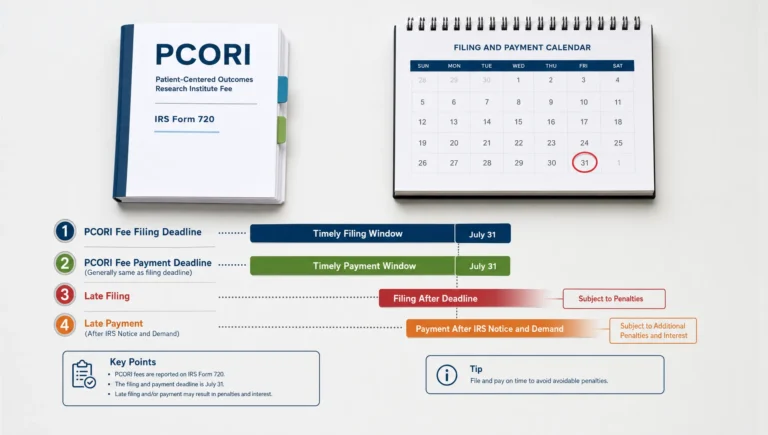
Form 720 is generally filed quarterly, with due dates on the last day of the month following the end of the quarter. For example, a first-quarter return is generally due April 30, and a second-quarter return is generally due July 31. If a due date falls on a weekend or legal holiday, the deadline generally moves to the next business day.
One common point of confusion is the difference between Form 720, Form 720-X, and Form 8849. Form 720 reports current-quarter excise tax. Form 720-X amends certain prior Form 720 filings. Form 8849 is generally used for eligible refund claims. If you are unsure which path applies, this comparison of Form 720 vs. Form 8849 can help.
Other business IRS forms that appear in specific situations
Some business IRS forms are less universal, but they are very important when triggered. Missing them can cause penalties, delayed refunds, or IRS notices.
| Situation | Form to know | When to pay attention |
|---|---|---|
| Receiving large cash payments | Form 8300 | When a trade or business receives more than $10,000 in cash in one transaction or related transactions |
| Nonpayroll withholding | Form 945 | When reporting certain federal income tax withheld from nonpayroll payments |
| Applicable large employer health coverage reporting | Forms 1094-C and 1095-C | When an employer is subject to ACA employer reporting rules |
| Payments to foreign persons | Forms 1042 and 1042-S | When withholding and reporting may apply to certain U.S.-source payments to foreign persons |
| Foreign ownership or cross-border reporting | Forms 5471, 5472, or related forms | When the business has certain foreign owners, foreign corporations, or reportable transactions |
Form 8300 is especially important for businesses that receive large cash payments, such as auto dealers, jewelers, construction businesses, and other trades. The IRS offers more detail on Form 8300 cash reporting.
These specialized forms are fact-sensitive. If your business has foreign owners, foreign subsidiaries, large cash receipts, or complex withholding obligations, get professional guidance early rather than waiting until tax season.
A practical deadline rhythm for business IRS forms
Instead of thinking about IRS forms once a year, businesses should build a compliance calendar. Many business forms are event-based, quarterly, or due shortly after year-end.
| Timing | Forms commonly involved | Compliance habit |
|---|---|---|
| Business formation | SS-4, 2553, 8832 | Confirm EIN needs and tax classification before operations scale |
| Before paying workers or vendors | W-4, W-9 | Collect accurate information before the first payment |
| Each payroll period | Payroll deposits, withholding records | Track tax deposits and employee withholding data |
| Quarterly | Form 941, Form 720 when applicable | Review payroll and excise tax obligations before due dates |
| January | W-2, W-3, 1099-NEC, many 1099 recipient statements, Form 940 | Close payroll and contractor records quickly after year-end |
| March or April for many calendar-year businesses | Form 1065, 1120-S, 1120, Schedule C with Form 1040 | File annual income tax returns or extensions based on entity type |
| July 31 for many PCORI filers | Form 720 | Report applicable PCORI fees on the second-quarter Form 720 filing |
| After discovering an excise tax error or overpayment | Form 720-X or Form 8849 | Determine whether an amendment or refund claim is the correct route |
A business that waits until the annual income tax return to review compliance may miss quarterly payroll or excise filings. This is why monthly or quarterly closing procedures are useful, even for smaller companies.
Common mistakes when choosing a business IRS form
Choosing the wrong form usually happens when a business focuses on the tax category too broadly. “Business tax” could mean income tax, payroll tax, excise tax, information reporting, withholding, or refund claims. Each category has its own forms and deadlines.
| Mistake | Why it causes problems | Better approach |
|---|---|---|
| Assuming the annual income tax return covers all IRS obligations | Payroll, excise, and information returns may be due separately | Track obligations by activity, not just by entity type |
| Treating employees as contractors without analysis | It can lead to payroll tax liabilities and penalties | Review worker classification before choosing W-2 or 1099 reporting |
| Using Form 8849 when the issue is really a Form 720 correction | Refund claims and amended returns serve different purposes | Compare Form 720-X and Form 8849 before filing |
| Ignoring Form 720 because the business is small | Excise tax obligations depend on activity, not business size | Check whether your products, services, or benefits trigger excise tax |
| Missing deposit rules | Filing the return does not always mean the tax was paid on time | Track deposit obligations separately from return due dates |
| Waiting until January to collect W-9 forms | Missing or incorrect TINs can delay 1099 preparation | Collect W-9 forms before vendor payment |
| Using outdated IRS instructions | Rates, thresholds, and requirements can change | Review current IRS instructions for the filing year |
The most reliable process is to create a form map for your business. List your entity type, employees, contractors, products, services, benefit plans, vehicles, payment methods, and any regulated activities. Then match each item to the forms and deadlines it may trigger.
When eFileExcise720 fits into your business tax workflow
Not every business IRS form belongs in the same filing system. Payroll forms may be handled by a payroll provider, income tax returns may be prepared by a CPA, and certain information returns may be filed through other IRS-authorized channels.
For federal excise tax compliance, eFileExcise720 helps businesses file Form 720 online through an IRS-authorized e-filing platform. It is designed for businesses that need to report quarterly federal excise taxes without downloading software. The platform also supports Form 720 amendments through Form 720-X and excise tax refund claims through Form 8849.
This can be especially useful for businesses in industries such as fuel, transportation, environmental products, indoor tanning, communications, manufacturing, and employers or plan sponsors dealing with PCORI fee reporting. With secure data handling, simple dashboard navigation, free account creation, and personalized customer support, eFileExcise720 can help reduce friction in a filing category that many businesses find confusing.
If you are planning your next quarterly excise filing, review the current Form 720 due date guide and gather your source records before you start the return.
Frequently Asked Questions
What IRS form does a small business use to file taxes? It depends on how the business is taxed. Many sole proprietors use Schedule C with Form 1040, partnerships use Form 1065, S corporations use Form 1120-S, and C corporations use Form 1120. A business may also need payroll, contractor, excise, or information reporting forms.
Is IRS Form 720 required for every business? No. Form 720 is activity-based. It is required when a business has reportable federal excise tax activity, such as certain fuel, environmental, communications, air transportation, indoor tanning, manufacturer, or PCORI fee obligations.
What is the difference between Form 720 and Form 8849? Form 720 is used to report quarterly federal excise tax liabilities. Form 8849 is used to claim certain refunds of excise taxes. If you are correcting a previously filed Form 720, Form 720-X may be the more appropriate form.
Which IRS forms do I need when hiring employees? Common forms include Form W-4 for employee withholding, Form 941 for quarterly payroll tax reporting, Form 940 for annual FUTA tax reporting, and Forms W-2 and W-3 for year-end wage reporting.
Do LLCs have their own IRS tax form? Not always. An LLC’s federal tax form depends on how it is classified for tax purposes. A single-member LLC may use Schedule C, a multi-member LLC may use Form 1065, and an LLC that elects corporate tax treatment may use Form 1120 or Form 1120-S.
Can business IRS forms be filed electronically? Many business IRS forms can be e-filed, but availability depends on the form, tax year, provider, and IRS rules. For federal excise tax filings, eFileExcise720 provides IRS-authorized e-filing for Form 720, with support for Form 720-X amendments and Form 8849 claims.
File federal excise tax forms with more confidence
If your business needs to report federal excise taxes, correct a prior Form 720 filing, or submit an excise tax refund claim, you do not have to manage the process manually. eFileExcise720 provides IRS-authorized online filing for Form 720, supports Form 720-X amendments and Form 8849 claims, and offers customer support to help you move through the process securely.
Create a free account, gather your excise tax records, and start your next filing online with eFileExcise720.