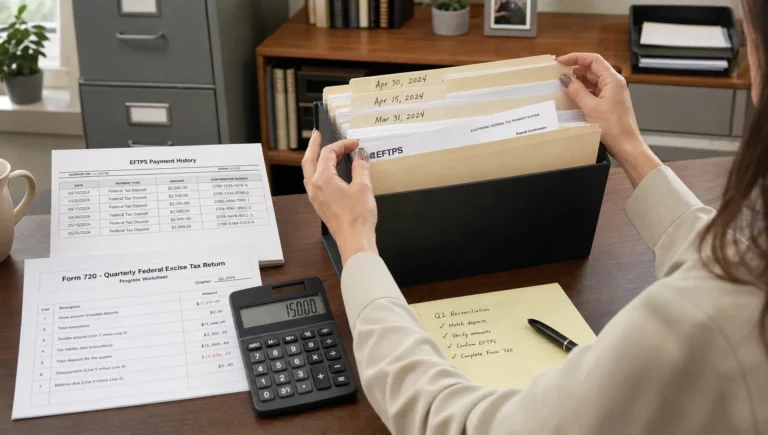
form 720 filing massachusetts
form 720 filing massachusetts
Massachusetts businesses that manufacture, import, sell, or provide certain regulated products and services may owe federal excise taxes. When those taxes apply, the IRS generally requires a quarterly filing on Form 720 (Quarterly Federal Excise Tax Return). This requirement is federal, not Massachusetts state tax, but it often affects Massachusetts-based companies in transportation, fuel distribution, manufacturing, healthcare benefits, and more.
This page explains form 720 filing Massachusetts requirements in plain language, what taxes commonly trigger a filing, and how to submit an accurate return online.
What is IRS Form 720 and why Massachusetts businesses file it?
IRS Form 720 is used to report and pay specific federal excise taxes. Excise taxes are often “transaction-based,” meaning they apply when you sell, use, import, or provide something taxable (for example, certain fuel activities or air transportation).
If you have a filing obligation, you typically file Form 720 every quarter, even if you are located and operating entirely in Massachusetts. In other words, form 720 Massachusetts rules depend on your taxable activity, not your state.
For a plain-English overview of the form itself, see this guide to Form 720.
Who needs to file Form 720 in Massachusetts?
You may need to file IRS Form 720 Massachusetts if your business has liability for one or more federal excise taxes reported on Form 720. Common filer profiles in Massachusetts include:
- Fuel-related businesses (distribution, blending, certain uses of fuel)
- Transportation-related businesses (including certain air transportation taxes)
- Manufacturers, importers, or sellers of goods subject to federal excise taxes
- Organizations responsible for the PCORI fee (often employers and plan sponsors with certain self-insured health plans)
- Businesses liable for communications-related excise taxes (where applicable)
If you are unsure, a good starting point is to identify what you sell or what services you provide, then match it to the IRS Form 720 tax categories and IRS “numbers” (the form uses IRS numbers to label each tax).
For additional context on who is commonly required to file, you can reference this article: 720 irs form.
Common federal excise taxes reported on Form 720 (key categories)
Form 720 covers multiple categories of federal excise tax. The exact taxes that apply depend on your activities, products, and industry. Below are several of the most common categories Massachusetts businesses ask about.
| Form 720 category (examples) | What it generally relates to | Typical Massachusetts connection |
|---|---|---|
| Fuel taxes | Taxable fuel activities and certain fuel-related transactions | Fuel distributors, fleets, marine operators, logistics |
| Environmental taxes | Certain chemicals and imported substances, and other environmental excise taxes (as applicable) | Manufacturers, importers, industrial supply chains |
| Communications and air transportation taxes | Certain communications taxes and air travel related excise taxes | Travel-related businesses, aviation activities |
| Manufacturers taxes | Certain manufacturer-level excise taxes | Manufacturing and specialty products |
| Retail taxes | Certain retail excise taxes | Applicable retail segments |
| Foreign insurance taxes | Excise tax on certain policies issued by foreign insurers | Businesses buying coverage from foreign insurers |
| PCORI fee | Patient-Centered Outcomes Research Institute fee reported on Form 720 (typically annually, using Form 720) | Employers and plan sponsors with certain self-insured plans |
| Indoor tanning services tax (when applicable) | Federal excise tax on indoor tanning services (if applicable under current rules) | Service providers (only if the tax applies) |
If you are filing specifically for the PCORI fee, review form 720 pcori.
If you may be eligible for a credit or refund claim related to excise taxes, you may also need form 8849 (Claim for Refund of Excise Taxes), depending on your situation.
Form 720 due dates (quarterly filing schedule)
For most filers, Form 720 is due quarterly. The standard due dates are:
| Quarter you are reporting | Typical due date |
|---|---|
| Q1 (Jan, Feb, Mar) | April 30 |
| Q2 (Apr, May, Jun) | July 31 |
| Q3 (Jul, Aug, Sep) | October 31 |
| Q4 (Oct, Nov, Dec) | January 31 |
If a due date falls on a weekend or federal holiday, the deadline generally shifts to the next business day.
Keep in mind: some taxpayers with larger excise tax liabilities may have separate federal deposit requirements during the quarter (often made via EFTPS). Filing Form 720 still matters even if deposits are required.
For the latest reminders, see the due date guide here: Form 720.
How to file Form 720 online from Massachusetts (simple process)
For many Massachusetts businesses, online filing is the most practical way to improve accuracy and receive confirmation that the return was accepted. With online filing Massachusetts users can submit the federal return without printing and mailing paper forms.
A straightforward filing process usually looks like this:
- Confirm which excise taxes apply to your business for the quarter (or for PCORI, the applicable period)
- Gather supporting totals (sales, gallons, units, premiums, covered lives, or other tax base depending on the category)
- Complete Form 720 with the correct IRS numbers and amounts
- Include any required schedules or supporting forms (only if they apply)
- Review for common errors (wrong quarter, mismatched EIN/business name, incorrect IRS numbers)
- Transmit the return and keep a copy of the accepted filing for your records
If you need to amend a previously filed return, the IRS generally uses Form 720-X (Adjusted Quarterly Federal Excise Tax Return). eFileExcise720 supports Form 720 amendments (720-X) and Form 8849 claims support (when applicable).

Massachusetts-specific tips to file accurately
Even though Form 720 is federal, Massachusetts businesses often run into a few predictable issues:
Multi-location and multi-activity reporting
If you operate in Massachusetts and also ship, import, or perform taxable activities across state lines, your excise tax calculations may rely on operational records (invoices, bills of lading, usage logs, flight segments, plan documents, or similar documentation). Keeping clean quarterly totals makes Form 720 preparation significantly easier.
PCORI fee (common for employers)
Many employers in Massachusetts that sponsor certain self-insured health coverage may have a PCORI filing obligation, even if they do not think of themselves as an “excise tax business.” The PCORI fee is reported on Form 720 (typically once per year, using Form 720), so it is important to select the correct period and compute covered lives using an IRS-accepted method.
Avoiding IRS rejections and notices
The IRS commonly rejects or delays returns for mismatched business information, wrong quarter selection, or incorrect tax codes. Before transmitting, verify:
- EIN and legal business name match IRS records
- Correct tax period/quarter is selected
- Amounts map to the right Form 720 line and IRS number
- You included schedules only when required
Filing with eFileExcise720 (IRS-authorized e-file)
eFile Excise720 is an IRS-authorized online platform that helps taxpayers e-file Form 720 without downloading software. Massachusetts businesses can create an account, prepare the return, and submit it electronically with secure data handling and access to customer support when questions come up.
If you are budgeting for filing, review IRS Form 720 Cost to understand pricing and what may affect it (for example, filing frequency and which schedules apply).
To understand how e-filing compares with mailing a paper return, see: file 720 online.
Frequently Asked Questions
Is Form 720 a Massachusetts state tax form? Form 720 is a federal IRS form used to report federal excise taxes. Massachusetts may have separate state tax obligations, but Form 720 is filed with the IRS.
Do I need to file Form 720 every quarter if I am in Massachusetts? If you have a Form 720 filing requirement for a tax category, you generally file quarterly for those liabilities. Some items, like PCORI, are commonly reported annually on Form 720, even though the form is a quarterly return.
What if I made a mistake on a prior Form 720? The IRS generally uses Form 720-X to adjust a previously filed Form 720. Supporting claims may also involve Form 8849, depending on the situation.
Can I e-file IRS Form 720 from Massachusetts? Yes. Massachusetts businesses can e-file Form 720 through an IRS-authorized provider rather than mailing a paper return.
File Form 720 online in Massachusetts with IRS-compliant accuracy
If your business has a federal excise tax obligation, timely and accurate filing matters. eFileExcise720 helps form 720 filing Massachusetts taxpayers submit IRS Form 720 online in a secure, IRS-authorized way, with a clear workflow and support when you need it. Start your form 720 e file Massachusetts filing today at eFileExcise720 to complete your return accurately and stay compliant with IRS rules.