Free Tax Filing E File: How It Works and Who Qualifies
Typing “free tax filing e file” into Google usually means one thing: you want to submit a tax return online without paying for software, and you want to know whether you qualify.
That’s a smart goal, but it’s also where many taxpayers and businesses get tripped up. “Free” depends on the type of tax return (income tax vs. excise tax), the forms you need, and whether you need help preparing the return or just a way to transmit it electronically.
Below is a clear breakdown of how free e-file options work, who qualifies, and what to do if you’re filing specialized federal excise forms like IRS Form 720.
What “free tax filing e file” actually means
When people say “free e-file,” they can mean different things:
- Free tax preparation + free electronic filing (typical with IRS Free File partner offers, or VITA sites)
- Free electronic filing but you prepare the return yourself (often “fillable forms” style)
- Free federal filing, but state filing costs extra (common with many commercial offers)
- Free account creation, but the filing itself has a fee (common for specialized business tax forms)
So the first step is clarifying what you’re filing.
Income tax vs. excise tax (why it matters)
Most “free e-file” programs are built around individual income tax returns (Form 1040 series). If you’re trying to file a federal excise tax return such as Form 720 (Quarterly Federal Excise Tax Return), the toolset and pricing model are usually different, because the form is business-focused, category-driven, and often requires industry-specific inputs.
How e-file works (in plain English)
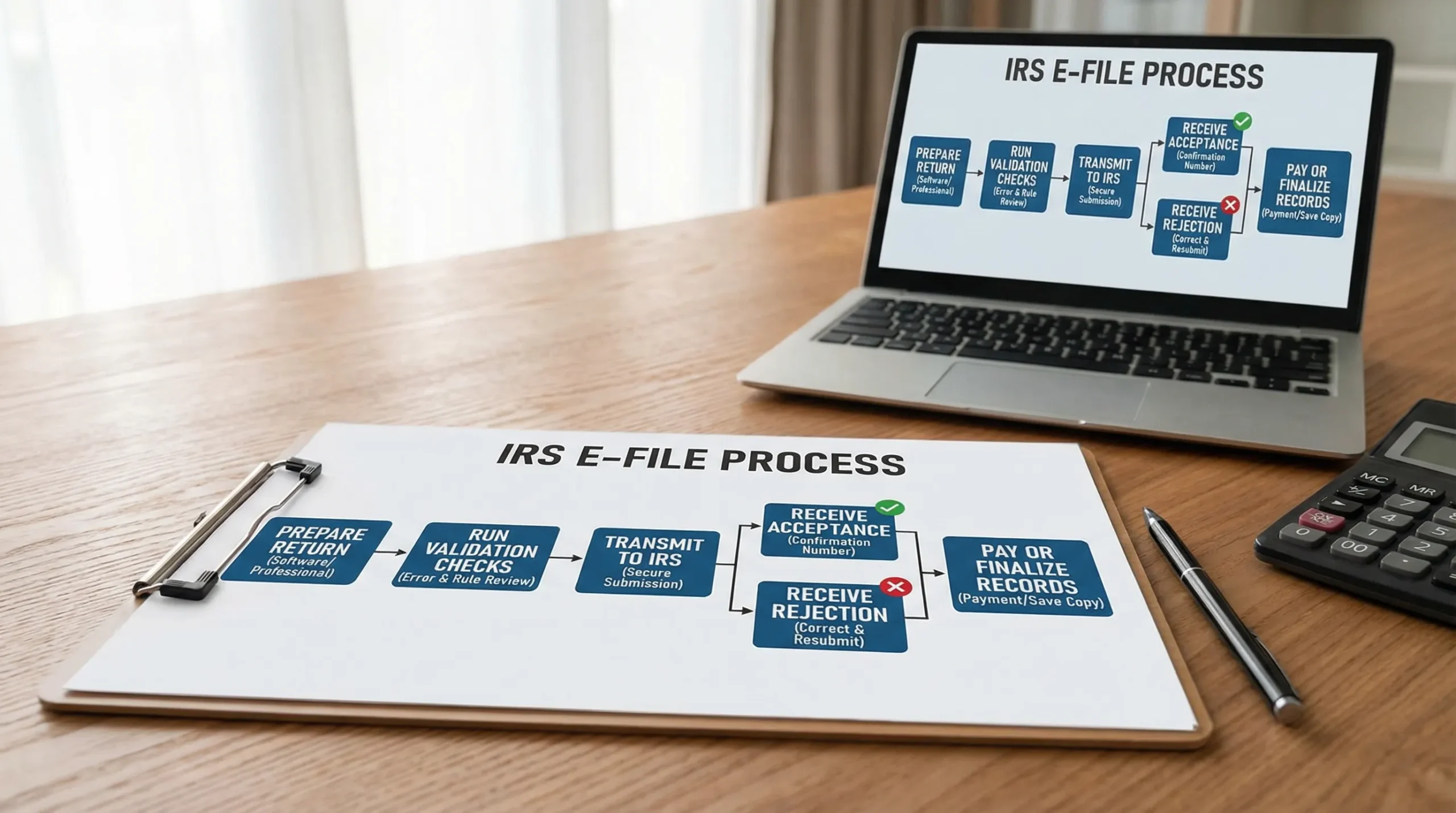
Whether you’re filing a Form 1040 or a business excise return, the basic e-file flow is similar:
- Prepare the return: You enter taxpayer/business details, then report amounts on the correct forms/lines.
- Validation checks: Good e-file systems run checks for missing fields, formatting errors, and basic math.
- Electronic transmission: The return is transmitted to the IRS through an authorized e-file channel.
- IRS acceptance or rejection: You receive an electronic acknowledgment. If rejected, you correct issues and retransmit.
- Payment or refund handling: Depending on the return, you pay electronically (or schedule payment) or receive refunds through IRS processes.
The biggest practical benefit of e-filing is fast confirmation and fewer preventable errors, compared with printing and mailing.
Who qualifies for free tax filing e-file options
There are several legitimate ways to file for free, but they target different audiences.
1) IRS Free File (federal income tax)
The IRS runs the IRS Free File program for eligible taxpayers, allowing qualified filers to use guided software from partner providers at no cost for federal returns.
Key point: the income eligibility threshold changes by filing season, so it’s best to confirm the current year’s limit directly on the IRS website.
- Official resource: IRS Free File
If you’re above the income threshold, you may still be able to e-file using Free File Fillable Forms, which are more do-it-yourself and provide fewer guided prompts.
- Learn more: Free File Fillable Forms
2) VITA and TCE (in-person free help)
If your situation is straightforward and you want human help, the IRS-supported volunteer programs are worth checking:
-
VITA (Volunteer Income Tax Assistance): free tax help for eligible individuals
-
TCE (Tax Counseling for the Elderly): specialized support for older taxpayers
-
Official locator: Find a free tax prep site (VITA/TCE)
3) MilTax (for eligible military community members)
Members of the military community may qualify for free tax preparation and e-filing through MilTax.
- Official source: MilTax
4) State “free file” programs (state returns)
Some states offer their own free filing portals or participate in separate free-file initiatives. Availability varies widely, and eligibility is state-specific.
What free e-file typically covers (and what it usually does not)
To avoid surprises, here’s a practical comparison of common “free e-file” routes and which forms they usually target.
| Free filing route | Best for | Typically includes | Common limitations |
|---|---|---|---|
| IRS Free File partner offers | Individuals who meet the annual income threshold | Federal Form 1040 and many related schedules | Eligibility rules vary by provider; state filing may not be included |
| Free File Fillable Forms | Confident DIY filers | Federal income tax forms (self-prepared) | Minimal guidance; higher risk of user error |
| VITA/TCE | Eligible taxpayers who want in-person help | Federal returns, sometimes state returns | Appointment availability, scope limits for complex situations |
| MilTax | Eligible military community members | Federal filing (and often state support depending on situation) | Eligibility requirements |
If you’re searching “free tax filing e file” but your tax obligation is not an income tax return, you’ll want to confirm that your form is supported.
So, can you e-file Form 720 for free?
In most cases, “free e-file” programs are not designed for Form 720, because Form 720 is a quarterly federal excise tax return used to report certain excise tax liabilities (fuel, environmental taxes, communications, PCORI fee reporting, and more depending on the filer’s activities).
If you file Form 720, you’re usually a business, plan sponsor, or another organization with a recurring compliance need. The priority becomes:
- Filing through an IRS-authorized e-file solution
- Correctly mapping activity to the right Form 720 lines/categories
- Maintaining documentation (especially for fuel and environmental categories)
- Handling corrections with Form 720-X or claims via Form 8849 when applicable
If you’re new to Form 720, these two primers may help you confirm which path applies:
How Form 720 e-filing works with eFileExcise720 (and what is actually free)
eFileExcise720 is positioned for filers who need to submit Form 720 online using an IRS-authorized portal. Based on the site’s published offer summary, it includes:
- IRS-authorized e-filing
- Free account creation
- No software download needed
- Personalized customer support
- Secure data protection
- Dashboard-based navigation
- Support for all Form 720 categories
- Support for Form 720 amendments (720-X)
- Support for Form 8849 claims
Important clarification: “free tax filing e file” can be interpreted as “the return itself costs nothing.” For Form 720, that is often not how filing tools are priced. eFileExcise720 offers free account creation, but you should review any filing fees during checkout or pricing screens (and compare them to the time and risk cost of paper filing).
You can start here to see the platform and filing entry points:
When eFileExcise720 is the right fit
Consider an IRS-authorized Form 720 e-file portal when:
- You must file quarterly and want consistent acknowledgments and a repeatable workflow
- You’re reporting multiple excise categories and want guided navigation
- You may need to correct a quarter using Form 720-X
- You expect to claim refunds or credits via Form 8849 and want a clean documentation trail
For refund-related context, these resources can help you choose the correct claim route:

A quick eligibility guide: Which “free e-file” path fits your situation?
If you want a fast way to self-triage, use this decision logic.
You likely qualify for free e-file if you are filing an individual income tax return
If your goal is to file a personal federal return (typically Form 1040), start with:
- IRS Free File (check current-year eligibility)
- VITA/TCE if you want in-person help
- MilTax if eligible
You probably do not qualify for “free e-file” if you’re filing a specialized business excise return
If you need to file Form 720, your decision is less about “free” and more about:
- Whether you can file accurately and on time
- Whether you’ll need amendments (720-X) or claims (8849)
- Whether you want electronic acknowledgments and a documented submission trail
A helpful compliance reference is the IRS e-file provider framework and authorized options.
- Learn more: IRS Authorized e-file Providers
How to avoid “free e-file” scams and surprise fees
Because “free tax filing e file” is a high-intent search term, it attracts misleading ads and lookalike sites. A few practical safeguards:
- Confirm you’re on an official IRS page when starting: IRS.gov Free File hub
- Look for clear fee disclosures before you enter sensitive data
- Verify the provider is listed on the IRS directory if they claim authorization: IRS e-file provider listing
- Avoid services that promise outcomes (for example, guaranteed refunds or “instant” IRS approvals)
Bottom line
“Free tax filing e file” is real, but it’s mostly aimed at federal individual income tax filing through IRS Free File, volunteer programs, or military-focused support.
If you’re trying to file Form 720, you’re in a different category: quarterly federal excise tax compliance. In that case, the practical goal is typically a secure, IRS-authorized e-file workflow with solid support and clean documentation, which is where a dedicated portal like eFileExcise720 is designed to help.