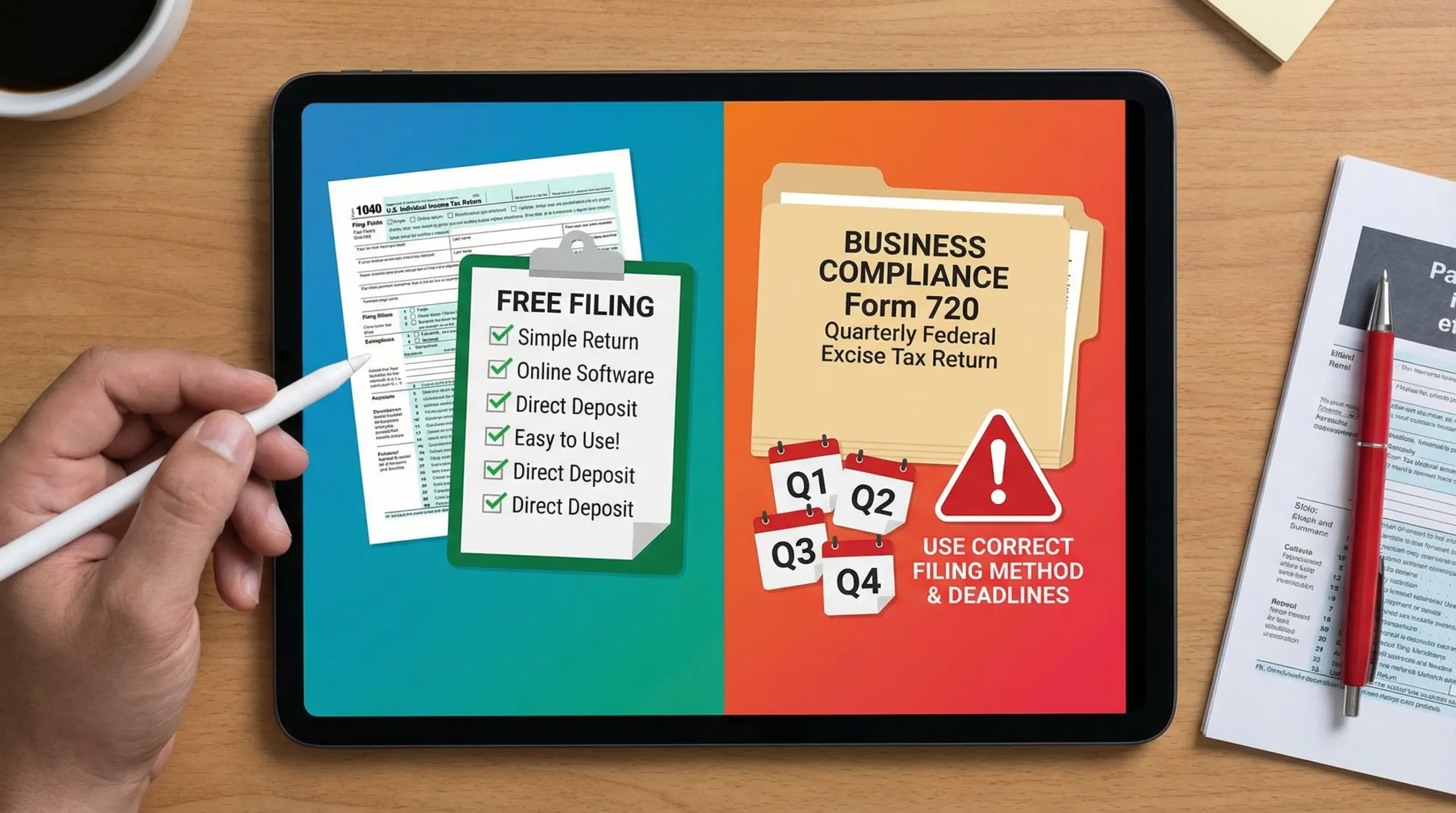
File Tax Return for Free: Eligibility Rules and Pitfalls
“Free” tax filing is real, but it’s also one of the easiest places to make expensive mistakes. The biggest issue is that many people search file tax return for free expecting it to apply to every tax situation, every form, and every filer. In practice, legitimate free options usually have eligibility rules (income limits, state availability, form limitations), and “free” products may still charge for state returns, add-ons, or more complex schedules.
This guide breaks down the most reliable ways to file for free, the eligibility rules that matter in 2026 filing season (for 2025 returns), and the most common pitfalls that cause surprise charges, rejected returns, or missed tax benefits.
What “file tax return for free” usually means (and what it does not)
Most “free filing” offers are referring to federal individual income tax returns, typically Form 1040 and common schedules. Free filing rarely applies to:
- Business entity returns (for example, Forms 1120, 1120-S, 1065)
- Payroll tax filings
- Specialized federal excise tax filings (for example, Form 720, Form 720-X, Form 8849)
- Heavy multi-state complexity or industry-specific filings
Even for individuals, “free” can mean different things:
- Free e-file: The software lets you transmit your federal return for $0.
- Free preparation: You get guided help (software interview or a volunteer preparer) at no cost.
- Free forms only: You can fill out the forms online for free, but you do most of the work.
A key reality: “free federal” does not automatically mean “free state,” and “free to start” does not mean “free to finish.”
The most legitimate ways to file your taxes for free in the US
1) IRS Free File (partner offers, based on income)
The IRS Free File program is the most recognized path for free federal filing if you qualify. It generally has:
- An income-based eligibility cap for guided partner products (the cap can change by year)
- Multiple partner options, each with its own rules (age, state residency, forms supported)
If you qualify and pick the right partner offer, this can be the closest thing to truly free and guided filing.
Official starting point: IRS Free File.
2) IRS Free File Fillable Forms (no income limit, but not guided)
If you do not qualify for the guided partner offers, the IRS typically provides Free File Fillable Forms. This is more like an electronic version of completing the forms yourself.
This can be a “$0 federal filing” option for many people, but it is not ideal if you:
- Need step-by-step interview guidance
- Are not comfortable reading instructions and doing calculations carefully
- Have complex credits, multiple states, or nonstandard situations
3) IRS Direct File (limited rollout, state dependent)
The IRS has been expanding Direct File, which is designed to let eligible taxpayers file directly with the IRS for free. Eligibility depends heavily on:
- Whether your state participates or supports the workflow
- Your tax situation (types of income, credits, and forms supported)
Because availability and scope can change, confirm eligibility on the IRS website before planning around it.
4) Volunteer programs: VITA and TCE (free human help)
If you want free preparation from a trained volunteer, IRS-sponsored programs can be a great fit:
- VITA (Volunteer Income Tax Assistance), often for lower-to-moderate income filers and other qualifying groups
- TCE (Tax Counseling for the Elderly), often focused on seniors
These programs can be especially valuable if you want a real person to help you avoid missed credits or filing errors.
Learn more: IRS VITA and TCE.
5) Free state filing options (varies widely)
Some states offer their own free filing portals or free e-file options for qualifying residents. The rules vary substantially by state.
If you are comparing free options, treat “state filing” as its own decision instead of assuming it is included.
Quick comparison: free filing options and where people get surprised
| Free filing option | Best for | Typically free for | Common “gotchas” |
|---|---|---|---|
| IRS Free File (partner offers) | Most eligible W-2 filers | Federal return (guided) | Picking the wrong partner offer, state return not included, upgrades for added forms |
| IRS Free File Fillable Forms | Confident DIY filers | Federal forms and e-file | Not guided, easy to miss deductions/credits, more error risk |
| IRS Direct File (where available) | Eligible filers in supported states | Federal return | Limited form/credit coverage, availability depends on state |
| VITA / TCE | People wanting free human help | Prep + federal filing (and often state) | Appointment availability, scope limitations (some complex items may be out of scope) |
Eligibility rules that determine whether you can really file for free
Income thresholds (and how they are applied)
For IRS Free File guided offers, your adjusted gross income (AGI) is often the starting point. Two important nuances:
- The program-wide AGI cap is only half the story. Each partner offer can add its own filters.
- Your AGI is based on tax definitions, not your “take-home pay.” If you had unemployment, investment activity, or side income, your AGI may be higher than expected.
Form and schedule limitations
Many free offers cover common situations, but become paid when you add certain forms or schedules. Examples that sometimes trigger paid tiers include:
- Certain self-employment scenarios (Schedule C), especially with more advanced deductions
- Rental real estate (Schedule E)
- Complex investment reporting
- Multi-state filing
Even if a provider advertises “free,” confirm that your situation is supported before you enter hours of data.
State residency and state return rules
A very common pitfall is assuming the federal return being free means the state return is also free. In reality:
- Some free offers include a state return for certain states or certain income levels
- Some charge for state returns or charge per state
- If you moved states, you may need part-year returns in more than one state, which can increase cost and complexity
Filing status and dependent rules
Free preparation programs (especially volunteer programs) and free software flows may handle common situations well, but you still need to be careful with:
- Claiming dependents (especially shared custody situations)
- Head of household qualification
- Education credits and dependency coordination
Mistakes here can cause IRS notices, delayed refunds, or lost credits.
The biggest “free filing” pitfalls (and how to avoid them)
Pitfall 1: Starting in the wrong place and getting routed to a paid product
Many taxpayers end up paying because they enter through a general marketing page, not the specific Free File entry point.
What to do instead: start from the IRS program pages (for example, the official IRS Free File page), then select your offer.
Pitfall 2: Add-ons that are not required to file
Some products offer optional add-ons such as audit support, identity monitoring, or premium chat. These may be useful for some filers, but they are not required to file.
A simple rule: if you are trying to file for free, decline extras unless you have a clear reason and you understand the cost.
Pitfall 3: Refund transfer, “pay from refund,” or bank product fees
If you choose to have preparation fees deducted from your refund (or use certain refund advance products), you may pay additional bank processing fees.
If your goal is $0 filing, pay nothing from the refund and avoid refund-based bank products.
Pitfall 4: Free federal, paid state, then surprise total cost
You can complete a federal return for free and still face a state filing fee right at the end.
What to do: check state return pricing early, and compare it to alternative free state options or VITA/TCE availability.
Pitfall 5: E-file rejects caused by identity mismatches
Even “free” filing tools cannot fix data mismatches automatically. Common reject triggers include:
- Name not matching Social Security card
- Incorrect Social Security number
- Prior-year AGI mismatch when e-filing (used as an identity check)
Before you start, verify names, SSNs, and keep last year’s return accessible.
Pitfall 6: Missing credits or deductions due to “too-simple” filing
Some people try to keep their return “simple enough to be free,” but that can backfire if you skip legitimate credits or deductions.
If you are eligible for credits like the Earned Income Tax Credit (EITC) or education credits, accuracy matters more than the filing fee.
Special note for self-employed and side-income filers (1099 work)
If you have gig work or side income, you may still be able to file for free, but be realistic about complexity:
- Self-employment tax calculations, home office rules, mileage, and business expenses increase error risk.
- You may need to consider quarterly estimated taxes going forward, even if you can file the annual return for free.
If you are comfortable doing a true do-it-yourself return, Free File Fillable Forms can be a $0 path. If you want guided help at no cost, VITA sites may be an option depending on your situation and local availability.
When “free tax filing” doesn’t apply: business and excise tax returns
Many business owners land on “file tax return for free” articles when what they actually need is a business compliance filing that is not part of typical free 1040 software.
A common example is IRS Form 720 (Quarterly Federal Excise Tax Return), which applies to specific activities (for example, certain fuel taxes, environmental taxes, communications and air transportation excise taxes, and the PCORI fee for applicable health plans). Form 720 is not an annual 1040, it is generally filed quarterly (with some exceptions like PCORI timing).
Two practical pitfalls show up repeatedly:
- Trying to use income tax software for an excise tax return. Most consumer products are designed for Form 1040, not federal excise tax reporting.
- Assuming “free e-file” options exist for specialized forms. Excise filings often require an authorized provider, correct tax category mapping, and careful reconciliation to avoid notices, penalties, or missed claims.
If you need to file Form 720 online, an IRS-authorized platform that focuses on excise returns can reduce friction. eFileExcise720 is built specifically for Form 720 e-filing (including support for amendments via Form 720-X and claims via Form 8849) with secure handling and customer support. The site offers free account creation, but you should expect that specialized filing is a paid service in most cases.
A quick international note (because “free filing” rules vary by country)
Tax “free filing” programs are country-specific. If you are comparing systems or you file in more than one jurisdiction, use tools designed for that country’s rules. For example, for India’s FY 2025-26, you can estimate liability and compare old vs new regime using an income tax calculator for FY 2025-26 before you file.
A simple checklist to avoid paying when you qualify for free
Use this short checklist before you begin:
- Confirm you are filing the right type of return (individual income tax vs business vs excise).
- Start from the official IRS Free File or Direct File information pages.
- Verify your situation is supported (income limit, state, and needed forms/schedules).
- Check state return cost early.
- Avoid optional add-ons and refund-based bank products if your goal is $0.
- Keep last year’s return handy for identity verification and carryovers.
Bottom line
You can often file a tax return for free if you are filing a federal individual income tax return and you meet the program and provider eligibility rules. The main risks are picking an offer that does not match your situation, getting pushed into paid upgrades, or discovering late in the process that state returns are extra.
If your “tax return” is actually a specialized compliance filing like Form 720 federal excise taxes, free consumer filing options generally won’t apply. In that case, the smartest “cost saver” is avoiding mistakes, rejections, and penalties by using the correct filing method and an IRS-authorized e-file provider built for excise returns.