
When Should Illinois Businesses Start Preparing for Form 720 Filing?
Many Illinois businesses only think about IRS Form 720 when the quarter is almost over, or when a notice arrives. The problem is that Form 720 is not just a “fill it in and submit” return. It often depends on transaction level details (gallons, minutes, ticketed sales, covered lives, taxable events, exemptions) and sometimes separate payment and deposit rules.
If you want Form 720 filing Illinois compliance to feel routine instead of stressful, the best time to prepare is earlier than most teams expect.
The practical answer: start preparing as soon as excise activity starts, not when the return is due
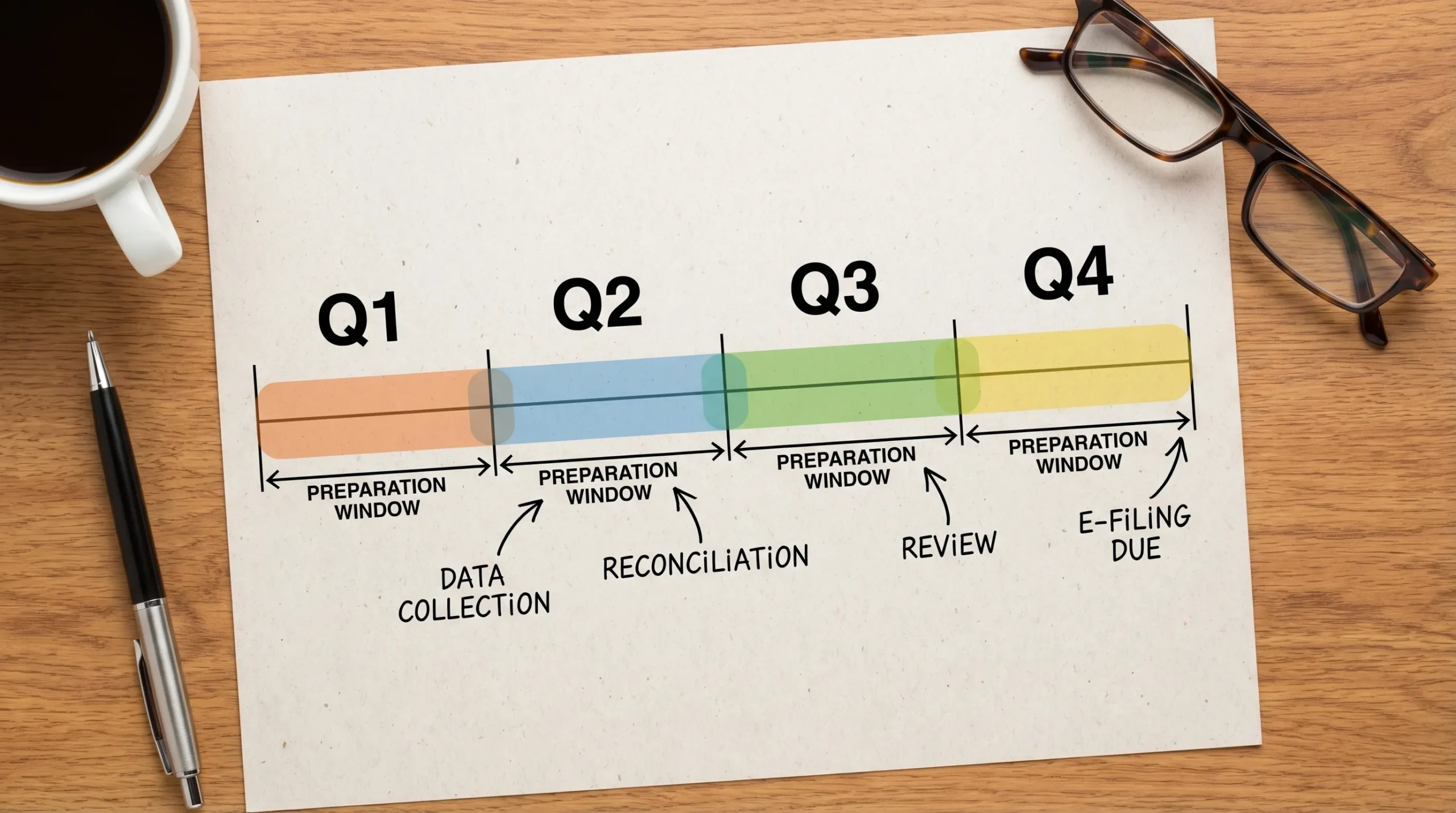
Form 720 is a quarterly return, due four times per year. For most filers, the IRS due dates are:
| Quarter (activity period) | Form 720 due date (typical) | Preparation window that works best |
|---|---|---|
| Q1 (Jan to Mar) | April 30 | Start by early March |
| Q2 (Apr to Jun) | July 31 | Start by early June |
| Q3 (Jul to Sep) | October 31 | Start by early September |
| Q4 (Oct to Dec) | January 31 | Start by early December |
For many Illinois businesses, “start preparing” really means establishing a repeatable monthly (or even weekly) excise workflow, especially if you have fuel, communications, manufacturing, or multiple operating locations.
For official dates and details, see the IRS Form 720 page and the current Form 720 instructions.
Do not let PCORI timing surprise you (common in Illinois)
A lot of Illinois employers only touch Form 720 for one reason: PCORI filing (Patient-Centered Outcomes Research Institute fee) for certain self-insured health plans and HRAs.
PCORI is reported on Form 720, but it is not filed every quarter in the same way as many other excise categories. It has its own annual cycle.
Strategically, if you plan to handle PCORI online, start earlier than you think because you may need HR, benefits, payroll, and your third-party administrator to align on a covered lives method and supporting documentation.
A realistic preparation cadence for PCORI looks like:
- May to June: confirm plan type, confirm who is responsible, choose the counting method, request covered lives data.
- Early July: calculate the fee, complete internal review, confirm payment method.
- Before the deadline: submit with form 720 online filing and retain support.
(If PCORI is your main reason for filing, treat it like a mini annual “excise close”, not a last-minute form.)
Why starting early matters, the penalty math gets expensive fast
The IRS can assess separate penalties for filing late and paying late. While every situation is fact-specific, the Form 720 penalty framework commonly referenced in IRS guidance includes:
| What went wrong | Common IRS penalty structure (high level) | Why early preparation helps |
|---|---|---|
| Filed late | Failure-to-file can be 5% per month, up to 25% | Avoids missing the deadline due to data gaps or rejects |
| Paid late | Failure-to-pay can be 0.5% per month | Ensures payment is planned and scheduled |
Even when a team intends to file on time, late happens because data is not ready, liability is not reconciled, or the business discovers it needed to file after the deadline.
The 6-week Form 720 prep playbook (what to do before the quarter ends)
If you want a clean, repeatable quarter, build your preparation around these workstreams. This aligns with how experienced controllers and tax managers run a “tax close”.
1) Map taxable events to the correct Form 720 lines
Most errors start here. Illinois businesses often add new revenue streams (bundled telecom plans, delivery fees, fuel surcharges, imported inputs, benefit plan changes) without re-checking excise impact.
Use the quarter as a trigger to refresh your internal “excise map”:
- What products or services could create federal excise tax?
- Which entity is liable, especially after reorganizations or acquisitions?
- Which Form 720 categories and IRS numbers apply?
If your team relies on Form 720 filing instructions, keep a short internal memo that explains how your business interprets them, plus who owns each data feed.
2) Build source-of-truth reports (not screenshots)
The fastest Form 720 filers do not “hunt for numbers” at quarter end. They pull structured reports from accounting systems, invoicing platforms, fuel systems, benefits administration, or ERP.
If you are investor-backed or scaling quickly, this is where diligence pressure shows up.
Lesson learned (anonymized investor-backed example): A private equity backed Midwest logistics and fuel operator expanded into a new line of business mid-year. The tax team only discovered a reporting gap during a lender audit request. They fixed it by creating a monthly excise reconciliation pack (volumes, taxable vs exempt, tie-out to revenue, and variance notes) that made quarterly Form 720 reporting predictable.
3) Reconcile liability before the last week
Treat excise like sales tax, it needs a reconciliation step.
Good reconciliations typically include:
- Volume or unit tie-outs (for per-unit excise categories)
- Revenue tie-outs (for percentage-based categories)
- Exemption and credit documentation checks
- A final quarter-to-date liability estimate (so cash is not a surprise)
4) Decide early whether you may need amendments or claims later
Two forms come up often when teams are preparing:
- Form 720-X if you need to correct a previously filed Form 720.
- 8849 form (Form 8849) if you are making a claim for refund of excise taxes in eligible situations.
You do not need to pre-decide that you will amend, but you should capture supporting documents as you go. Waiting until after filing usually turns an easy fix into a time-consuming reconstruction.
Illinois-specific reality: state lines do not change federal rules, but operations often do
Federal excise tax is federal, but Illinois business patterns create recurring Form 720 risk:
Fuel and transportation operations
Illinois has major freight corridors and fuel activity, which often means higher transaction volume and more reliance on operational systems. If your volumes are high, start preparing at the beginning of the quarter and reconcile monthly.
Communications and bundled billing
If you sell communications services, VoIP, or bundled offerings, quarter-end is when teams discover that taxable and non-taxable charges were not separated cleanly. Build rules in invoicing so you are not manually parsing line items at the deadline.
Manufacturers and importers
Product changes and sourcing changes can create new excise exposure. A simple quarterly checklist item like “did we introduce a new SKU or import flow?” can prevent a missed filing obligation.
Self-insured employers (PCORI)
In Illinois, mid-size and large employers commonly have benefits complexity. If you rely on third parties for covered lives counts, give yourself weeks, not days.
A simple decision rule: when should you start preparing?
If you want one rule that works across industries, use this:
| Your situation | Start preparing |
|---|---|
| You file because of PCORI only | 6 to 8 weeks before the annual deadline |
| You have steady excise activity each quarter | At the start of every quarter, reconcile monthly |
| You have changing products, new locations, M&A, or new billing models | Immediately when the change happens, then maintain quarter-long tracking |
Filing without the scramble: using eFileExcise720
When you are ready to file Form 720 online, an IRS-authorized portal can reduce operational risk because you can submit electronically, avoid mailing delays, and get a clearer submission workflow.
eFileExcise720 is an IRS-authorized e-filing platform for Form 720 that supports all Form 720 categories, offers secure data handling, and provides customer support for businesses that want a more guided process. It also supports Form 720 amendments (720-X) and Form 8849 claims.

Frequently Asked Questions
When should I start preparing for Form 720 filing Illinois deadlines? Start 6 to 8 weeks before the due date at minimum. If you have ongoing excise activity (fuel, communications, manufacturing), start at the beginning of the quarter and reconcile monthly.
Can I do Form 720 online filing instead of mailing the return? Yes, electronic filing is available through IRS-authorized providers. E-filing helps reduce mailing risk and generally speeds up error resolution if something needs correction.
Is PCORI online filing done on Form 720? Yes. The PCORI fee is reported on Form 720. Many employers prepare PCORI data weeks in advance because covered lives counts and documentation can take time to compile.
Where can I find Form 720 filing instructions? The IRS publishes official instructions for Form 720 on its website. Use those instructions to confirm categories, lines, and supporting schedules that apply to your activity.
When would I use the 8849 form instead of Form 720? Form 720 is generally for reporting and paying excise tax liabilities. Form 8849 is generally for eligible refund claims. Some businesses may file both depending on the scenario.
Get ahead of the next deadline
If you want your next quarter to be easier, start with a preparation calendar and a monthly reconciliation habit, then choose a filing method that reduces last-minute friction.
To streamline your next filing, you can create a free account and file Form 720 online with eFileExcise720, the IRS-authorized portal built to make Form 720, 720-X amendments, and Form 8849 claims simpler and more secure.