United States IRS Forms Every Excise Filer Should Know
Excise tax compliance gets much easier when you know which IRS form does what. For many businesses, the hardest part is not only calculating the tax, but understanding whether they are reporting a liability, correcting a prior return, claiming a refund, supporting an environmental calculation, or registering for a specific excise activity.
That is why excise filers should treat key United States IRS forms as a compliance map. Form 720 is usually the center of that map, but it is not the only form that matters. The right supporting form can help you avoid rejected filings, delayed refunds, duplicate reporting, and costly IRS notices.
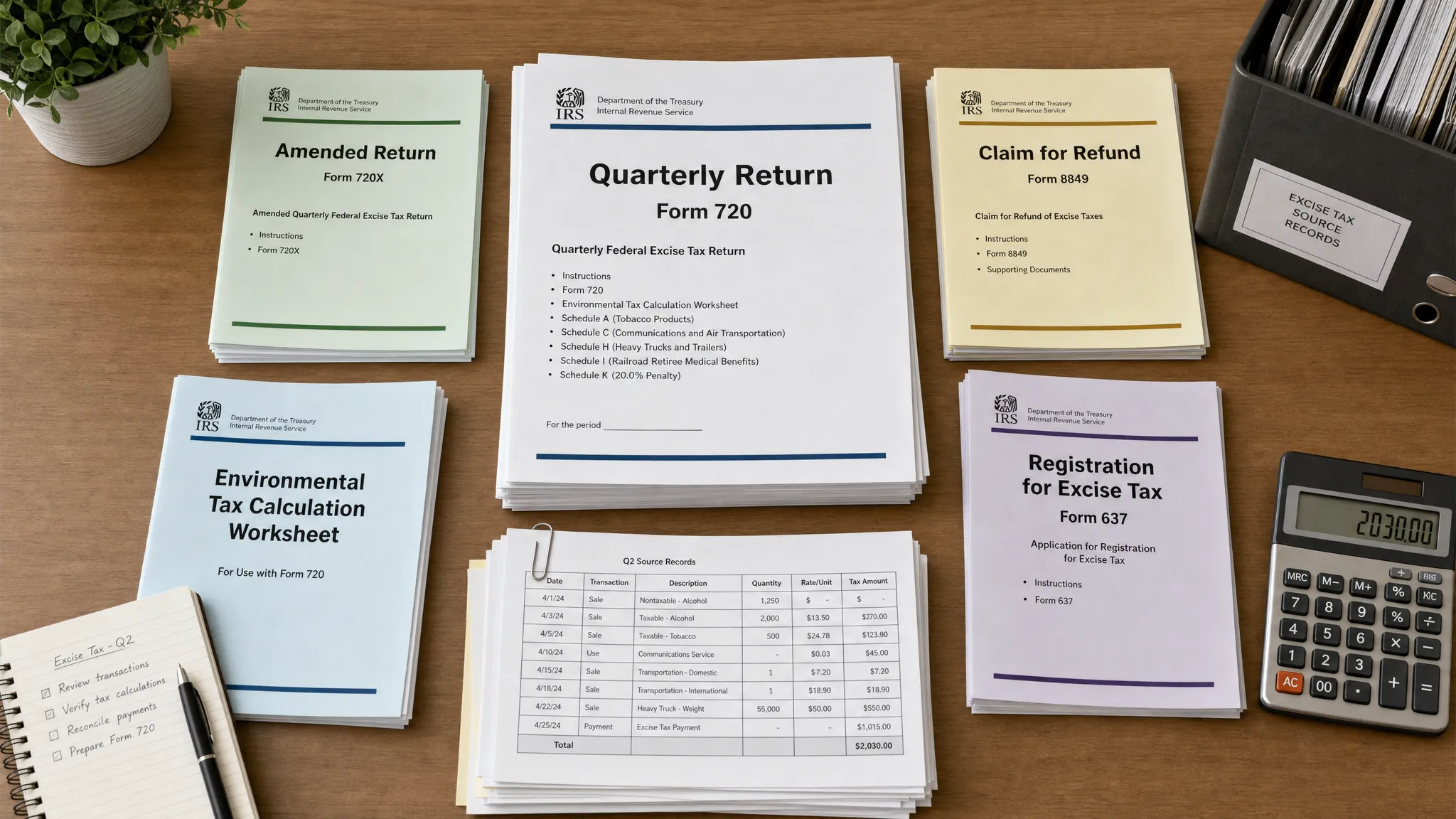
Quick reference: United States IRS forms for excise filers
Not every business will use every form below. A tanning salon, fuel distributor, chemical importer, plan sponsor, trucking company, and vehicle manufacturer can all have very different excise obligations. Still, these are the forms most likely to appear in or around federal excise tax compliance.
| IRS form | Primary purpose | Why excise filers should know it |
|---|---|---|
| Form 720 | Quarterly Federal Excise Tax Return | The core return for reporting many federal excise taxes, including fuel, environmental, communications, air transportation, indoor tanning, and PCORI-related liabilities. |
| Form 720-X | Amended Quarterly Federal Excise Tax Return | Used to correct certain errors on a previously filed Form 720 when an amendment is the right path. |
| Form 8849 | Claim for Refund of Excise Taxes | Used to claim refunds or credits for eligible excise tax situations, often involving fuel, exports, or overpayments. |
| Form 6627 | Environmental Taxes | Used to calculate environmental excise taxes that may be reported with Form 720. |
| Form 6197 | Gas Guzzler Tax | Used by certain manufacturers or importers to calculate gas guzzler tax reported with Form 720. |
| Form 637 | Application for Registration for Certain Excise Tax Activities | Used to apply for IRS registration for certain excise tax activities, especially in fuel and other specialized excise areas. |
| Form 4136 | Credit for Federal Tax Paid on Fuels | Used on an income tax return to claim certain fuel tax credits, rather than reporting quarterly Form 720 liability. |
| Form 2290 | Heavy Highway Vehicle Use Tax Return | A separate excise return for taxable heavy highway vehicles, commonly relevant for trucking and fleet operators. |
Always confirm the current IRS instructions for your filing year and tax category. Excise tax rates, schedules, and supporting documentation rules can change, and different taxes have different calculation methods.

Form 720: the central return for many federal excise taxes
IRS Form 720 is the Quarterly Federal Excise Tax Return. If your business is responsible for collecting, paying, or reporting certain federal excise taxes, this is often the form you file.
Form 720 covers many categories, including fuel-related taxes, environmental taxes, communications taxes, air transportation taxes, indoor tanning services, manufacturers taxes, foreign insurance taxes, and the Patient-Centered Outcomes Research Institute fee, commonly called the PCORI fee. Not all categories apply to all businesses. The filing obligation depends on the activity, product, service, or plan arrangement that triggers the tax.
For most Form 720 filers, the return follows a quarterly pattern. If a deadline falls on a weekend or federal holiday, the due date generally shifts to the next business day.
| Quarter | Period covered | Standard due date | 2026 due date for planning |
|---|---|---|---|
| Q1 | January 1 to March 31 | April 30 | April 30, 2026 |
| Q2 | April 1 to June 30 | July 31 | July 31, 2026 |
| Q3 | July 1 to September 30 | October 31 | November 2, 2026 |
| Q4 | October 1 to December 31 | January 31 | February 1, 2027 |
A key point for finance teams is that filing Form 720 and paying excise tax are related but not always the same workflow. Some excise taxes require semi-monthly deposits, often made through EFTPS, depending on the tax type and liability amount. That means a business may need to manage deposits before the quarterly return is filed.
Form 720-X: when the original Form 720 needs correcting
Form 720-X is used to amend certain previously filed Form 720 returns. This matters because excise mistakes often involve the wrong IRS number, the wrong quarter, an incorrect quantity, a rate error, or a missed taxable transaction.
A good amendment file should clearly show the original amount, the corrected amount, the difference, and the reason for the change. Keep the explanation tied to the specific quarter and excise tax category. If the correction affects supporting schedules, calculations, or documentation, keep those records with your amended return workpapers.
Form 720-X is not a universal refund tool. In some situations, a refund claim belongs on Form 8849, not an amended Form 720. The distinction is important because choosing the wrong form can delay IRS processing. If you are unsure whether you need an amendment or a refund claim, review the IRS instructions and compare the two paths carefully. You can also use this guide on Form 720 vs Form 8849 for a practical breakdown.
Form 8849: when you are claiming an excise tax refund
Form 8849 is the Claim for Refund of Excise Taxes. It is commonly used when tax was paid but the taxpayer later qualifies for a refund or credit under specific IRS rules.
Fuel-related claims are among the most common examples. A business may have paid federal fuel tax but used the fuel in a nontaxable way, such as certain off-highway business uses or other qualified uses. Other refund situations can involve exports, overpayments, or specific excise tax adjustments, depending on the schedule and facts.
The schedules attached to Form 8849 matter. Each schedule serves a different claim type, and the IRS expects the claim to match the right schedule. Documentation is also critical. Refund claims should be supported by invoices, proof that tax was paid, usage records, exemption certificates where applicable, export records where applicable, and internal reconciliations.
The most common mistake is treating Form 8849 as a replacement for Form 720. It is not. Form 720 reports current excise liability. Form 8849 claims a refund or credit when the taxpayer is eligible under a specific rule.
Form 6627: environmental tax calculations behind Form 720
Form 6627 is used to calculate certain environmental taxes reported with Form 720. This form can be especially important for businesses dealing with taxable chemicals, imported chemical substances, ozone-depleting chemicals, petroleum-related environmental taxes, and other environmental excise categories.
Environmental excise taxes often depend on quantities, substance classifications, import data, conversion factors, and product composition. That means the information needed for Form 6627 may come from procurement, customs brokers, production records, inventory systems, or environmental compliance teams, not just the accounting department.
A strong Form 6627 process starts before quarter-end. Businesses should map taxable substances, confirm units of measure, reconcile import records, and document any assumptions used in the calculation. The totals then flow into the relevant Form 720 reporting lines.
Form 6197: gas guzzler tax for certain vehicles
Form 6197 is used to calculate the gas guzzler tax. This tax generally applies to certain passenger automobiles that do not meet specified fuel economy standards, and it is typically relevant to manufacturers and importers rather than ordinary vehicle purchasers.
For businesses in the automotive supply chain, the important distinction is whether the company is merely selling vehicles or is responsible as a manufacturer or importer for the excise tax. If the tax applies, Form 6197 supports the calculation that is reported on Form 720.
Because vehicle classifications and fuel economy data are highly specific, filers should keep certification records, import documentation, vehicle identification details, and calculation support in the return file.
Form 637: registration before certain excise activities
Form 637 is not a tax return. It is an application for registration for certain excise tax activities. This form is especially important because some excise transactions require a valid IRS registration before the taxpayer can participate in a tax-free or tax-deferred transaction, claim a particular status, or operate under certain excise rules.
Fuel businesses are a common example, but Form 637 can also affect other specialized excise activities. Registration is tied to activity codes, so it is not enough to say your business is registered in a general sense. You need the right registration for the right activity.
If your business is entering a new fuel, chemical, aviation, or other excise-sensitive transaction, check whether Form 637 registration is needed before the transaction begins. Waiting until after the quarter closes can create documentation gaps that are difficult to fix.
Form 4136 and Form 2290: related forms that often cause confusion
Form 4136 is used to claim certain credits for federal tax paid on fuels. Unlike Form 8849, which is an excise refund claim form, Form 4136 is generally attached to an income tax return. Some taxpayers may need to evaluate whether a fuel tax recovery belongs on Form 8849 during the year or Form 4136 with the annual income tax return.
Form 2290 is the Heavy Highway Vehicle Use Tax Return. Trucking companies, logistics businesses, construction fleets, and other operators of heavy highway vehicles may know Form 2290 well. However, it is separate from Form 720. A business can have Form 2290 obligations for vehicles and Form 720 obligations for fuel, environmental taxes, or other excise categories.
The practical lesson is simple: similar industries can trigger different excise forms. Do not assume that filing one excise form satisfies another obligation.
How to choose the right form before you file
The best way to avoid filing errors is to start with the business event, not the form. Ask what actually happened: did the business sell a taxable product, import a taxable substance, use tax-paid fuel in a qualified nontaxable way, discover a prior-period mistake, or need registration before a special transaction?
| Business situation | Likely form to review | Watch-out |
|---|---|---|
| You owe current-quarter federal excise tax | Form 720 | Use the correct quarter, IRS number, tax category, and supporting schedule. |
| You found an error on a prior Form 720 | Form 720-X | Confirm an amendment is allowed for that correction and keep a clear explanation. |
| You qualify for an excise tax refund | Form 8849 | Choose the correct schedule and attach strong documentation. |
| You report environmental excise taxes | Form 6627 plus Form 720 | Reconcile quantities, imports, substance classifications, and tax rates. |
| You are a manufacturer or importer subject to gas guzzler tax | Form 6197 plus Form 720 | Maintain vehicle-level fuel economy and import or manufacturing records. |
| You need IRS registration for certain excise activities | Form 637 | Apply before relying on registered status in transactions. |
| You claim certain annual fuel tax credits | Form 4136 | This generally connects to the income tax return, not quarterly Form 720 reporting. |
| You operate taxable heavy highway vehicles | Form 2290 | This is separate from Form 720 and has its own filing rules. |
Common mistakes when multiple IRS forms are involved
Using a refund form to fix a reporting obligation
A refund claim and an amended return are not the same thing. If you underreported tax, overreported tax, or used the wrong IRS number on a prior Form 720, you need to determine whether Form 720-X, Form 8849, Schedule C, or another path applies. The right answer depends on the tax type and the nature of the correction.
Forgetting the calculation form
Some excise categories require more than a single line on Form 720. Environmental taxes may require Form 6627. Gas guzzler tax may require Form 6197. Fuel-related claims may require a specific Form 8849 schedule. Missing support can create processing delays or make an audit response more difficult.
Relying on accounting data alone
Excise taxes often depend on operational details. Gallons, barrels, pounds, chemical composition, customer exemption status, transportation activity, plan covered lives, or vehicle data may determine the liability. Accounting totals are important, but they should be reconciled to source records.
Missing payment and deposit timing
Quarterly filing does not always mean quarterly payment. Some Form 720 taxes require deposits before the return due date. Late deposits can generate penalties even when the quarterly return is filed on time.
Reusing last year’s form logic without review
Excise tax compliance is not something to copy forward blindly. New products, new customers, imported materials, updated rates, changed plan structures, and new states of operation can all affect the federal excise filing package.
Records that support excise IRS forms
Good records make the correct form easier to file and easier to defend. They also reduce the time needed to prepare amendments or refund claims later.
| Record type | Examples | Forms supported |
|---|---|---|
| Sales and invoice records | Taxable sales, exempt sales, customer charges, taxable service revenue | Form 720, Form 720-X, Form 8849 |
| Quantity records | Gallons, barrels, tons, pounds, covered lives, vehicle counts | Form 720, Form 6627, Form 6197, Form 8849 |
| Import and customs records | Entry summaries, bills of lading, product classifications | Form 720, Form 6627, Form 8849 |
| Fuel usage documentation | Off-highway use logs, equipment records, farm or business use support | Form 8849, Form 4136 |
| Registration records | IRS registration letters, activity codes, exemption certificates | Form 637, Form 720, Form 8849 |
| Payment confirmations | EFTPS confirmations, deposit schedules, bank confirmations | Form 720, Form 720-X |
| Workpapers and reconciliations | Rate calculations, line mapping, prior-quarter comparisons | All excise filings |
A practical best practice is to build a quarterly excise close folder. Keep the filed return, IRS acknowledgments, payment confirmations, source reports, calculation workpapers, and supporting documents together by quarter.
Why e-filing helps excise filers stay organized
Excise filing can become complicated when a business has multiple tax categories, supporting forms, amendments, and refund claims. Paper filing adds more friction because teams must manage mailing proof, manual signatures, slower correction cycles, and physical records.
An IRS-authorized online portal such as eFileExcise720 helps businesses file Form 720 online without downloading software. The platform supports Form 720 categories, Form 720-X amendments, and Form 8849 claims, with secure data handling, simple dashboard navigation, and personalized customer support.
If you are preparing for an upcoming quarter, use a structured checklist before filing. You can also review the Form 720 e-filing checklist for 2026 for a practical preparation workflow.
Frequently Asked Questions
What United States IRS forms do excise filers use most often? Many excise filers primarily use Form 720 to report quarterly federal excise taxes. Depending on the situation, they may also use Form 720-X for amendments, Form 8849 for refunds, Form 6627 for environmental taxes, Form 6197 for gas guzzler tax, Form 637 for registration, or Form 4136 for certain fuel credits.
Is Form 8849 the same as Form 720? No. Form 720 reports and pays current excise tax liability. Form 8849 is used to claim refunds or credits for eligible excise tax situations. Filing the wrong form can delay processing.
Do I need Form 6627 with every Form 720? No. Form 6627 is generally relevant when you are calculating certain environmental excise taxes. If your Form 720 filing does not include those environmental categories, Form 6627 may not apply.
Can Form 720 amendments be e-filed? Form 720-X is used to amend certain Form 720 filings, and e-filing availability depends on the provider and the type of correction. eFileExcise720 supports Form 720-X amendments through its online platform.
What happens if I file the wrong excise form? The IRS may reject the filing, delay processing, request more information, or assess penalties and interest if tax was underpaid or late. Review the current IRS instructions and correct the issue as soon as possible.
Do I still need to make EFTPS payments if I e-file Form 720? E-filing the return and making required tax payments are separate steps. Many filers pay or deposit excise taxes through EFTPS. Always confirm the payment and deposit rules for your specific excise tax category.
File the right excise form with confidence
Knowing the right IRS form is the first step toward cleaner excise compliance. The next step is filing accurately, on time, and with the records needed to support your return.
With eFileExcise720, you can create a free account, prepare your Form 720 online, file amendments with Form 720-X, and manage eligible Form 8849 claims through an IRS-authorized e-filing portal. Start with the form that matches your situation, keep your documentation organized, and use online filing to reduce manual errors and simplify quarterly compliance.
Ready to file? Visit eFileExcise720 and begin your excise tax return online.