Best Form to Pay Federal Taxes for Form 720 Filers
If your business files IRS Form 720, the best form to pay federal taxes depends on what you are trying to do: report a quarterly excise tax, make an excise tax deposit, mail a payment, correct a prior return, or claim a refund.
For most Form 720 filers, the cleanest approach is simple: e-file Form 720 to report the excise tax, use EFTPS for required deposits or electronic payments, and use Form 720-V only when the IRS instructions allow a mailed payment voucher. Form 8849 and Form 720-X have important roles too, but they are not the right tools for ordinary quarterly payment.
Quick answer: what is the best form to pay federal taxes for Form 720 filers?
Form 720 is the main return for federal excise taxes. It tells the IRS what excise tax your business owes for the quarter, such as fuel tax, environmental tax, communications tax, foreign insurance tax, indoor tanning tax, air transportation tax, or the PCORI fee.
But Form 720 is not the only document involved in paying. The IRS separates three concepts that many filers accidentally combine:
- Filing the return, which reports the liability.
- Depositing or paying the tax, which sends money to the IRS.
- Correcting or claiming money back, which uses separate forms when needed.
The IRS provides current Form 720 resources on its About Form 720 page, and businesses should review the official instructions for their exact tax category. Still, the decision table below will help you identify the right path before you file.
| Situation | Best form or payment route | What it is for | Key caution |
|---|---|---|---|
| Reporting quarterly federal excise tax | Form 720 | The quarterly excise tax return | Filing the return does not always satisfy deposit rules |
| Making required excise tax deposits | EFTPS | Electronic federal tax deposits and payments | Enroll early and select the correct tax period |
| Mailing a check or money order when allowed | Form 720-V | Payment voucher for Form 720 | Not a substitute for required EFTPS deposits |
| Correcting a previously filed Form 720 | Form 720-X | Amended excise tax return | Do not use it for a first-time quarterly filing |
| Claiming certain excise tax refunds | Form 8849 | Claim for refund of excise taxes | Requires support for the refund claim |
| Paying income, payroll, or other non-excise taxes | Other IRS forms or payment systems | Not Form 720 excise tax | Do not apply Form 720 payments to the wrong tax type |
Form 720 vs. Form 720-V vs. EFTPS
A common search for Form 720 filers is which form to pay federal taxes. The answer is not always a paper form. In many cases, the better answer is an electronic payment method.
Form 720 reports the tax
Form 720 is the Quarterly Federal Excise Tax Return. It is used to report federal excise tax liabilities for a quarter. The return may include multiple tax categories, schedules, and supporting calculations depending on your business activity.
For example, a fuel distributor may report fuel-related excise taxes, an insurer or policyholder may report foreign insurance tax, and a self-insured employer may use Form 720 for the PCORI fee. The return organizes the liability so the IRS can match your tax category, quarter, and business identity.
If you are new to the process, our guide to the Form 720 filing process explains the return workflow in more detail.
EFTPS is usually the best way to pay or deposit
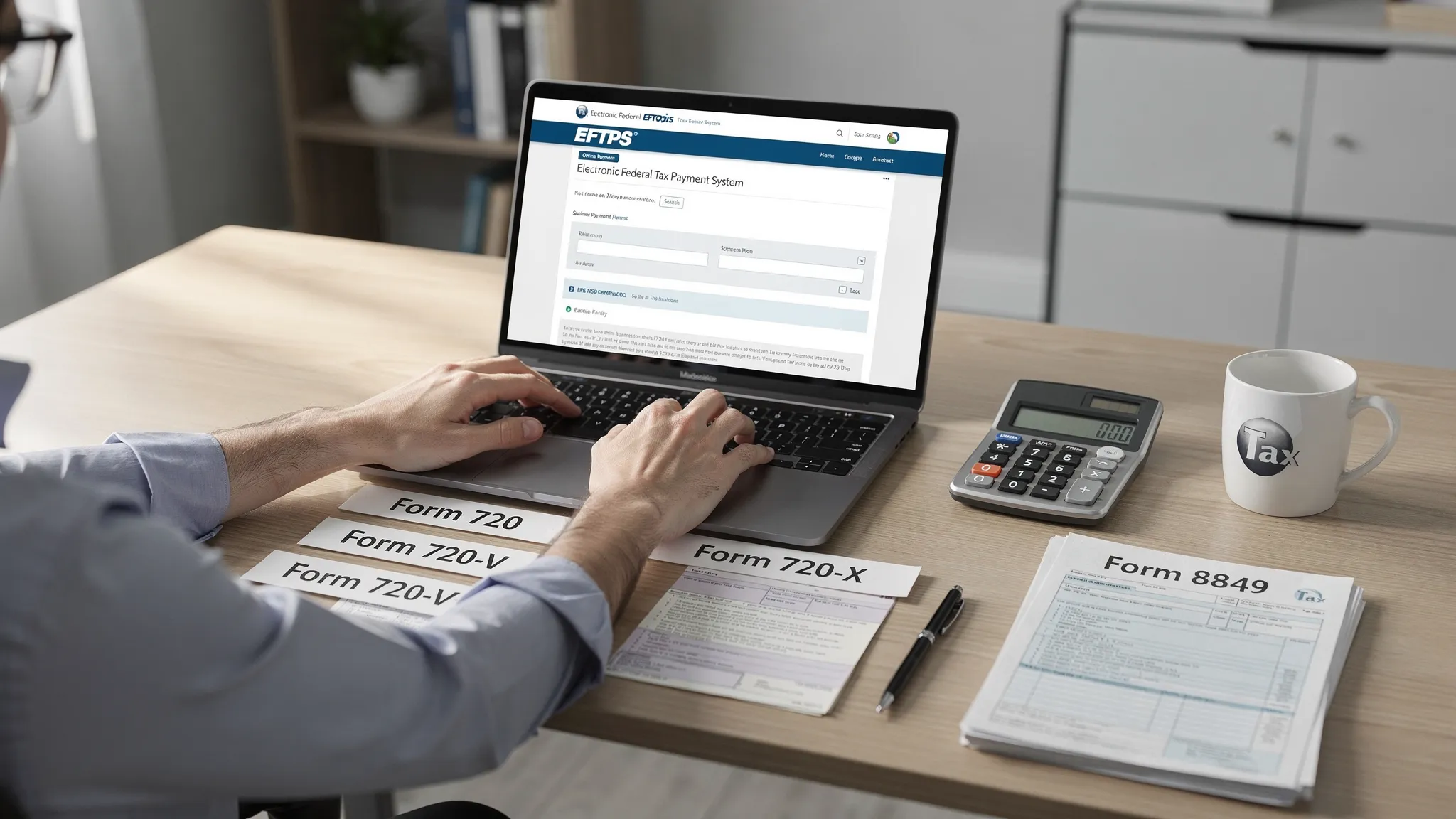
The Electronic Federal Tax Payment System, commonly called EFTPS, is the IRS-supported system used by many businesses to pay federal taxes electronically. For excise tax filers, EFTPS is especially important because some Form 720 liabilities require deposits before the quarterly return is due.
The IRS explains EFTPS enrollment and payment options at EFTPS.gov. New filers should set up access well before the due date because enrollment can take time, and missed deposits can lead to penalties even if the quarterly return is filed on time.
When using EFTPS, pay close attention to the form number, tax type, tax period, settlement date, EIN, and payment amount. A payment made under the wrong period or wrong tax form can create IRS notices even when the money was sent.
Form 720-V is only a payment voucher
Form 720-V is a payment voucher. It helps the IRS process a check or money order when a Form 720 payment is mailed under the instructions.
It is not a standalone tax return. It is not the best option for businesses required to make electronic deposits. It also does not correct a prior quarter or claim a refund. Think of Form 720-V as a payment label, not as the main tax compliance document.
If you e-file Form 720, check the IRS instructions and your filing workflow for the correct payment method. Many businesses prefer to avoid mailed payments because electronic payments create clearer confirmation and reduce mailing risk.
Why Form 720 filers should not wait until the quarterly due date
Form 720 is filed quarterly, but some federal excise taxes are deposited more frequently. This is where many businesses make mistakes.
For many Form 720 tax categories, if the net tax liability for the quarter is more than $2,500, deposits may be required during the quarter, often on a semimonthly schedule. The details depend on the tax category and the current IRS instructions. Schedule A of Form 720 is used to report certain semimonthly deposit liabilities.
If the total net tax liability for the quarter is $2,500 or less, the IRS instructions generally allow payment with the return instead of semimonthly deposits. However, because excise tax rules vary by category, you should confirm the deposit rule that applies to your specific tax.
This distinction matters because a business can file the correct Form 720 by the deadline and still face a failure-to-deposit issue if deposits were required earlier. The best compliance process is not just to ask which form pays the tax, but when the IRS expects the money.
Choosing the right form in common Form 720 payment scenarios
You owe federal excise tax for the current quarter
Use Form 720 to report the liability. If deposits are required, make them through EFTPS according to the IRS deposit schedule. If a balance remains due with the return, pay it by the Form 720 due date using the appropriate IRS payment method.
This is the standard path for most Form 720 filers.
You have a small quarterly liability and no required deposits
If your liability falls under the applicable deposit threshold, you may be able to pay with the return. In that situation, Form 720 is still the return, and Form 720-V may apply only if you are mailing a check or money order as instructed.
Even with a small liability, e-filing can reduce errors and provide a clearer record of the filing date.
You are filing only for the PCORI fee
The PCORI fee is reported annually on the second quarter Form 720, generally due July 31. Many employers and plan sponsors that do not otherwise file Form 720 encounter the form only because of this fee.
For PCORI filers, Form 720 is still the correct return. Deposit rules differ from many other excise tax categories, so filers should follow the PCORI-specific instructions and pay by the applicable deadline.
You made a mistake on a prior Form 720
Use Form 720-X to correct certain previously filed Form 720 errors. Do not use the next quarter's Form 720 to casually net out old mistakes unless the IRS instructions allow that treatment for the specific adjustment.
An amendment should explain what changed, why it changed, and how the corrected amount was calculated. eFileExcise720 supports Form 720 amendments, helping filers manage corrections without starting from scratch.
You overpaid or qualify for an excise tax refund
Use Form 8849 when you are claiming certain refunds of excise taxes, such as eligible fuel tax refund claims. Form 8849 is not the same as Form 720. It is a claim for money back, not the regular quarterly return.
If you are unsure which form applies, review our comparison of Form 720 vs. Form 8849. Choosing the wrong form can delay processing or trigger IRS correspondence.
2026 Form 720 filing dates to keep on your calendar
For Form 720 filers, payment planning starts with the quarterly filing calendar. Standard due dates shift to the next business day when they fall on a weekend or federal holiday.
| Quarter | Tax period | Standard due date | 2026 due date to watch |
|---|---|---|---|
| 1st quarter | January 1 to March 31, 2026 | April 30 | April 30, 2026 |
| 2nd quarter | April 1 to June 30, 2026 | July 31 | July 31, 2026 |
| 3rd quarter | July 1 to September 30, 2026 | October 31 | November 2, 2026 |
| 4th quarter | October 1 to December 31, 2026 | January 31 | February 1, 2027 |
These are the return due dates. Deposit deadlines can occur earlier during the quarter. For a deeper due date breakdown, see our guide to the Form 720 due date.
What to prepare before you pay or file Form 720
Before choosing a payment form or method, gather the records that prove the amount is correct. This is especially important for businesses with multiple excise categories or locations.
Useful records often include:
- EIN and legal business name used on IRS accounts.
- Tax quarter and tax year being filed.
- Product volumes, gallons, barrels, premiums, service charges, lives covered, or other category-specific measures.
- Tax rates from the current IRS instructions.
- Prior deposits made through EFTPS.
- Supporting schedules such as Schedule A, Schedule T, Schedule C, or Form 6627 when applicable.
- Refund, credit, or adjustment documentation if reducing the amount due.
Good records protect your business in two ways. They help you calculate the right tax before filing, and they help you respond if the IRS questions the return or payment later.
Common mistakes when selecting a form to pay federal taxes
The wrong form or payment method can create avoidable penalties, notices, and administrative work. The mistake is often not the amount of tax, but how the tax was submitted.
| Mistake | Why it causes trouble | Better approach |
|---|---|---|
| Using Form 720-V for a required deposit | A voucher does not replace EFTPS deposit rules | Use EFTPS when deposits are required |
| Paying without filing Form 720 | The IRS receives money but may not have the return detail | File the return and pay the tax |
| Filing Form 720 without paying | The return is filed, but failure-to-pay issues can still apply | Pay or deposit by the required deadline |
| Selecting the wrong tax period in EFTPS | Payment may not match the IRS account for that quarter | Verify quarter and tax year before submission |
| Using Form 8849 for a regular tax payment | Form 8849 is for refund claims, not current tax due | Use Form 720 and the proper payment method |
| Amending with the wrong form | Prior quarter corrections may not be processed correctly | Use Form 720-X when an amendment is required |
If you have already missed a deadline or received an IRS notice, review the possible consequences in our Form 720 penalties and interest resource.
Is e-filing better than mailing for Form 720 filers?
For most businesses, e-filing Form 720 is the better filing method because it reduces paper handling, provides faster submission confirmation, and helps catch common data-entry issues before the return is transmitted.
Mailing a paper return with a payment voucher may still be available in some cases, but it increases the risk of delays, lost mail, manual processing issues, and uncertainty around timing. If a deadline is close, those risks matter.
eFileExcise720 is an IRS-authorized online platform designed for Form 720 filers. Users can create an account for free, file without downloading software, navigate a simple dashboard, and access personalized customer support. The platform supports Form 720 categories, Form 720-X amendments, and Form 8849 claims support, helping businesses handle excise tax compliance in one place.
Payment still needs to follow IRS rules for your tax category. That may mean EFTPS deposits, an electronic payment, or a voucher-based payment where allowed. The key advantage of e-filing is that the return side of your compliance process becomes more organized and easier to document.
A simple workflow for paying federal excise taxes correctly
Use this practical sequence each quarter to reduce the risk of using the wrong form or missing a payment deadline.
- Identify which Form 720 excise tax categories apply to your business.
- Calculate the liability using current IRS rates and category-specific records.
- Determine whether semimonthly deposits are required for the quarter.
- Make required deposits through EFTPS and save confirmations.
- Prepare and e-file Form 720 with the correct quarter, EIN, schedules, and deposit details.
- Pay any remaining balance by the return due date using the allowed IRS payment method.
- Keep the filed return, payment confirmations, worksheets, and support documents together.
This workflow is especially valuable for businesses with recurring excise liabilities because it separates the filing decision from the payment decision. That separation helps prevent the most common Form 720 mistakes.
Frequently Asked Questions
What is the best form to pay federal taxes if I file Form 720? For Form 720 excise taxes, use Form 720 to report the tax and EFTPS for required deposits or electronic payments. Use Form 720-V only when a mailed voucher payment is allowed by the IRS instructions.
Is Form 720-V required for every Form 720 payment? No. Form 720-V is a payment voucher for certain check or money order payments. Many businesses use EFTPS for deposits and payments instead, especially when deposits are required.
Can I pay Form 720 taxes without filing Form 720? Paying without filing is not enough. The IRS also needs the return information that identifies the tax category, quarter, and liability. File Form 720 and make the payment or deposit using the correct method.
What if I paid the wrong Form 720 quarter in EFTPS? Review your EFTPS confirmation and IRS account information. You may need to contact the IRS or your tax professional to correct how the payment was applied. Fixing the issue early can help prevent notices.
Should I use Form 8849 instead of Form 720 if I expect a refund? Form 8849 is used for certain excise tax refund claims. It does not replace Form 720 when you are required to report quarterly excise tax. Some businesses may need both forms for different purposes.
Can Form 720-X be used to pay current quarter taxes? No. Form 720-X is for amending certain previously filed Form 720 returns. Current quarter excise tax should generally be reported on Form 720 and paid or deposited under the applicable IRS rules.
File Form 720 online with less confusion
The best form to pay federal taxes as a Form 720 filer is not always one document. Most businesses need a coordinated process: Form 720 for reporting, EFTPS for required deposits or electronic payments, Form 720-V only when appropriate, Form 720-X for amendments, and Form 8849 for qualifying refund claims.
If you want a simpler way to prepare and submit your excise tax return, eFileExcise720 can help you file Form 720 online through an IRS-authorized platform with secure data handling and dedicated customer support. Create your account, prepare your return, and keep your federal excise tax compliance moving without downloading software.