Federal Tax Filing Requirements: Who Must File and When
Federal tax compliance is not one single deadline, it is a set of federal tax filing requirements that change based on what you do (sell fuel, run payroll, issue contractor payments, operate a self-insured health plan), not just what you are called (LLC, corporation, nonprofit). The fastest way to get surprised by penalties is to assume you only need to file an annual income tax return.
This guide breaks down who must file which common federal forms and when, with a practical focus on businesses that may also have federal excise tax obligations (Form 720).
What “federal tax filing requirements” usually means
For most taxpayers, federal filing requirements fall into four buckets:
- Income tax returns (annual): report profit, losses, and tax due (or refunds).
- Employment tax returns (quarterly/annual): report wages, withholding, and employer payroll taxes.
- Information returns (annual): report payments to workers and others (W-2, 1099 series).
- Excise tax returns (quarterly/other): report specific activity-based taxes (fuel, communications, air transportation, PCORI fee, environmental taxes, and more).
Each bucket has its own due dates, payment rules, and correction processes.
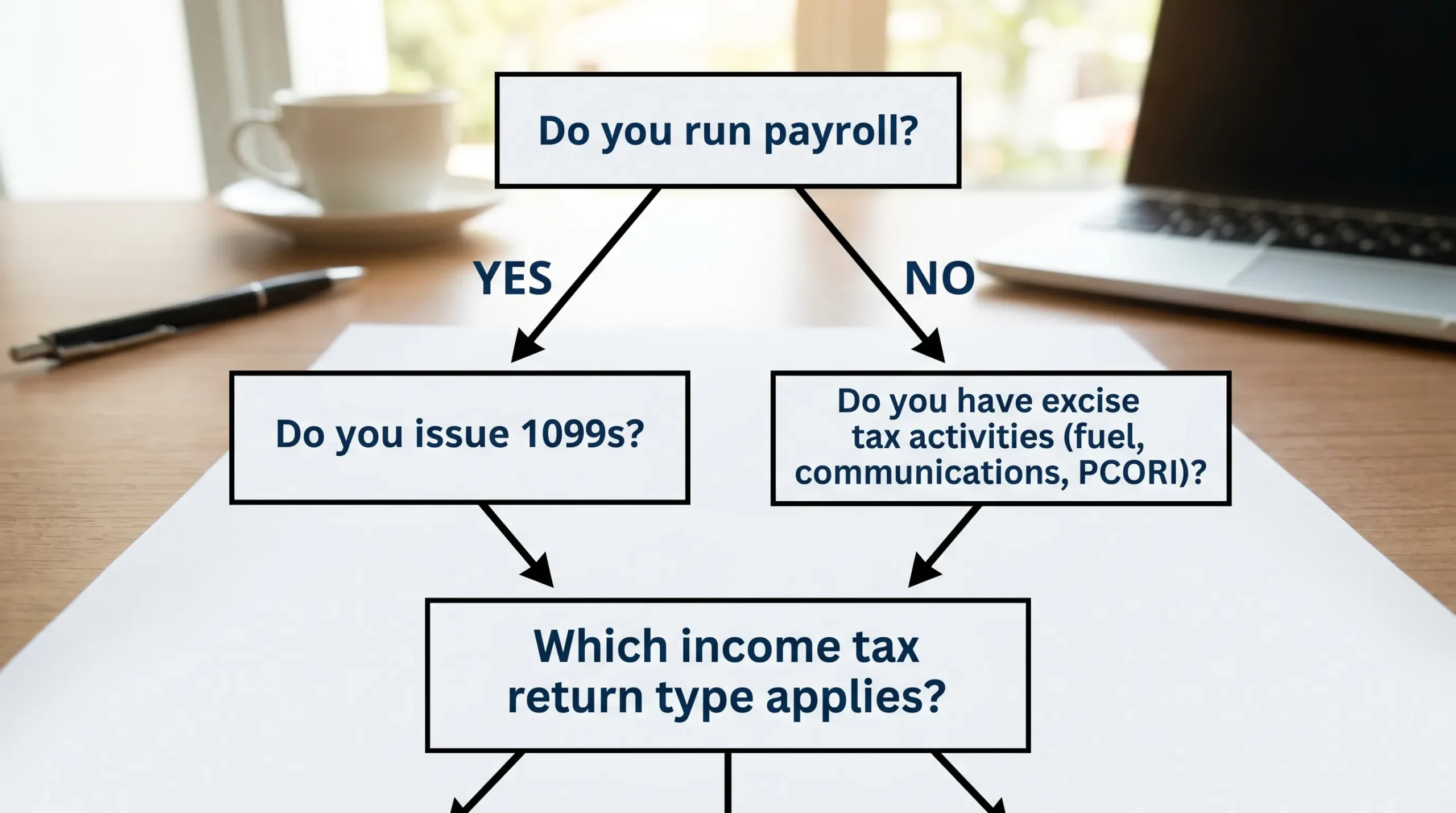
Who must file: the three questions that determine your obligations
Most filing decisions become clearer if you answer these three questions.
What is your taxpayer type?
Your entity type generally determines your income tax return.
Common examples:
- Sole proprietor (including single-member LLC taxed as a sole prop): typically files Form 1040 plus Schedule C.
- Partnership (including multi-member LLC taxed as a partnership): typically files Form 1065.
- S corporation: typically files Form 1120-S.
- C corporation: typically files Form 1120.
- Tax-exempt organization: often files Form 990 series (if required).
Do you have employees (or pay wages)?
If you run payroll, you usually have ongoing federal filing and deposit requirements for:
- Federal income tax withholding
- Social Security and Medicare taxes (FICA)
- Federal unemployment tax (FUTA)
Do you trigger activity-based taxes or reporting?
This is where many businesses get caught off guard. Examples include:
- You sell, import, or use certain fuels.
- You charge for certain communications services.
- You provide air transportation or collect related charges.
- You manufacture or import specific products subject to excise.
- You sponsor certain self-insured health plans (PCORI fee, reported on Form 720).
- You make payments that require 1099 reporting.
Common federal tax forms and due dates (quick reference)
Deadlines can vary by fiscal year-end, deposit schedule, and special rules. The table below reflects the most common timing rules for calendar-year taxpayers.
| Category | Common IRS forms | Who typically files | Typical filing frequency | Typical due date rule |
|---|---|---|---|---|
| Individual income tax | Form 1040 | Individuals | Annual | April 15 (or next business day) |
| Partnership return | Form 1065 | Partnerships, many LLCs | Annual | 15th day of the 3rd month after tax year end |
| S corporation return | Form 1120-S | S corporations | Annual | 15th day of the 3rd month after tax year end |
| C corporation return | Form 1120 | C corporations | Annual | 15th day of the 4th month after tax year end |
| Payroll tax return | Form 941 | Employers | Quarterly | Last day of the month after quarter end |
| FUTA return | Form 940 | Employers | Annual | January 31 (often) |
| Wage reporting | Forms W-2, W-3 | Employers | Annual | January 31 |
| Contractor reporting | Form 1099-NEC | Businesses paying contractors | Annual | January 31 |
| Other 1099 reporting | 1099-MISC and others | Businesses with reportable payments | Annual | Varies (commonly late Jan or Feb; depends on form/method) |
| Quarterly federal excise tax return | Form 720 | Businesses with excise tax liability (activity-based) | Quarterly | Last day of the month after quarter end |
For an official, current view across form types, the IRS maintains a tax calendar and deadline information. See the IRS tax calendar for the year you are filing.
Federal excise tax filing requirements (Form 720): who must file?
Form 720 filing is activity-based. You generally must file if you are liable for certain federal excise taxes during a quarter. That can include businesses in fuel, transportation, communications, manufacturing, import/export, and benefits administration.
Industries commonly impacted include:
- Fuel distribution, blending, trucking, and certain off-highway fuel use cases
- Airlines and aviation-related services
- Communications service providers (including certain VoIP and bundled offerings)
- Manufacturers and importers of select excise-taxable products
- Employers and plan sponsors responsible for the PCORI fee (reported on Form 720)
If you are trying to confirm whether Form 720 applies to your business, this companion resource goes deeper on common triggers and a quick self-check: Does your business need to file Form 720?
What counts as an “excise tax activity” in real life?
Here are practical signals that you may have Form 720 obligations:
- You collect a federal excise tax from customers (or show it on invoices).
- You import products and your customs or compliance process references excise tax.
- You track volumes (gallons, barrels, passenger counts, minutes, segments) for tax purposes.
- You have industry-specific compliance items like environmental excise taxes.
- You sponsor a self-insured health plan and have heard of the PCORI fee.
Because excise categories are detailed, many teams validate their exposure each quarter using the current IRS Form 720 instructions. You can find the official form and instructions on the IRS site: About Form 720, Quarterly Federal Excise Tax Return.
When is Form 720 due?
Form 720 is generally filed quarterly, with deadlines that follow a consistent schedule: the return is due the last day of the month after the quarter ends.
| Form 720 quarter | Covers months | Due date (typical) |
|---|---|---|
| Q1 | Jan to Mar | April 30 |
| Q2 | Apr to Jun | July 31 |
| Q3 | Jul to Sep | October 31 |
| Q4 | Oct to Dec | January 31 |
If you want a filing-focused breakdown (including payment timing and common deadline mistakes), see: Form 720 due date.
A note on payments and deposits
Some excise taxes require deposits (often through EFTPS) depending on the type of tax and liability levels, and some filers must complete Schedule A to report certain liabilities. Because deposit rules can be highly specific, many businesses treat them as part of a monthly or semi-monthly close process, not a once-a-quarter task.
If you are unsure whether you have a deposit requirement, confirm based on your specific excise category and facts, or consult a tax professional.
What if you need to fix a mistake or claim a refund?
Federal tax filing requirements also include knowing how to correct what you filed.
For Form 720-related issues, two common paths are:
- Form 720-X: generally used to amend or make adjustments to a previously filed Form 720.
- Form 8849: generally used to claim refunds of certain excise taxes (often fuel-related), using the appropriate schedule.
If you are deciding which form applies to your situation, this comparison can help: Form 720 vs Form 8849: What’s the difference?
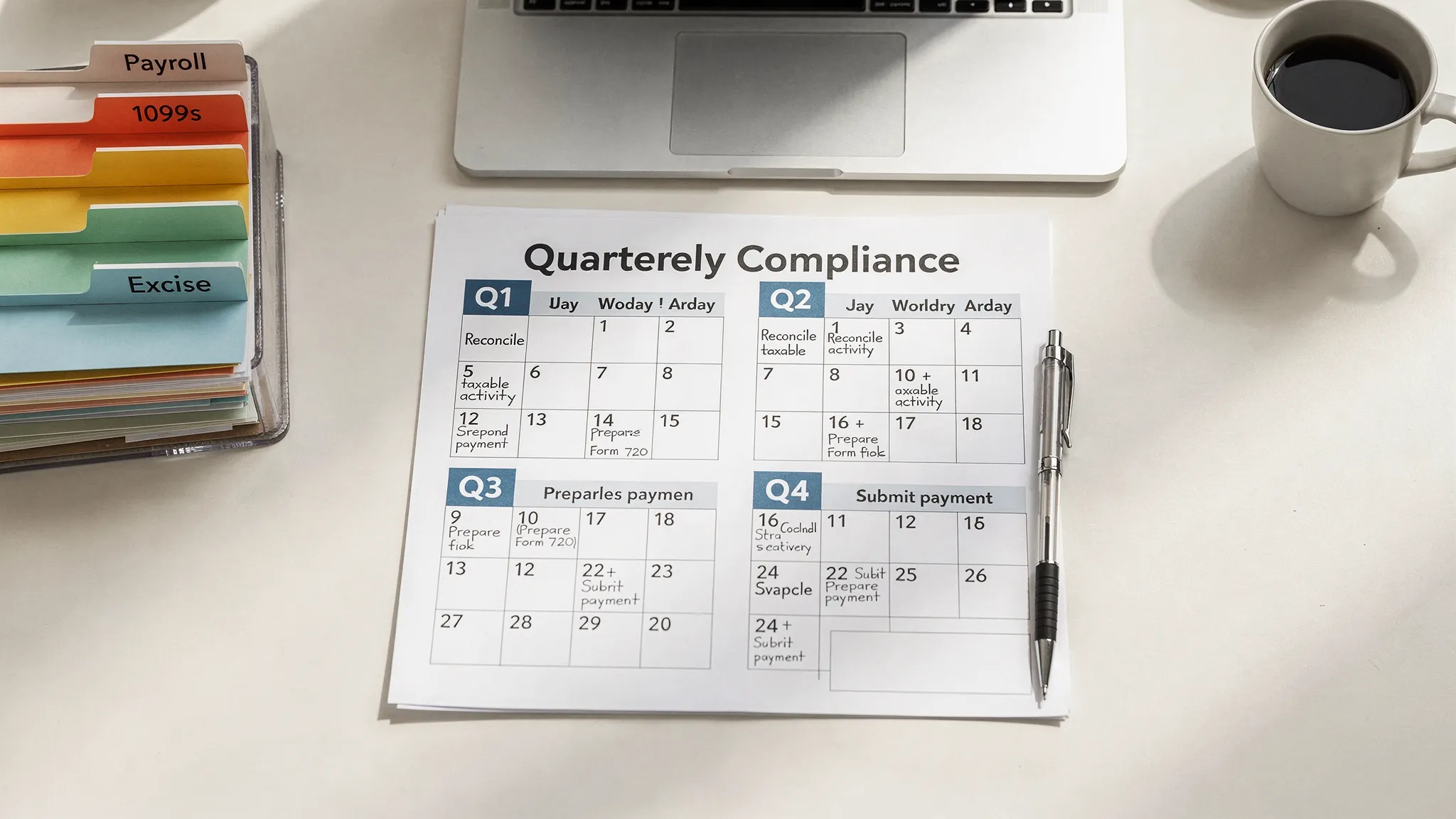
A practical compliance workflow (so deadlines do not sneak up)
Most businesses that stay consistently compliant do a few simple things.
Build a filing inventory
Maintain a living list of the forms you file, the owner, and the recurring due date rule (quarterly, annual, event-based). This prevents “silent obligations,” like adding contractors (1099-NEC) or adding a taxable service line mid-year.
Treat taxes like a close process
Instead of waiting until the deadline week:
- Reconcile source systems monthly (sales, billing, fuel volumes, imports, payroll).
- Keep supporting documentation in one place.
- Review new products, new billing bundles, and new jurisdictions for tax impacts.
File early enough to fix rejects
Whether you e-file or paper-file, a major operational risk is discovering an issue too late to resolve it calmly. Excise returns can be detail-heavy, and corrections can take time.
If you do end up filing late, penalties can add up quickly. For Form 720, see: Form 720 late filing penalties.
Frequently Asked Questions
What are federal tax filing requirements for a small business? Federal tax filing requirements typically include an annual income tax return (based on entity type), payroll filings if you have employees (often Form 941 quarterly), and information returns like W-2 or 1099s. Some businesses also have excise tax requirements, such as Form 720.
Who must file Form 720? Businesses must file Form 720 if they have liability for certain federal excise taxes during a quarter. Filing is based on taxable activities (for example, specific fuel, communications, transportation, environmental, or PCORI-related obligations), not simply business size.
When is Form 720 due? Form 720 is due quarterly, generally on the last day of the month following the end of the quarter (April 30, July 31, October 31, and January 31 for typical calendar quarters).
What happens if I file federal taxes late? Late filing can trigger penalties and interest, and some tax types also have failure-to-deposit penalties if required payments were not deposited on time. It is often better to file as soon as possible and correct issues afterward (for excise, often via Form 720-X or Form 8849 where applicable).
Do I have to file even if I owe zero excise tax for the quarter? It depends on your facts and whether you are required to file for that quarter under the applicable excise rules. When in doubt, confirm with the Form 720 instructions or a tax professional, because filing expectations can differ by tax type.
File Form 720 online with an IRS-authorized provider
If your federal tax filing requirements include Form 720, filing on time is only half the job. You also need accurate category mapping, secure submission, and proof your return was accepted.
eFileExcise720 is an IRS-authorized e-filing portal built specifically for Form 720 excise returns. You can create a free account, file online without downloading software, and get personalized customer support when you have questions. The platform also supports Form 720 amendments (720-X) and Form 8849 claims.
Get started here: File Form 720 online with eFileExcise720