
Help With Tax Return: Where to Get Reliable Support
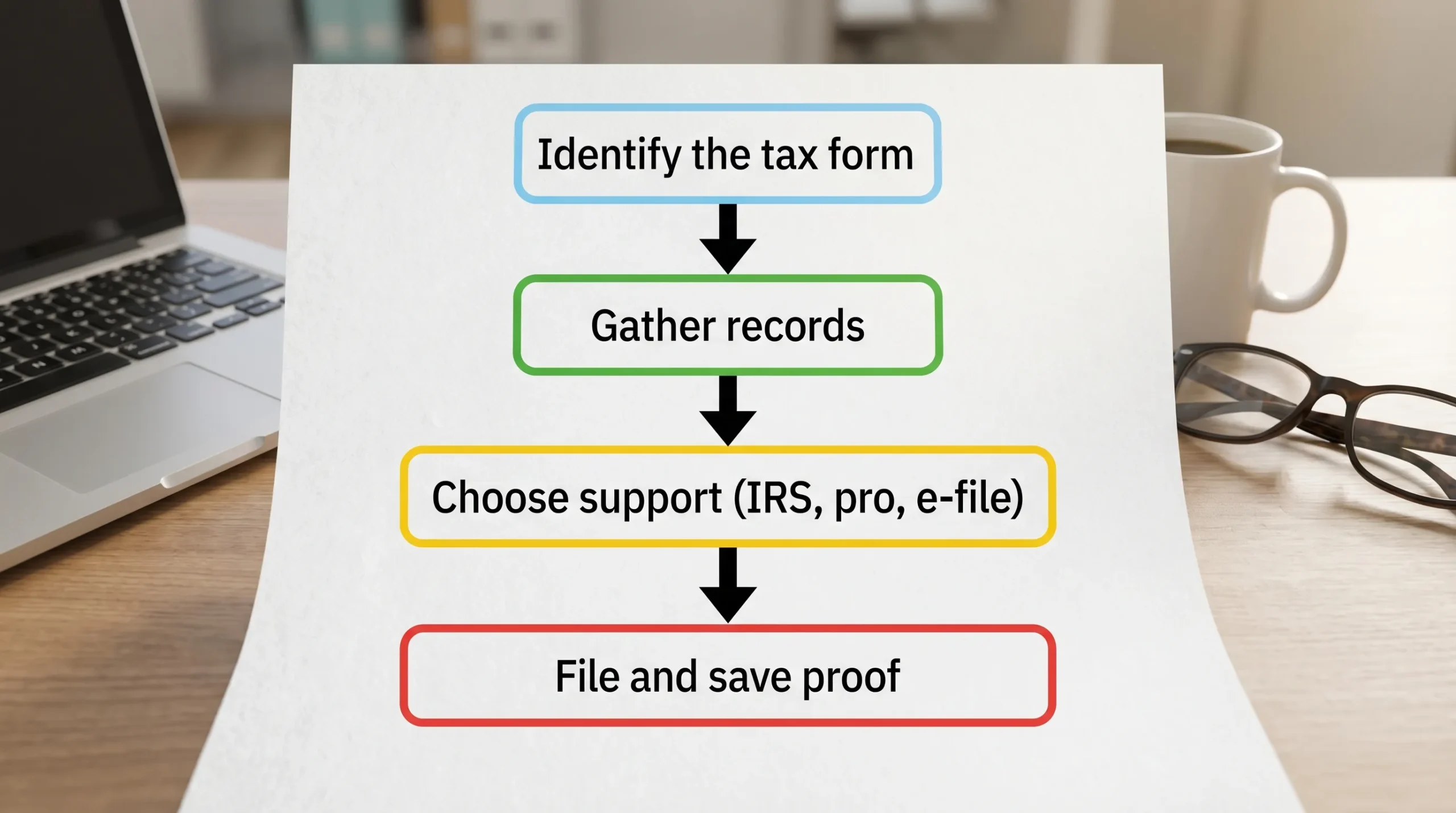
Tax season (or quarter-end for businesses) can feel deceptively simple until you hit a question you cannot confidently answer: Am I filing the right return, reporting the right amounts, and doing it on time? If you are searching for help with tax return preparation, the most reliable support usually comes from sources that can (1) point you to the correct IRS rules, (2) apply those rules to your facts, and (3) leave you with proof of what was filed and when.
This guide breaks down where to get trustworthy tax return help, how to vet it, and what to do when your return includes specialized filings like IRS Form 720 (Quarterly Federal Excise Tax Return).
First, identify what kind of “tax return help” you actually need
Not all help is the same. Before you choose a support option, get clear on which category you are in:
- Clarifying what you must file (for example, whether you need Form 1040, Form 1120, Form 941, or Form 720).
- Preparing the return (calculations, correct lines, correct schedules, correct quarter).
- Filing the return (paper vs. e-file, acknowledgments, proof of timely submission).
- Paying the tax (EFTPS, deposits, payment timing, avoiding penalties).
- Fixing a mistake (amendments such as Form 720-X, or refund claims such as Form 8849).
If your business deals with excise taxes (fuel, environmental, communications, PCORI fee, and other categories), help that is “good for income taxes” may still be incomplete for Form 720 reporting.
Where to get reliable help with a tax return
Below are the most common places people go for tax return support, plus when each is a good fit.
1) IRS resources (best for official rules and forms)
If you need authoritative instructions, start with the IRS:
- Forms and instructions: For excise taxes, use the official IRS Form 720 page to confirm the current revision and instructions.
- General IRS help and topics: The IRS Help page is a good starting hub.
IRS resources are reliable for “what the rule says.” They typically do not function like a personal advisor for applying the rule to your unique facts.
2) Credentialed tax professionals (best for advice and complex situations)
For many taxpayers, the most dependable “real world” help comes from professionals who are qualified to represent taxpayers and sign returns.
Common credential types include:
- CPA (Certified Public Accountant)
- EA (Enrolled Agent) (federally authorized to represent taxpayers before the IRS)
- Tax attorney (often helpful for disputes, high-risk issues, or legal interpretation)
To verify whether a preparer has IRS-recognized credentials, use the IRS Directory of Federal Tax Return Preparers.
If your question involves excise taxes, ask directly whether they routinely handle Form 720, deposits, amendments (Form 720-X), and refund claims (Form 8849). Many preparers focus primarily on income tax returns.
3) Free and nonprofit programs (best for basic individual returns)
If you are an individual taxpayer with a relatively straightforward return, you may qualify for free support:
- VITA (Volunteer Income Tax Assistance) and TCE (Tax Counseling for the Elderly) programs are listed on the IRS site: Free tax return preparation for qualifying taxpayers.
These programs are valuable, but they are not designed for specialized business excise tax filing.
4) The Taxpayer Advocate Service (best when you are stuck)
If you are dealing with a significant IRS processing issue, hardship, or repeated failures to resolve a problem through normal channels, the Taxpayer Advocate Service can help you navigate next steps.
5) IRS-authorized e-file providers (best for secure, trackable filing)
If your primary pain is the filing process itself (getting the return submitted correctly, reducing rejects, receiving an acknowledgment, keeping records), an IRS-authorized e-filing provider can be a dependable form of support.
For businesses that need to file Form 720, an IRS-authorized portal designed for excise returns can reduce friction compared to paper filing.

Quick comparison: which help source is best for which situation?
| Support option | Best for | Limitations | Good fit if you… |
|---|---|---|---|
| IRS forms and instructions | Official rules, correct forms, line-by-line instructions | Not personalized advice | Want to confirm requirements before you file |
| CPA / EA / tax attorney | Complex facts, planning, representation | Cost, availability near deadlines | Need expert judgment and accountability |
| VITA / TCE | Basic individual tax returns for qualifying taxpayers | Not built for business excise filings | Need free help and your return is simple |
| Taxpayer Advocate Service | Stalled cases, hardship, systemic issues | Not a preparation service | Cannot resolve an IRS issue through normal channels |
| IRS-authorized e-file provider | Filing workflow, confirmations, secure submission | Does not replace legal/tax advice | Know what you must file and want a smoother filing process |
How to vet tax return help (and avoid costly surprises)
Reliable support is not only about friendliness or speed. It is about competence, transparency, and data protection.
Ask these questions before you share documents
Are you credentialed, and will you sign the return? Legitimate preparers should have a PTIN (and sign paid-prepared returns).
What experience do you have with my exact form? If you are filing excise taxes, ask specifically about Form 720, Schedule A deposits, and common attachments that may apply to your category.
How do you protect my data? You are providing high-risk identity and financial details. You should understand where data is stored, who can access it, and how you will receive copies of filings.
How will I get proof of filing? For e-file, you should receive an IRS acknowledgment. For paper, you will need a defensible proof strategy (for example, certified mail).
What is included in your fee? Clarify whether it covers notices, corrections, amendments, or follow-up questions.
Red flags that usually mean “walk away”
- Promises of “guaranteed” refunds or outcomes before reviewing facts
- Pressure to sign a blank return or “we will fill it in later” behavior
- Refusal to provide a copy of your filed return
- Payment demands based on refund size instead of work scope
- Requests to send sensitive data through insecure channels
For scams and impersonation tactics, the IRS maintains a running list of tax scams and consumer alerts.
Getting organized before you ask for help (saves time and reduces errors)
Even the best support works better when you show up with clean inputs. For businesses, think of this as a “tax close” process.
Start by gathering:
- Legal business name, EIN, and current address
- The filing period (for Form 720, the quarter matters)
- Transaction reports or operational source data that drive tax (sales, units, volumes, invoices)
- Prior-quarter returns (especially if you need to reconcile, amend, or claim credits)
- Payment and deposit records (dates, amounts, EFTPS confirmations)
If Form 720 applies to you, it also helps to keep a simple mapping of “what we do” to “which excise line it impacts,” then maintain that mapping quarter after quarter.
For deadlines, see a dedicated guide to the quarterly due dates here: Form 720 due date. Filing late can trigger penalties and interest, so it is worth understanding the timing rules: Form 720 penalties and interest.
When you need excise-tax-specific tax return support
A lot of “help with tax return” content online focuses on annual income taxes. Excise tax compliance is different because it is often:
- Quarterly
- Driven by operational activity (not just accounting close)
- Sensitive to product and transaction classification
- More likely to involve amendments or refund claims when facts change
If you are unsure whether your business must file, this explainer can help you confirm the trigger: Does your business need to file Form 720?
If you already know you are filing Form 720, these resources are often the fastest way to get unstuck:
- How Form 720 works and how to file it: Understanding Form 720 and how to file it
- If you are correcting a previously filed return: amendments and e-filing context: Can an amended return be efiled?
- If you are comparing reporting vs. refunds: Form 720 vs Form 8849: What’s the difference?
How eFileExcise720 fits into reliable tax return support
If your return involves federal excise taxes, eFileExcise720 is built specifically for that workflow. It is an IRS-authorized e-filing platform for Form 720 that lets you file online without downloading software.
Depending on what you need to file, the platform supports:
- Form 720 (all categories)
- Form 720-X amendments
- Form 8849 claims
If you are trying to reduce friction and uncertainty in excise tax filing, using a specialized, IRS-authorized portal can be a practical way to make the process more trackable and less stressful.
Frequently Asked Questions
What is the most reliable place to get help with a tax return? The most reliable starting point is the IRS (forms and instructions) for official rules, then a credentialed tax professional (CPA, EA, or attorney) for advice on your specific facts.
How do I verify that a tax preparer is legitimate? Use the IRS directory of preparers with credentials and select qualifications, confirm they have a PTIN, and ensure they will sign the return and provide you a copy.
Can I get free help with my tax return? Many individuals may qualify for free help through IRS VITA or TCE programs. These programs are generally not intended for specialized business excise filings.
What if my business needs to file Form 720 and I am confused about what applies? Start by confirming whether your activities trigger Form 720 filing, then use IRS instructions and excise-focused resources (or a professional experienced in excise taxes) to map your activity to the correct lines.
Is it better to e-file or mail a tax return? E-filing is typically more trackable because you can receive electronic acknowledgments and address rejects faster. Mailing may be appropriate in limited situations but can increase timing and proof risks.
If I made a mistake on an excise tax return, do I amend or file a refund claim? It depends on the situation. Excise corrections often involve Form 720-X (amendments) or Form 8849 (claims). A Form 720 vs. Form 8849 comparison can help you choose the correct path.
Get reliable support for your excise tax return
If you are looking for help with tax return filing specifically for IRS Form 720, you can file online through an IRS-authorized provider.
Create your free account and start your Form 720 filing with eFileExcise720 here: https://www.efileexcise720.com.