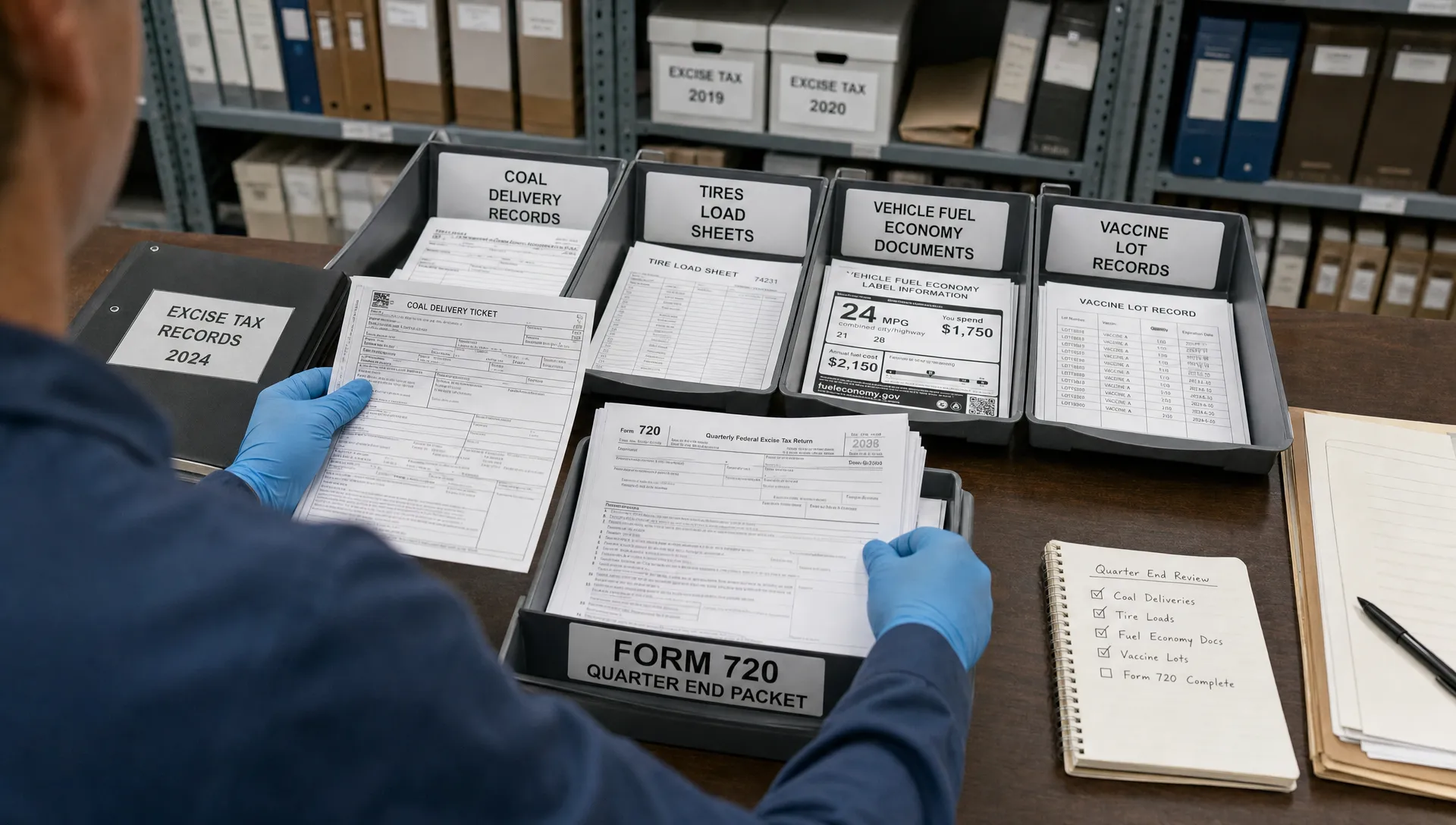
Who Pays Manufacturers Excise Tax? A Guide for Coal, Tire, Gas Guzzler & Vaccine Producers
If your business mines coal, manufactures highway tires, imports low fuel economy automobiles or produces taxable vaccines, the first question is usually who pays manufacturers excise tax and how that tax gets reported. In most cases, the manufacturer, producer or importer is responsible for calculating the tax and reporting it when they file IRS Form 720 online.
That answer sounds simple, but the details depend on the product, when the first sale or use happens and whether an exemption applies. This guide breaks down manufacturers excise tax liability for coal, tires, gas guzzler vehicles and vaccines so your team can identify the right taxpayer before filing.
What Is the Manufacturers Excise Tax?
Manufacturers excise tax is a federal tax imposed on the sale or use of specific taxable products made, produced or imported into the United States. It is not a general tax on every manufacturer. It applies only when the Internal Revenue Code identifies the product as taxable and assigns responsibility to a manufacturer, producer or importer.
Under IRS manufacturers excise tax rules, the tax is usually triggered when the taxable article is first sold by the manufacturer or importer. In some cases, using the item instead of selling it can also trigger the tax. For a business asking who pays manufacturers excise tax, the starting point is the taxable article itself, not the size of the company.
Who Pays Manufacturers Excise Tax? The Short Answer
The manufacturer, producer or importer of the taxable item generally pays the tax. For coal, that usually means the person who mines the coal. For taxable tires, gas guzzler automobiles and vaccines, liability generally falls on the company that manufactures, produces or imports the taxable item.
The IRS collects the tax through Form 720, the Quarterly Federal Excise Tax Return. For businesses asking who collects manufacturers excise tax, the practical answer is that the IRS collects it from the legally liable business, even if that business later builds the cost into its invoice or product price.
How It Differs from Other Federal Excise Taxes
Federal excise taxes cover many activities beyond manufacturing, including fuel, air transportation, indoor tanning and certain environmental taxes. Manufacturers excise tax is narrower because it focuses on taxable articles made, produced or imported for sale or use.
That makes it different from fuel use tax matters, retail excise taxes and service based excise taxes. The liability point is tied to the manufacturer, producer or importer, rather than the end user in most cases. This distinction matters because who pays manufacturers excise tax may be different from who ultimately bears the cost economically.
Where Manufacturers Excise Tax Fits on Form 720
Manufacturers excise taxes are reported on IRS Form 720, along with several other federal excise taxes. Many manufacturer related items appear in Part I, while vaccine taxes are generally reported in Part II.
The IRS Form 720 instructions should always be checked for the current period because line numbers, IRS numbers and calculation instructions can change. Businesses often use the Form 720 PDF or an online filing system to match each taxable item with the correct IRS number and schedule.
| Product category | Typical liable party | Form 720 reporting area |
|---|---|---|
| Coal | Mine operator or coal producer | Manufacturers Taxes, generally Part I |
| Taxable highway tires | Manufacturer, producer or importer | Manufacturers Taxes, generally Part I |
| Gas guzzler automobiles | Auto manufacturer or importer | Manufacturers Taxes, generally Part I |
| Taxable vaccines | Vaccine manufacturer or importer | Generally Part II |
Who Is Considered a "Manufacturer" for Excise Tax Purposes?
For federal excise tax purposes, a manufacturer is not always limited to a factory owner. A business may be treated as the manufacturer if it produces, fabricates, processes or imports a taxable article and then sells or uses it in a taxable way.
The answer to who is liable for manufacturers excise tax depends on the role the business plays in the product chain. If a company imports a taxable article for sale in the United States, it may have the same tax obligation as a domestic manufacturer.
Manufacturers vs. Producers vs. Importers
The terms manufacturer, producer and importer often point to the same liability outcome, but they describe different business roles. A coal producer extracts coal from a mine. A tire manufacturer makes highway tires. An importer brings taxable articles into the United States.
The excise tax on manufacturers vs importers is best understood as a rule that prevents the tax from disappearing simply because the taxable item was made outside the country. If the product is taxable when produced domestically, the importer may be responsible when it enters the U.S. market.
First Sale/Use Rule Explained
The first sale rule excise tax concept means the tax generally applies when the manufacturer, producer or importer first sells the taxable article. If there is no sale because the business uses the item itself, first use may trigger the tax instead.
This rule is central to IRS manufacturers excise tax rules because it defines timing. For example, if a tire manufacturer produces taxable tires and sells them to a distributor, the taxable event usually occurs at that first sale, not when the distributor resells them. That is why who pays manufacturers excise tax is usually resolved early in the supply chain.
Coal Excise Tax: Who's Liable and How Much
Coal excise tax generally applies to coal from U.S. mines that is sold or used in the United States. The person who mines or produces the coal is usually liable, whether the coal is surface mined or underground mined.
For coal producers, who pays manufacturers excise tax usually comes down to who mined the coal and whether the coal was sold or used domestically. The tax is connected to the first sale or use, with special rules for exports and certain exempt transactions.
Underground vs. Surface-Mined Coal Rates
Coal rates differ based on how the coal is mined. The IRS instructions have historically applied different per ton caps for underground mined and surface mined coal, with a percentage of the sale price also considered.
| Coal type | General rate structure | Practical filing note |
|---|---|---|
| Underground mined coal | Percentage of sale price, subject to a per ton cap | Higher per ton cap than surface coal |
| Surface mined coal | Percentage of sale price, subject to a per ton cap | Lower per ton cap than underground coal |
Because coal excise tax calculations are rate sensitive, use the current IRS Instructions for Form 720 before filing. Coal producers should also keep production records, sales invoices and export documentation when claiming an exemption.
Coal Exporters and the Export Exemption
Coal exported from the United States may qualify for an export exemption if the required conditions and documentation are met. The key point is that the coal must be exported rather than consumed or sold for domestic use.
Manufacturers excise tax exemptions are not automatic. A coal producer should maintain contracts, bills of lading, export declarations and any other records that support the exemption. If the documentation is missing, the IRS may treat the sale as taxable.
Tire Excise Tax: Which Manufacturers Must Pay
Federal tire excise tax applies to certain taxable tires used on highway vehicles. It generally affects tire manufacturers, producers and importers rather than retail tire shops that only resell finished tires.
For tire companies, who pays manufacturers excise tax depends on whether the tire is a taxable highway tire and whether the company manufactured, produced or imported it. A reseller may show the tax as part of its pricing, but the legal liability usually starts with the maker or importer.
Taxable vs. Non-Taxable Tires
Taxability depends on the type of tire and its intended use. Highway tires above the relevant weight and load thresholds are the most common taxable category. Tires that are not designed for highway vehicles, or tires outside the taxable category, may be non taxable.
The tire rules are technical, so businesses should not rely only on a product nickname or marketing description. Product specifications, load ratings and tire type all matter when deciding who is liable for manufacturers excise tax.
How Tire Tax Is Calculated (Weight-Based Rates)
Tire tax is often described as weight based, but the IRS calculation generally looks to the maximum rated load capacity over a stated threshold. Different rates may apply to different tire types, including certain bias ply and super single tires.
| Tire factor | Why it matters |
|---|---|
| Highway vehicle use | Determines whether the tire is in a taxable category |
| Tire weight threshold | Helps identify tires potentially subject to tax |
| Maximum rated load capacity | Drives the tax calculation for many taxable tires |
| Tire type | May affect which rate applies |
The first sale rule excise tax analysis is especially important for tire importers because importing and selling taxable tires can create the same Form 720 obligation as domestic production.
Gas Guzzler Tax: Automakers' Responsibility
The gas guzzler tax applies to certain passenger automobiles that do not meet federal fuel economy standards. It is imposed on the manufacturer or importer, not on the dealership as the primary taxpayer.
For automakers and vehicle importers, who pays manufacturers excise tax depends on whether the automobile falls below the applicable fuel economy threshold. The tax amount increases as fuel economy decreases.
Which Vehicles Qualify as "Gas Guzzlers"
A gas guzzler is generally a passenger automobile that fails to meet the fuel economy standard used for this excise tax. The classification is important because not every vehicle with low mileage is automatically subject to this tax.
Manufacturers and importers should confirm the vehicle category, tested fuel economy and model details before filing. A small classification mistake can change whether tax is due and how much belongs on Form 720.
Fuel Economy Thresholds and Tax Brackets
The gas guzzler tax uses brackets based on miles per gallon. Passenger automobiles at or above the no tax threshold are not subject to the tax, while vehicles below that threshold fall into increasing tax amounts.
| Fuel economy result | General tax impact |
|---|---|
| At or above the no tax threshold | No gas guzzler tax |
| Slightly below the threshold | Lower bracket tax applies |
| Well below the threshold | Higher bracket tax applies |
| Lowest fuel economy categories | Highest statutory tax brackets apply |
The exact bracket should be verified against current IRS guidance and the certified fuel economy value for the vehicle. Automakers should keep test records and import documentation with their tax files.
Exemptions for Trucks, SUVs and Vans
The gas guzzler tax generally targets passenger automobiles. Many trucks, vans and SUVs are treated differently under the applicable classification rules, but businesses should confirm the vehicle category before assuming an exemption.
The excise tax on manufacturers vs importers matters here too. If a foreign vehicle is imported and falls within the taxable passenger automobile category, the importer may be responsible for the tax in the same way a domestic automaker would be.
Vaccine Excise Tax: A Unique Category
Vaccine excise tax is different from coal, tire and gas guzzler taxes because it helps fund a federal compensation system for certain vaccine related injuries. The tax is generally paid by the manufacturer or importer of taxable vaccines.
For vaccine businesses, who pays manufacturers excise tax usually means identifying the company that produced or imported the taxable vaccine component and sold it in the United States. eFileExcise720 also provides a deeper filing overview in its guide to vaccine manufacturer excise tax.
Which Vaccines Are Subject to Tax
Taxable vaccines are listed by law and IRS guidance. Examples may include vaccines for influenza, measles, mumps, rubella, polio, hepatitis, varicella, rotavirus, HPV, meningococcal disease and other covered categories.
Because the vaccine list can be updated, manufacturers and importers should rely on current Form 720 instructions and applicable IRS guidance. The tax is commonly stated as a flat amount per dose or per taxable vaccine component, depending on the vaccine.
How Vaccine Tax Funds the Injury Compensation Program
The vaccine excise tax is deposited into the Vaccine Injury Compensation Trust Fund, which supports the National Vaccine Injury Compensation Program. This makes it a targeted excise tax with a specific public funding purpose.

Unlike many general business taxes, the vaccine tax is tied to a defined federal program. That purpose does not change the filing requirement, but it explains why vaccine manufacturers and importers see this item separated from many other excise taxes.
How to Report Manufacturers Excise Tax on Form 720
Manufacturers excise tax is reported on Form 720 for the quarter in which the tax liability arises. Businesses calculate the tax by product category, enter the correct IRS number and pay or deposit according to the applicable rules.
If your accounting team is determining who pays manufacturers excise tax, map each product to the liable party first, then calculate the tax. This order helps prevent a common error: calculating tax for the right product but assigning it to the wrong entity.
Which IRS Numbers/Schedules Apply to Each Category
Always verify the current Form 720 instructions before filing. In recent Form 720 layouts, these manufacturer related categories are generally associated with the following IRS number references.
| Category | Common IRS number reference | General placement |
|---|---|---|
| Taxable tires | IRS Nos. 36 and 37 | Part I, Manufacturers Taxes |
| Underground mined coal | IRS No. 38 | Part I, Manufacturers Taxes |
| Surface mined coal | IRS No. 39 | Part I, Manufacturers Taxes |
| Gas guzzler tax | IRS No. 40 | Part I, Manufacturers Taxes |
| Vaccines | IRS No. 97 | Generally Part II |
The IRS numbers help route the tax to the right category, but they do not replace the line instructions. Manufacturers excise tax liability still depends on product facts, transaction timing and available exemptions.
Common Filing Mistakes to Avoid
Most Form 720 errors come from classification gaps rather than math alone. Review the product specifications before filing, especially for tires and vehicle classifications.
Common mistakes include:
- Treating an importer as exempt simply because the product was manufactured overseas
- Applying a retail sales approach instead of the first sale or first use rule
- Using outdated rates from an old Form 720 instructions PDF
- Missing export documentation before claiming manufacturers excise tax exemptions
- Forgetting to file Form 720 when there is taxable activity but no large balance due
A clean filing process should connect sales records, production data and import documents to the Form 720 workpapers for each quarter.
Filing Deadlines and Payment Schedules
Form 720 is generally filed quarterly. The due dates are April 30 for the first quarter, July 31 for the second quarter, October 31 for the third quarter and January 31 for the fourth quarter. If the due date falls on a weekend or legal holiday, the deadline generally moves to the next business day.
For businesses reviewing who pays manufacturers excise tax, the filing calendar should be set up as soon as taxable sales or uses begin. Waiting until year end can create missed deposits, interest and penalty exposure.
Quarterly Filing Requirements
The quarterly federal excise tax return is IRS Form 720. Businesses use it to report excise taxes collected or owed for the quarter, including manufacturers excise taxes and several other federal excise tax categories.
A return may still be required when a business has reportable excise tax activity for the quarter. If you are unsure who needs to file Form 720, review the taxable product category first, then confirm whether your company is the manufacturer, producer or importer.
Semi-Monthly Deposit Rules for Larger Manufacturers
Many Form 720 taxes require deposits before the quarterly return is filed, especially when tax liability is above the IRS threshold. Deposits are commonly made on a semimonthly schedule through EFTPS.
| Situation | Typical action |
|---|---|
| Net tax liability for the quarter is small | Tax may often be paid with the return, subject to IRS rules |
| Larger Part I liability | Semimonthly deposits may be required |
| First semimonthly period | Deposit is generally due later in the same month |
| Second semimonthly period | Deposit is generally due in the following month |
September has special deposit rules for certain excise taxes, so larger manufacturers should check the current IRS instructions before the third quarter closes.
Exemptions and Credits Manufacturers Should Know
Exemptions can reduce or eliminate tax, but they require documentation. The fact that a buyer says the item will be exported or used in an exempt way is not always enough by itself.
When deciding who pays manufacturers excise tax, do not skip exemption analysis. The liable manufacturer, producer or importer is usually the party expected to support why tax was not charged, reported or paid.
Export Exemptions
Export exemptions are among the most important manufacturers excise tax exemptions. Coal exported from the United States and certain exported taxable articles may qualify if the business can prove the goods actually left the country.
Keep shipping records, export declarations, contracts and customer certifications when relevant. If the IRS later examines the return, the exemption should be supported by records created at the time of the transaction.
Refunds and Adjustments
If tax was overpaid or reported incorrectly, the business may need to file an adjustment, claim a refund or correct a prior return. Form 8849 may apply to certain claims, while Form 720-X is used for amendments to previously filed Form 720 returns.
For prior period errors, eFileExcise720 provides support for Form 720-X online filing. Corrections should clearly identify the quarter, the IRS number, the original amount and the corrected amount.
Penalties for Non-Compliance
Failure to file Form 720 or pay the tax on time can lead to penalties and interest. The IRS may assess a failure to file penalty, a failure to pay penalty and interest on the unpaid balance.
For companies asking who pays manufacturers excise tax after the deadline has passed, the answer still matters because the liable business is the one that must correct the return and resolve the tax. Ignoring the issue usually makes the balance more expensive.
Late Filing and Late Payment Penalties
The failure to file penalty is commonly based on a percentage of unpaid tax for each month or part of a month the return is late, up to a statutory maximum. The failure to pay penalty is separate and can continue while the balance remains unpaid.
Late deposits can also trigger penalties even if the quarterly Form 720 is filed on time. This is why manufacturers with growing taxable sales should monitor deposit thresholds during the quarter, not only at filing time.
How to Correct Past Errors
Start by identifying the affected quarter, product category, IRS number and amount originally reported. Then compare that amount with the correct tax based on current records and IRS guidance.
If the mistake relates to a prior Form 720, Form 720-X may be needed. If the mistake relates to a refund or credit claim, another form or schedule may apply. Document the reason for the correction so the IRS can follow the calculation.
FAQs About Manufacturers Excise Tax
Do small manufacturers have to pay? Yes, if they manufacture, produce or import a taxable article and no exemption applies. Company size alone does not eliminate liability. The key question is whether the product and transaction fall under federal excise tax rules.
Is manufacturers excise tax passed to consumers? It can be built into the product price or shown separately on an invoice, but passing along the cost does not usually transfer legal liability. The manufacturer, producer or importer remains responsible for filing and paying when the law assigns liability to them.
How often does Form 720 need to be filed? Form 720 is generally filed quarterly. The usual due dates are April 30, July 31, October 31 and January 31, adjusted for weekends and legal holidays.
What is the purpose of Form 720? Form 720 is used to report and pay federal excise taxes, including certain manufacturers excise taxes, fuel taxes, environmental taxes, communication taxes and other excise tax categories.
What happens if I don't file Form 720? The IRS may assess late filing penalties, late payment penalties, deposit penalties and interest. Continued non filing can also lead to IRS notices and collection action.
What is the quarterly federal excise tax return and when is it due? The quarterly federal excise tax return is IRS Form 720. It is generally due by the last day of the month following the end of each calendar quarter.
Is Form 720 still required? Yes, Form 720 is still required for businesses that owe or must report federal excise taxes. If your business has no taxable activity, you may not need to file for that quarter, but you should confirm based on your specific tax category.
Who collects manufacturers excise tax from the buyer? The IRS is the tax authority that collects the tax through Form 720. A manufacturer may recover the cost from a buyer through pricing, but who collects manufacturers excise tax commercially is different from who is legally liable to the IRS.
Key Takeaways for Coal, Tire, Gas Guzzler & Vaccine Producers
The most important rule is that the manufacturer, producer or importer of the taxable item is generally responsible for the manufacturers excise tax reported on Form 720. Product classification, first sale or use timing and documentation decide the filing result.
If you remember one point about who pays manufacturers excise tax, make it this: coal producers, taxable tire manufacturers and importers, gas guzzler automakers and importers and vaccine manufacturers and importers should all review Form 720 obligations before the quarter closes.
For compliance teams, the best process is straightforward. Identify the taxable article, confirm the liable entity, apply the correct IRS number, document exemptions, monitor deposits and file Form 720 on time. That keeps manufacturers excise tax liability visible before it becomes a penalty notice.